

Swollen feet and ankles in pregnancy
Swollen feet and ankles in pregnancy come from extra fluid and a womb that slows blood leaving the legs. What eases it and the warning signs.
By The Renu lymphatic and massage team · 7 min read
Swollen feet and ankles are common in pregnancy because your body holds more water than usual and the growing womb slows blood flow back up from the legs, so fluid gathers in the lowest places, especially by evening, in hot weather and after standing. Rest with your feet up, keep walking, do simple foot exercises and wear shoes that do not pinch. A small study found gentle manual lymph drainage reduced leg volume over the course of a day. A sudden increase in swelling of the face, hands or feet, especially with a severe headache, vision changes or pain under the ribs, is not ordinary swelling and needs a call to your midwife, doctor or labour and delivery unit straight away.
Swollen feet and ankles are one of the most ordinary discomforts of later pregnancy, and for most women they are nothing more than that. Your body is holding more water than usual, and the pressure of the growing womb affects the blood flow in your legs, so fluid builds up in the lowest places. Gentle self-care eases it, manual lymph drainage has a small amount of real evidence behind it, and a short list of warning signs tells you when swelling is something else.
Why pregnancy swells the lower legs
Two things are happening at once. The first is volume: the NHS explains that swelling comes from your body holding more water than usual when you are pregnant. The second is drainage: the growing womb presses on the vessels that carry blood back up from the legs, so fluid tends to collect below it.
Gravity does the rest. Extra water gathers in the lowest parts of the body, which is why ankles that look fine at breakfast can have disappeared by dinner. The NHS notes it is often worse at the end of the day, further into pregnancy, in hot weather and after a lot of standing.
This kind of swelling has a recognisable character:
- it affects both feet and ankles more or less equally
- it builds slowly through the day rather than appearing suddenly
- it softens overnight or after an hour with your feet up
- it is uncomfortable, tight or heavy rather than painful
If your swelling behaves like this, you are looking at the ordinary pregnancy pattern. The section on warning signs below describes the two situations that look different.
What helps at home
The NHS self-care list is short and practical, and it is where we start with every pregnant client who asks about her ankles:
- avoid standing for long periods
- wear comfortable shoes and socks, and avoid tight straps or anything that might pinch if your feet swell
- rest with your feet up as much as you can
- take regular walks during the day, or do foot exercises
The foot exercises are simple enough to do at a desk or in bed. Bend and stretch your foot up and down 30 times, then rotate each foot in a circle eight times one way and eight times the other. The calf muscles act as a pump for the leg veins, so moving the ankle moves fluid.
Heat makes it worse, so on a hot Calgary afternoon a cool room, loose clothing and an early rest with your feet raised will do more than anything we can offer on the table.
What the research says about treatments
The honest summary is that the evidence is thin, and the one review that gathered it concluded that more research is needed. Here is what the trials found.
| Option | What was studied | Result |
|---|---|---|
| Manual lymph drainage | 15 pregnant women, 5th to 8th month, one hour of the Godoy technique, leg volume measured morning and afternoon | Leg volume fell by a mean 44.4 g over the day with drainage and rose by 40.0 g on the day without it (P = 0.04) |
| Water immersion | 32 women, 20 minutes standing in a pool versus sitting with legs raised | Reduced leg volume |
| Reflexology | 55 women, reflexology versus 15 minutes of rest | Reduced the symptoms associated with swelling |
| Compression stockings | 35 women, stockings versus rest in the left lateral position | No significant difference in lower-leg volume |
| Daily foot massage | 80 women, 20 minutes a day for five days versus routine care | No significant difference in lower-leg circumference |
The lymph drainage study is the one that matters most to what we do, so it is worth being precise about it. The women were measured by water displacement at 7 to 8 in the morning and again between 2 and 3 in the afternoon, on one day with an hour of drainage and on another day without. On the control day the mean leg volume rose from 2849.1 g to 2889.1 g. On the treatment day it fell from 2856.4 g to 2812.0 g. The authors concluded that manual lymph drainage helps to reduce limb size during the day in pregnant women, and they were candid that only one earlier study on the subject existed.
Fifteen women is a small group, and the measurement covered a single day. We read it as a signal that gentle drainage moves fluid in pregnancy, not as proof of a lasting effect. The Cochrane review’s foot massage finding is a useful contrast: a brisk foot rub did not change calf circumference, which fits what we see. It is the slow, directional, light-pressure work toward the groin and the trunk that shifts fluid, not pressure on the feet.
How we treat swollen legs in pregnancy
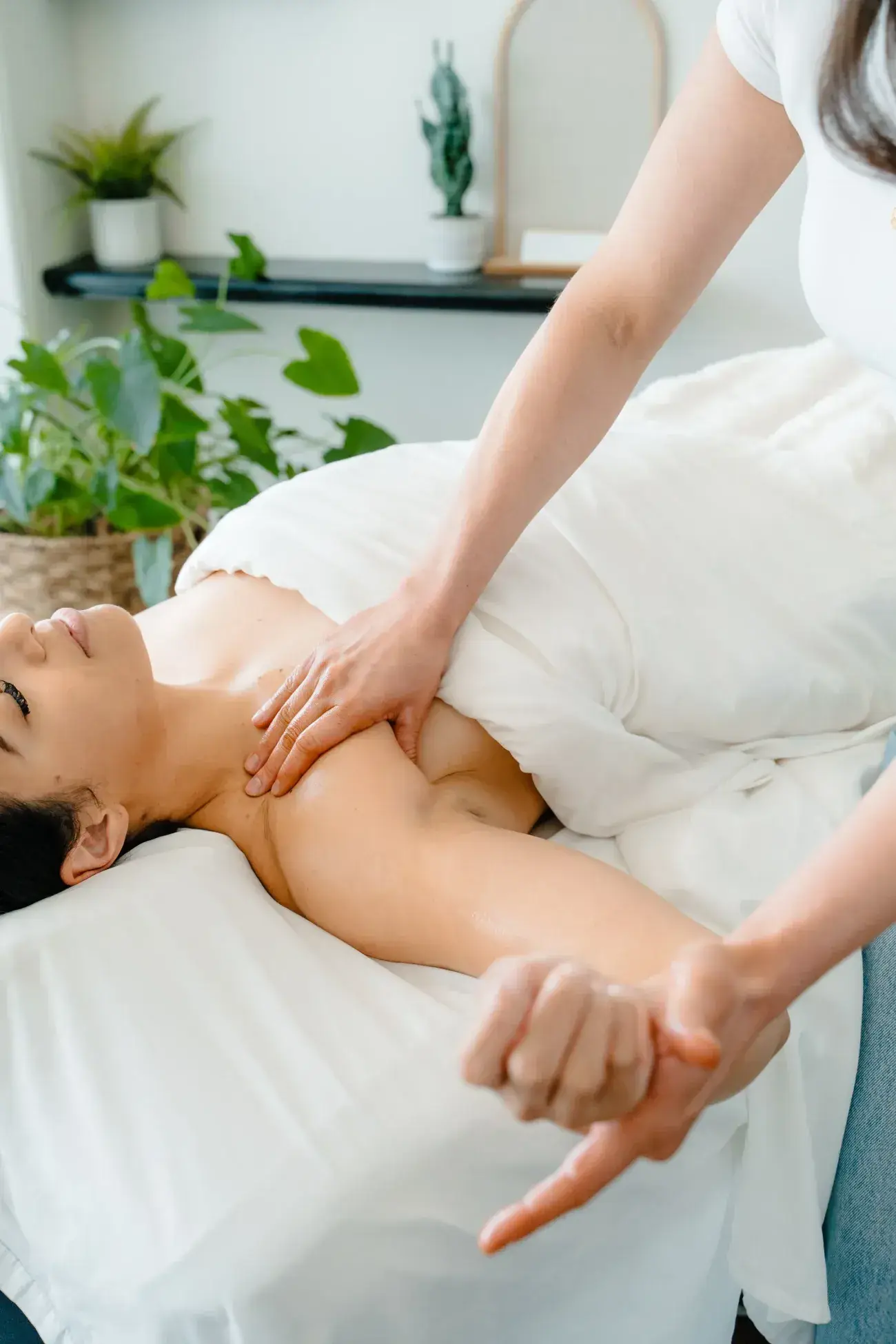
At Renu, leg swelling in pregnancy is handled within a prenatal massage or a dedicated lymphatic drainage session, always in side-lying or semi-reclined positioning. The strokes are the light, rhythmic ones described in the Godoy and Vodder traditions: the pressure is closer to stretching the skin than pressing the muscle, and the sequence clears the groin and thigh before working the lower leg, so the fluid has somewhere to go. The whole of lymphatic drainage during pregnancy is covered on its own page.
Before any leg work we ask the questions that separate ordinary swelling from a problem: whether both legs are swollen or one, whether it came on gradually or suddenly, whether the skin is warm or discoloured, and whether you have had a headache, visual changes or pain under the ribs. If any answer worries us, we will not treat that day and will ask you to call your care provider instead. That is not caution for its own sake. The two conditions below can look like swelling and need a clinician, not a therapist.
When to call your midwife or doctor
Pre-eclampsia can develop from 20 weeks of pregnancy onwards and even in the days or weeks after birth. The first signs, high blood pressure and protein in the urine, are picked up at your appointments rather than felt. The NHS says to call your midwife, GP or labour ward immediately if you have:
- a sudden increase in swelling in your face, hands or feet
- a very bad headache
- problems with your vision, such as blurring or flashing lights
- severe pain just below your ribs
- heartburn that does not go away with antacid medicine
- feeling very unwell
- nausea and vomiting
Cleveland Clinic notes that pre-eclampsia complicates between 5 and 8 percent of births in the United States, that most of it occurs in the third trimester, and that it is defined by blood pressure above 140/90 with the severe form at 160/110 or higher. In most cases it is not severe, but it is always assessed urgently.
The second condition is a blood clot. Pregnancy and the six weeks after birth raise the risk of deep vein thrombosis. The NHS describes throbbing pain in one leg, rarely both, usually in the calf or thigh, swelling in one leg, and red, blue or darkened skin around the painful area. If that is what you are seeing, contact your GP, midwife or an urgent care line the same day, and call emergency services if you also feel short of breath or have chest pain. Swelling in one leg is not something we massage; see why one leg is more swollen than the other.
A note on the heavy-leg feeling
Many women describe their legs as heavy or tight before they look swollen at all. That feeling usually tracks the same fluid shift and responds to the same things: moving the ankles, lying on your side, and keeping the feet raised whenever you sit. If you are curious why end-of-day swelling happens outside pregnancy too, why swelling is worse at the end of the day explains the mechanics.
Questions people ask
Is it normal for my feet to swell every evening in pregnancy?
Yes. Fluid gathers in the lowest parts of the body as the day goes on, and the NHS notes swelling is often worse at the end of the day, later in pregnancy, in hot weather and after a lot of standing. Swelling that is roughly equal in both legs, builds through the day and eases overnight with your feet up fits this ordinary pattern.
Does lymphatic drainage massage reduce pregnancy swelling?
The research is small but encouraging. In one study of 15 women between the fifth and eighth month, an hour of manual lymph drainage reduced measured leg volume over the day, whereas the same women gained volume on a day without it. It eases fluid; it does not treat a medical cause of swelling, so the warning signs below still apply.
Do compression stockings help swollen ankles in pregnancy?
The Cochrane review found one trial of 35 women where compression stockings made no significant difference to lower-leg volume compared with resting on the left side. Many women still find them comfortable for the heavy, achy feeling. If you want to try them, a properly measured pair matters more than the brand.
When is swelling in pregnancy an emergency?
A sudden increase in swelling of the face, hands or feet, a very bad headache, blurred vision or flashing lights, severe pain just below the ribs, vomiting or feeling very unwell can be signs of pre-eclampsia. The NHS says to call your midwife, GP or labour ward immediately. Swelling in one leg only, with pain, warmth or colour change, needs same-day assessment for a clot.
Sources
- NHS: Swollen ankles, feet and fingers in pregnancy
- Cataldo Oportus, Rodrigues, Pereira de Godoy and Guerreiro Godoy 2013, Nursing Research and Practice: Lymph drainage and pregnancy
- Cochrane (Smyth, Aflaifel and Bamigboye 2015): Interventions for varicose veins and leg oedema in pregnancy
- NHS: Pre-eclampsia
- Cleveland Clinic: Preeclampsia
- NHS: Deep vein thrombosis in pregnancy
Page reviewed October 4, 2026. This page is education, not a diagnosis. For your own situation, talk to your doctor, surgeon or care team, or ask us.
Keep reading
Related pages