
Why is my swelling worse at the end of the day?
Hours upright let gravity pull fluid into the ankles faster than the lymphatics return it; lying flat overnight reverses it. Why the pattern is reversible.
By The Renu lymphatic and massage team · 7 min read
Because you have been upright for hours. Gravity pulls fluid toward the lowest point of the body all day, and the lymphatic system, which has no pump of its own, cannot return it as fast as it arrives, so ankles and hands are puffiest by evening. Lying flat overnight lets the fluid drain back, which is why the swelling is minimal when you wake. Clinicians treat that pattern, worse through the day and gone by morning, as the hallmark of early, reversible swelling. The moment to be assessed is now, before the night stops undoing the day.
A pump that only works when you move
Every day about 20 litres of plasma seep out of the blood capillaries into the tissues and roughly 17 litres soak straight back. The Cleveland Clinic explains that the remaining three litres are the lymphatic system’s job: tiny lymph capillaries pick the fluid up, pass it along vessels fitted with one-way valves, and deliver it to two ducts in the upper chest that empty into the veins. Nothing drives that flow except the pulsing of nearby arteries and the squeezing of nearby muscles.
That design has a consequence. When you stand or sit for hours, the muscles that should be squeezing the vessels are mostly still, and gravity is pulling fluid toward the lowest part of you the whole time. Fluid arrives in the ankles faster than it leaves. By late afternoon the balance has tipped, and by dinner your socks have left a ridge.
Lie down and the picture reverses. With the legs level with the heart, gravity stops working against the vessels, the fluid that gathered during the day drains back, and you wake with slim ankles that will swell again by evening. The Lymphoedema Support Network describes exactly this: the swelling may be minimal on waking but become larger as the day progresses.
What the morning is telling you
The morning is a test you run every night without meaning to. If elevation alone, in the form of eight hours horizontal, clears the swelling, your lymphatic system is coping with a load that is simply too high during the day. Clinicians have a name for that. The National Cancer Institute’s stage I lymphedema is swelling that leaves a dent when pressed and that rest and elevation reduce; the Cleveland Clinic’s stage I is occasional swelling that goes away when you elevate the affected area. The NHS puts the same observation in plain words: at first the swelling may be soft and easy to push in, may come and go, and may get worse during the day and go down overnight.
That is why the end-of-day pattern is, counter-intuitively, good news. It means the swelling is still fluid rather than tissue, and still reversible. It is also why we would rather see someone at this stage than a year later.
The ordinary reasons an evening is worse than a morning
Not every puffy ankle at dinner is a lymphatic problem. The Cleveland Clinic’s list of causes of swelling reads like a diary of a long day:
- Long, unbroken periods of either sitting or standing
- What you eat, especially salty foods such as chips, processed meat, cheese, canned soup and fast food
- Alcohol
- Pregnancy
- Medication side effects
- Circulation problems such as venous insufficiency
- Heat, which NYU Langone says promotes swelling in the limbs
The NHS adds standing or sitting in the same position for too long, being overweight, and medicines including some blood pressure drugs, contraceptive pills, hormone therapy, antidepressants and steroids. If your evenings are worse on hot days, after a salty lunch, on your feet all shift or after a long drive, the cause is probably in that list and the fix is mostly in your own hands. Our pages on legs swelling in hot weather and the Journal’s five ways to decrease leg swelling cover the everyday causes.
When the night stops undoing the day
The pattern to watch for is the one where the morning test starts to fail. The Lymphoedema Support Network describes the progression plainly: without treatment the swelling over time becomes more permanent, it does not subside overnight, and the area begins to feel increasingly hard and solid. The NHS says the same, that without treatment the swelling will usually become more severe and persistent, and lists hard, tight or thickened skin among the later symptoms.
The staging systems mark the same turn. The National Cancer Institute’s stage II is swelling that is firmer than the surrounding area, no longer leaves a dent when pressed, and is no longer reduced by rest and elevation. The Cleveland Clinic’s stage II is an area that is almost always swollen with skin that feels firmer. What has changed is that the swelling has begun to alter the tissue itself, which the NHS describes as hard, tight or thickened skin, and gravity alone can no longer be relied on to clear it.
| The morning test | What it suggests |
|---|---|
| Swelling gone, or nearly gone, on waking | Early, fluid-only swelling; load is high, system still coping |
| Swelling smaller on waking but no longer gone | The system is falling behind; time for an assessment |
| Swelling the same morning and night, tissue firmer | Elevation has stopped working; tissue changes have begun |
If you have noticed your mornings are not what they were, why swelling no longer goes down overnight is the next page to read. The Learning Centre’s lymphedema and lipedema section explains the condition in full.
What helps the pattern, day by day
The advice from the clinical sources is consistent and practical:
- Break up still time. The Cleveland Clinic says not to sit or stand for long periods without a short walk, and on its lymphedema page suggests getting up every 30 minutes. NYU Langone adds changing position every 30 minutes when sitting and not crossing your legs.
- Elevate when you can. The National Cancer Institute suggests raising a leg on a pillow or rolled blankets when lying down; the Cleveland Clinic says elevate affected areas, especially legs and feet, to help fluid drain.
- Loosen what is tight. The NHS advises against clothes, socks or shoes that are too tight and recommends wide, comfortable, low-heeled shoes.
- Eat less salt. The Cleveland Clinic recommends a lower-salt diet and says salt makes you retain fluid; the NCI agrees.
- Keep moving. The NCI calls exercise a natural pump for the lymph system; the NHS suggests gentle exercise such as walking.
- Avoid heat. NYU Langone advises against hot baths, saunas and steam rooms for swollen limbs.
- Compression, with advice. The Cleveland Clinic suggests compression socks but asks you to check with your provider first. Meeghan Mackenzie, our founder, is a Certified Compression Fitter.
Our at-home lymphatic health page gathers the breathing and movement habits we teach.
When to see a doctor
The NHS asks you to see a GP if both ankles, feet or legs are swollen and it has not improved after a few days of home care, or if you have a diagnosed condition affecting your heart, kidneys or leg veins. Ask for urgent care if the swelling is in one leg only and you do not know why, if it is severe, painful or came on very suddenly, if the skin is red or hot, if you have a high temperature, if you also have swelling in your face or tummy, or if you have diabetes and your feet or legs are swollen. Call emergency services for swelling with shortness of breath, chest tightness or pain, coughing up blood, palpitations or feeling faint.
The Cleveland Clinic adds swelling in multiple parts of the body, especially when it appears suddenly, and any swelling alongside a personal or family history of heart, lung, liver or kidney disease. Evening ankle swelling that clears by morning is rarely any of these. Evening swelling that has started staying, hardening, or spreading is a reason to be seen.
At Renu
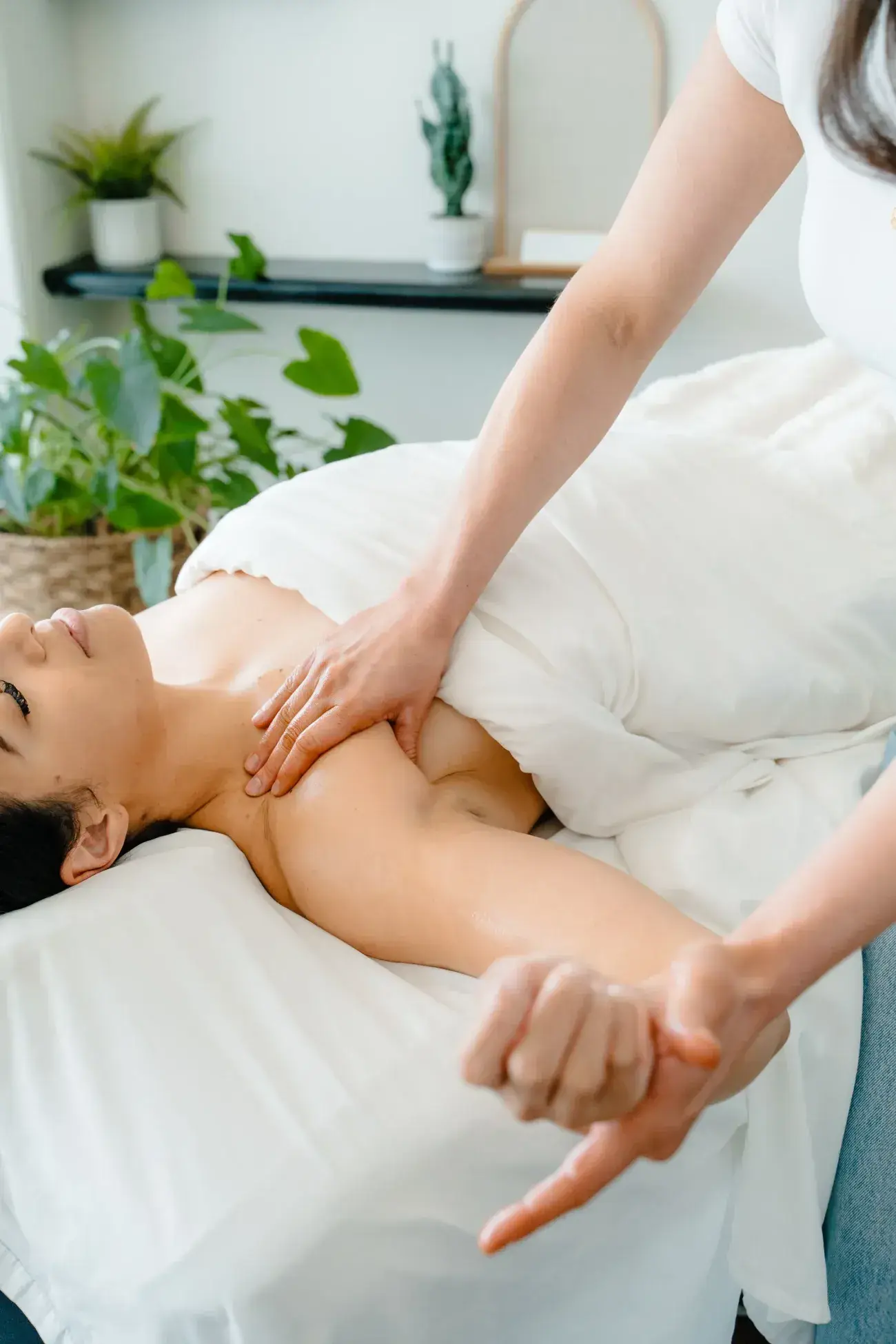
If your mornings still clear the swelling, a lymphatic drainage massage can show you what your legs feel like when the day’s fluid is gone, and your therapist can tell you whether what she feels is ordinary end-of-day fluid or something that deserves measuring. If the mornings have stopped clearing it, ask for Meeghan Mackenzie, our Certified Lymphedema Therapist, and bring a note of how long the change has been happening.
Questions people ask
If the swelling is gone every morning, do I really need to do anything?
It is worth an assessment, not a panic. The Lymphoedema Support Network describes swelling that is minimal on waking and larger as the day goes on as the early picture, and warns that without treatment it becomes permanent and the tissue increasingly hard. The NHS asks for lymphoedema to be identified and treated as soon as possible because untreated it gets worse. Early is when it is easiest to reverse.
Should I sleep with my legs raised?
Elevation is on every list. The National Cancer Institute suggests resting a swollen leg on a pillow or rolled blankets when lying down, and the Cleveland Clinic says to keep the affected area elevated as much as possible because gravity plays a role. If plain lying flat already clears your swelling by morning, raising the legs is a small extra; if it no longer clears, elevation alone has stopped being enough.
Why is it so much worse in summer?
Heat adds to the load. NYU Langone says high temperatures promote swelling in the limbs and advises against hot baths, saunas and steam rooms for people with lymphedema, and the Cleveland Clinic lists extreme heat as something that may increase lymphedema risk. Our page on legs swelling in hot weather goes into it.
Does drinking less water help the evening puffiness?
No source we read suggests it, and two say the opposite: the National Cancer Institute advises staying hydrated to keep lymph moving, and the Cleveland Clinic recommends drinking water through the day. The dietary change that both single out is less salt, which the Cleveland Clinic says makes you retain fluid.
Can one lymphatic session fix a daily pattern?
It can empty the ankles for an evening; it cannot change what tomorrow's hours upright will do. If the pattern is the ordinary dependent swelling of a long day, movement breaks, elevation and sensible shoes do more over a month than any session. If the pattern is early lymphatic failure, the session is the start of a plan with compression, not a one-off.
Sources
Page reviewed October 4, 2026. This page is education, not a diagnosis. For your own situation, talk to your doctor, surgeon or care team, or ask us.
Keep reading
Related pages