

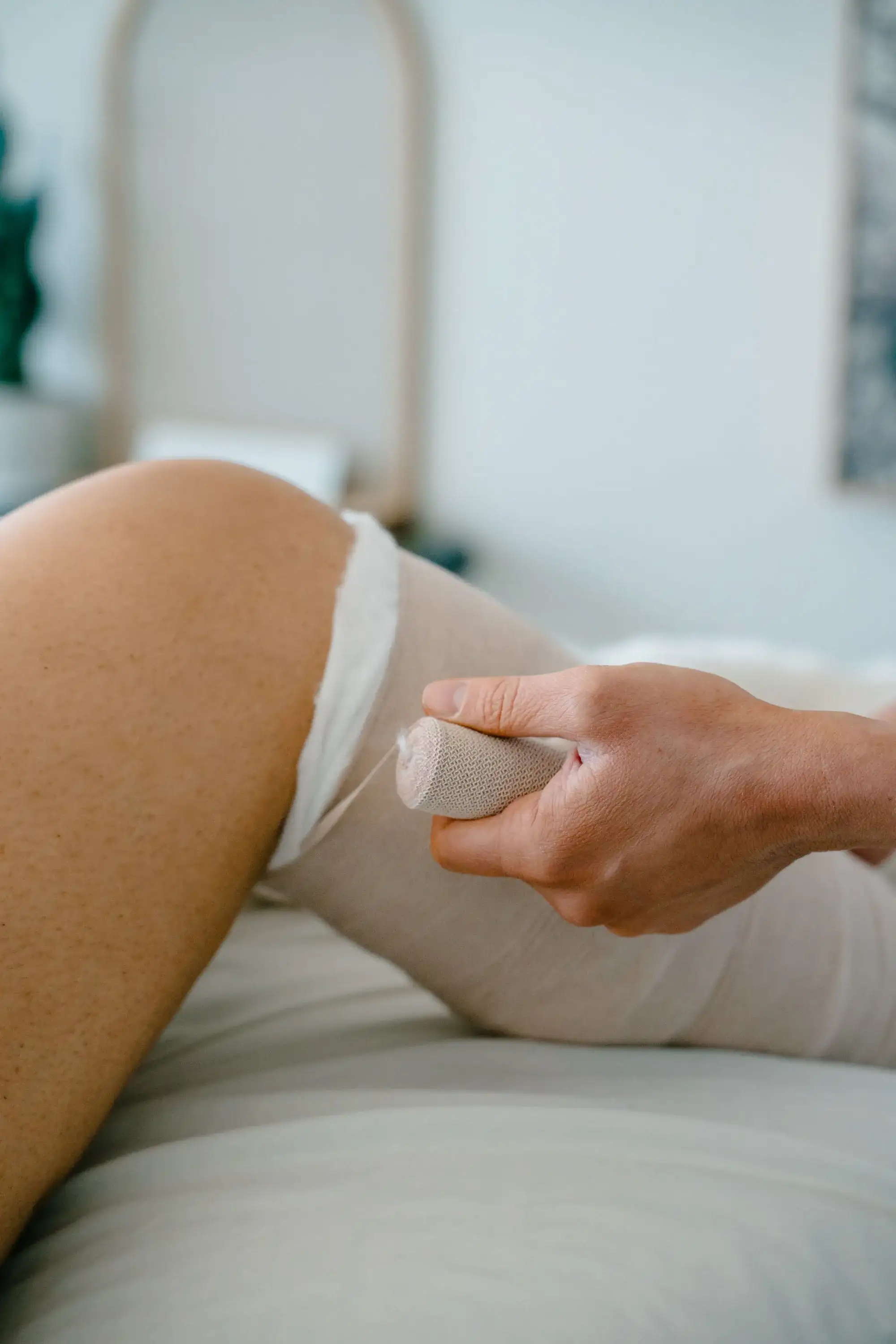
Compression garments
Not glamorous. Very effective. Here's how to get the fit right.
By Meeghan Mackenzie, RMT, CLT · 6 min read
Compression garments apply steady outside pressure that helps limit fluid build-up and supports healing tissue. After cosmetic surgery, wear them exactly as your surgeon directs, with no folds or creases. For lymphedema and lipedema, medical-grade garments should be professionally measured and replaced regularly.
What compression does
- Helps limit fluid build-up in the tissues
- Supports healing tissue and helps the skin settle into its new shape after liposuction
- Works with your muscles as you move, helping lymph and blood flow back toward the heart
After cosmetic surgery
Most surgeons use two stages. Your surgeon decides the timing.
- Stage 1 is worn in the early weeks. It usually has zippers or hooks, so it is easier to get on and off while you are sore.
- Stage 2 comes later, as swelling reduces. It is usually firmer, often pull-on, and helps with contouring.
Getting the fit right
- Snug, not painful. You should be able to breathe and move comfortably.
- No folds, rolls or creases. Wrinkled fabric can dig in, leave indentations and trap fluid. Check behind the knees, the groin, the waistband and under the bust.
- Refit as you shrink. A garment that fit in week one may be loose by week four.
- Foam or boards only if your surgeon recommends them, placed smoothly with no hard edges.
- Own two. Wear one, wash one. Gentle wash, then air dry.
- It depends on the surgery. A binder after a tummy tuck, a surgical bra after breast surgery, a chin strap after chin or neck work, sleeves after arm lipo, stockings after a joint replacement. We check the fit, and help you back into it, at every post-op session. Many clients find it closes a hook tighter afterwards.
For lymphedema and lipedema
Medical compression is different from surgical garments. It is graduated, meaning firmest at the far end of the limb and gentler toward the body, and it comes in specific pressure levels measured in mmHg.
- Get professionally measured by a certified compression fitter. Fit is everything.
- Circular-knit garments are thinner and seamless, suited to milder swelling.
- Flat-knit garments are thicker and firmer, with a seam. They hold their shape over uneven contours and are often the better choice for lymphedema and lipedema.
- Replace them regularly. Fabric loses elasticity with wear, often within about 6 months.
- Check your benefits. Many extended health plans cover prescribed compression garments, so ask your doctor for a prescription.
Putting them on
- Put them on first thing in the morning, when swelling is lowest.
- Rubber dish gloves give you grip and protect the fabric.
- Ask about donning aids. They help.
A well-fitted garment feels like a firm hug. A badly fitted one feels like a grudge. If yours leaves deep lines or keeps rolling down, bring it to your next session and we’ll look at it together.
Meeghan Mackenzie, RMT, CLT
Garment digging in, rolling down, or just not feeling right? Bring it to your next appointment and we’ll help you troubleshoot.
Page reviewed September 27, 2026 by Meeghan Mackenzie, RMT, CLT
Keep reading
Related guides


West Hillhurst, NW Calgary
Give fresh life or strength to.
Book online in a minute, or call the clinic. New clients can begin with the 60-minute intro massage, which includes a complimentary infrared cocoon session.
200, 209 19 St NW · Monday to Friday 8:00 am to 8:30 pm · Saturday and Sunday 10:00 am to 5:00 pm