
Pregnancy and postpartum
Diastasis recti after pregnancy
Diastasis recti after pregnancy is a stretched midline, not torn muscle. How common it is, the home check, why exercise helps and massage does not.
By The Renu lymphatic and massage team · 7 min read
Diastasis recti after pregnancy is a widening of the linea alba, the band of connective tissue between the two halves of the rectus abdominis, so the muscles sit further apart than usual. It is common: in a Norwegian cohort of 300 first-time mothers, 60 percent had it six weeks after birth and about one in three still did a year later. The NHS expects the gap to settle by the time the baby is eight weeks old; if it is still obvious then, ask your GP for a physiotherapy referral, because guided deep-abdominal and pelvic-floor exercise is what helps. Massage does not close a diastasis. What we can do is ease the back and hip tension that travels with a weaker core, and offer gentle lymphatic and scar work alongside your physiotherapist.
A soft bulge down the middle of the belly, a ridge that domes when you sit up, a waist that does not feel like yours months after the birth: this is usually diastasis recti, and it is a stretched seam rather than damaged muscle. It is very common, it often narrows on its own in the first weeks, and when it does not, the fix is a specific kind of exercise rather than anything we can do with our hands. Here is what the research says, how to check yourself, and where massage honestly fits.
What has stretched
The two long muscles down the front of the abdomen, the rectus abdominis, are joined at the midline by the linea alba, a band of connective tissue. The Cleveland Clinic describes it as normally elastic, like a rubber band, but notes that repeated stretching can cause a permanent loss of elasticity, so the band thins and the two muscles separate during pregnancy and the gap does not always close afterwards. A 2021 review in the journal Hernia defines diastasis recti abdominis as a separation of the rectus muscles by an abnormal distance along their length without a true defect in the fascia, measured as the inter-rectus distance, and points out that the threshold for calling it abnormal varies from study to study. The Cleveland Clinic uses a gap wider than two centimetres.
What it feels like, per the Cleveland Clinic: a visible bulge or pooch above or below the belly button, softness around the navel, doming of the muscles when you contract them, difficulty with everyday tasks, lower back pain and poor posture. The condition itself is not painful; the weakness around it can be.
How many women have it, and for how long
The best longitudinal numbers come from a 2016 study in the British Journal of Sports Medicine that followed 300 first-time mothers in Norway from mid-pregnancy to a year after birth, measuring by palpation 4.5 cm above, at and 4.5 cm below the navel.
| Time point | Women with a diastasis |
|---|---|
| 21 weeks of pregnancy | 33.1 percent |
| 6 weeks after birth | 60.0 percent |
| 6 months after birth | 45.4 percent |
| 12 months after birth | 32.6 percent |
The study graded a gap under two fingerbreadths as normal, two to three as mild, three to four as moderate and four or more as severe, and found that most of the diastasis it recorded was mild. Age, height, pre-pregnancy weight, weight gain, mode of delivery, the baby’s birth weight, joint hypermobility, general cardio exercise and abdominal or pelvic floor training were all unrelated to whether a woman had a diastasis. The one factor that was: lifting heavy loads 20 or more times a week, which roughly doubled the odds (odds ratio 2.18). And at 12 months, women with a diastasis reported no more low back or pelvic pain than women without one.
The 2021 Hernia review cautions that the true prevalence is unknown because it changes with the measurement method, the site measured and the threshold used, quoting 39.3 percent at six months in one cohort and 28.4 percent in women who happened to have CT scans. Across the studies it gathered, the number of births, a higher body mass index and diabetes were the consistent risk factors, and caesarean delivery was significant only in women with two or more births. The Cleveland Clinic adds pregnancies spaced less than 12 months apart, being over 35, carrying twins or a large baby, and being very petite.
Checking for a gap at home
The NHS self-check:
- Lie on your back with your legs bent and your feet flat on the floor.
- Raise your shoulders off the floor slightly and look down at your tummy.
- With the tips of your fingers, feel between the edges of the muscles, above and below your belly button.
- Note how many fingers fit in the gap.
The NHS says the separation will usually go back to normal by the time your baby is eight weeks old. If the gap is still obvious eight weeks after the birth, contact your GP, because you may be at risk of back problems, and ask about a referral to a physiotherapist. The Cleveland Clinic’s version is to see your provider for a gap wider than two fingers or any pain with it. For a precise measurement, clinicians use their hands, ultrasound, a tape or calipers.
What closes it, and what does not
Guided exercise is the treatment. The NHS recommends regular pelvic floor and deep stomach muscle exercises, standing tall with good posture, and avoiding sit-ups, planks, high-impact exercise, straining on the toilet and heavy lifting. The Cleveland Clinic names physical therapy with a trained specialist as the primary treatment, built on deep breathing and controlled movements that target the deep abdominals, and lists the movements to leave out while the gap is open: crunches, sit-ups, planks, push-ups, downward dog, boat pose, double leg lifts and scissors. Its everyday advice is to roll onto your side before getting up from bed and to lift nothing heavier than your baby in the early weeks. Elastic belly bands can support but do not heal. Surgery is reserved for an umbilical hernia or chosen cosmetic repair through a tummy tuck, and is not required for healing; it is never too late to start the exercise programme, even years on.
The SOGC’s pelvic floor guidance makes the same referral: pelvic floor physiotherapy can be effective at improving function and strength in these muscles, during pregnancy or long after. In Calgary, a pelvic floor physiotherapist is the person to book for a measured gap and a programme; we do not assess or treat the diastasis itself.
Massage, to be plain, does not close the gap. No source we read lists any form of hands-on soft tissue work as a treatment for the linea alba, and we will not pretend otherwise.
Where we fit alongside your physiotherapist
Three things are honestly ours:
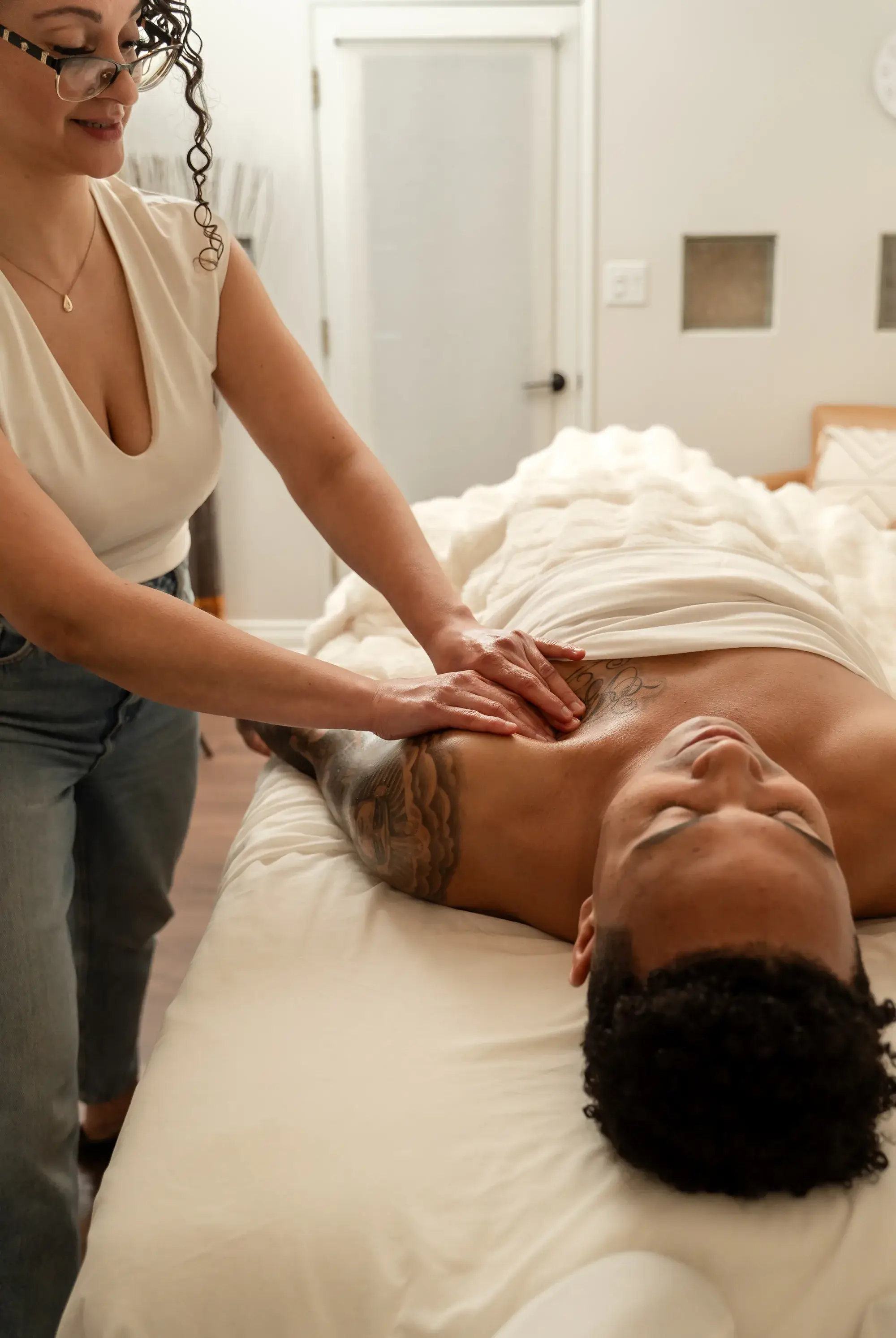
- The compensations. A core that is not yet pulling its weight asks the lower back, hips and glutes to do more, and the Cleveland Clinic lists lower back pain and poor posture among the consequences. A massage therapy session for a tired postpartum back is 60 minutes for $120, and the positioning is side-lying or on your back; nothing presses on the abdomen. The reasons the back was already sore before the birth are in low back pain in pregnancy.
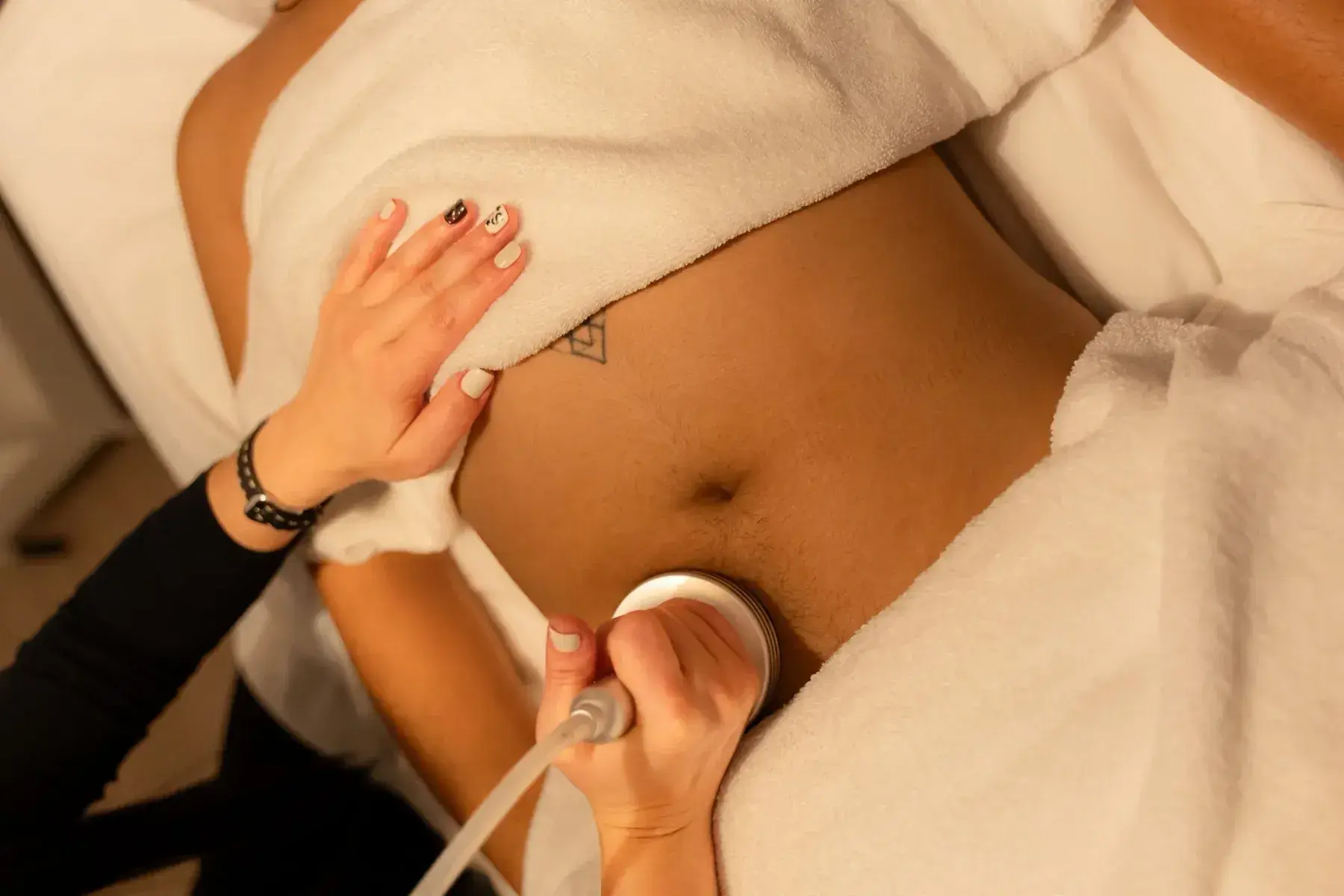
- Gentle abdominal lymphatic work. Light lymphatic drainage over the belly, once your care provider is happy with hands-on work, is comfort for the heavy, puffy feeling of the early months, not a treatment for the gap. The pressure is far lighter than anything that would load the midline.
- Scar care after a caesarean. If a scar sits below the separation, c-section recovery and lymphatic drainage explains when scar mobility work can begin and why it waits.
If you are weighing an abdominoplasty later, lymphatic drainage after a tummy tuck covers that recovery; it is a different conversation and a surgeon’s decision. In the first weeks after birth, massage after birth is the place to start.
When to see your doctor
- The gap is still obvious when your baby is eight weeks old (NHS): ask your GP about physiotherapy.
- The gap is wider than two fingers, or there is pain with it (Cleveland Clinic).
- A bulge at the navel or along the midline that is painful. The 2021 review notes that thinning and stretching of the linea alba is a risk factor for midline hernias, and that 45 percent of patients with small umbilical or epigastric hernias in one series also had a diastasis, so a tender lump needs a clinician’s hands, not ours.
- Back pain that is getting worse rather than better, which the NHS flags as the main reason to act on a persistent gap.
Bring whatever your physiotherapist tells you to your next session with us, and we will work around their plan rather than across it.
Questions people ask
Can massage fix diastasis recti?
No. The gap is in a band of connective tissue, and none of the sources we read lists massage as a way to narrow it. The NHS and the Cleveland Clinic both point to pelvic floor and deep abdominal exercise, ideally with a physiotherapist. Massage earns its place beside that programme, easing the lower back and hips while the core is being retrained.
Does a caesarean make diastasis recti more likely?
Not clearly. The 300-woman Norwegian cohort found no association between mode of delivery and diastasis in first-time mothers, and a 2021 review found caesarean delivery mattered only for women who had given birth two or more times. The number of pregnancies and body mass index were the more consistent factors in that review.
Is it too late to close the gap a year after birth?
The Cleveland Clinic's wording is that it is never too late to repair diastasis recti, even years after pregnancy, with physical therapy as the main treatment. The Norwegian cohort still showed 32.6 percent of first-time mothers with a diastasis at 12 months, so you are far from alone. A physiotherapist can measure the gap and set a programme.
Will diastasis recti give me back pain?
Not necessarily. The same cohort found no difference in low back and pelvic pain at 12 months between women with and without a diastasis. The Cleveland Clinic lists lower back pain and poor posture among possible symptoms, so if your back hurts it is worth a look, but the gap is not an automatic cause.
Should I wear a belly band?
The Cleveland Clinic says elastic belly bands can provide support but do not heal the condition on their own. If one makes you more comfortable while you build strength, that is a reasonable use; it is not a substitute for the exercise programme.
Do I need surgery for diastasis recti?
Rarely. The Cleveland Clinic says surgery is considered when there is an umbilical hernia, or when someone chooses cosmetic correction through an abdominoplasty, and that it is not required for healing. A 2021 review notes that a thinned, stretched linea alba is a risk factor for midline hernias, which is why a painful bulge should be assessed rather than ignored.
Sources
- NHS: Your post-pregnancy body (separated stomach muscles)
- Sperstad, Tennfjord, Hilde, Ellström-Engh and Bø 2016, British Journal of Sports Medicine: Diastasis recti abdominis during pregnancy and 12 months after childbirth
- Cleveland Clinic: Diastasis recti
- Cavalli et al. 2021, Hernia: Prevalence and risk factors for diastasis recti abdominis, a review
- SOGC pregnancyinfo.ca: Pelvic floor health
Page reviewed October 4, 2026. This page is education, not a diagnosis. For your own situation, talk to your doctor, surgeon or care team, or ask us.
Keep reading
Related pages