
Why do you pee more after lymphatic drainage?
Peeing more for a day or two after lymphatic drainage is expected: fluid moved from your tissues returns to the blood and the kidneys pass the extra as urine.
By The Renu lymphatic and massage team · 6 min read
You pee more after lymphatic drainage because the fluid moved out of your tissues drains into the bloodstream, and your kidneys remove the extra water as urine. Increased urination for 24 to 48 hours is listed as an ordinary, minor effect of the treatment. What you are passing is water and dissolved waste the kidneys would have filtered anyway, not toxins that the massage dislodged.
The short answer: the fluid had to go somewhere
Lymphatic drainage moves fluid that has pooled in your tissues back into circulation. Your body has one main exit for excess water, and that is the kidneys. So the bathroom trips are not a side effect in the usual sense. They are the end of the route the fluid was always going to take.
Healthline, in a medically reviewed overview of the treatment, lists increased urination for 24 to 48 hours as a minor effect of manual lymphatic drainage. If that matches your experience, nothing has gone wrong.
Where the fluid comes from
It helps to picture the plumbing. The Cleveland Clinic describes it this way: every day about 20 litres of plasma seep out through the walls of your capillaries to feed the tissues. About 17 litres soak straight back into the blood vessels. The remaining 3 litres are left in the tissue spaces, and collecting them is the lymphatic system’s job.
Tiny lymphatic capillaries pick that fluid up, at which point it is called lymph. It passes through progressively larger vessels and through lymph nodes, which the Cleveland Clinic describes as monitoring and cleansing the lymph, clearing out damaged cells and storing immune cells. Finally the lymph reaches two ducts in the upper chest, the right lymphatic duct and the thoracic duct, which empty into the subclavian veins. From there it is blood again.
Lymphatic drainage does not add fluid to this system. It encourages fluid that was sitting in the tissues, where it had no business staying, to get into those vessels and travel that route a little faster than it otherwise would. In a 2011 imaging study, lymph velocity rose by 28 percent in healthy limbs and 23 percent in limbs with lymphedema immediately after a session.
Where the fluid goes
Once lymph has joined the blood, the blood volume is briefly a little higher than your body wants. The kidneys notice.
The NIDDK, part of the US National Institutes of Health, describes what happens next. Healthy kidneys filter about half a cup of blood every minute, removing wastes and extra water to make urine. Over a day they filter roughly 150 quarts of blood; almost all of the water is reabsorbed, and only one to two quarts become urine. When there is more water than the body needs, more is passed.
That is the whole mechanism. Fluid leaves the tissues, enters the veins at the collarbones, and the kidneys trim the excess over the following day or so. The timing fits the 24 to 48 hour window Healthline describes, and it fits what people tell us: a busier evening and next morning, then back to normal.
What you are passing, and what you are not
Here is where the “detox” story gets in the way. What leaves in your urine is water, minerals and the ordinary wastes the kidneys remove constantly, whether or not you had a treatment that day. The NIDDK describes the filtering step: the glomerulus lets water, small molecules and wastes through while proteins and blood cells stay in the blood, then the tubule returns almost all the water and the needed substances.
Lymph itself, the Cleveland Clinic says, contains proteins, minerals, fats, damaged cells, cancer cells and germs, along with infection-fighting white blood cells. The nodes filter the cells and germs. The protein goes back into the blood where it belongs. None of that is “toxin” in any meaningful sense, and none of it ends up in the toilet because a therapist moved your skin.
Cedars-Sinai makes the related point about appearance: lymphatic drainage can have a temporary trimming effect because it moves fluid through the body, not because it removes anything. If you woke up looking less puffy and weighing a little less, that is the same water you are now passing. It comes back as your tissues return to their normal balance.
We have a fuller page on whether lymphatic drainage removes toxins if you want the regulator’s view as well as the physiology.
Why the belly session makes it more noticeable
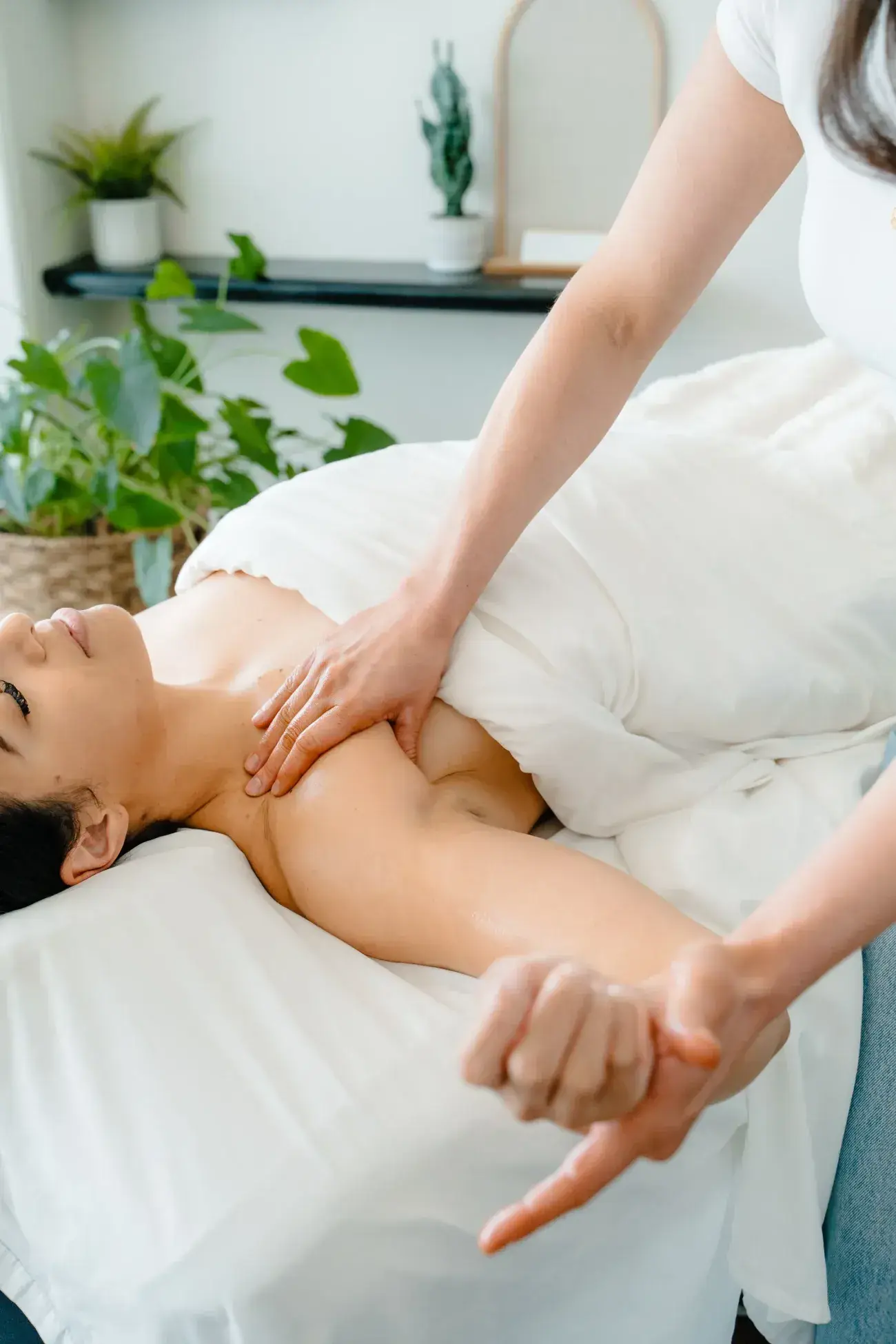
People often report the effect most strongly after abdominal work or a full-body session, and the simplest explanation is territory: a session that treats the trunk and both legs has moved fluid from far more tissue than a facial. The Cleveland Clinic describes the standard order of a session, clearing the node areas at the armpits, neck and, with your consent, the groin, before moving fluid from swollen tissue toward them. The more territory treated, the more fluid shifts, and the more you notice downstream.
Other things you may notice at the same time
Alongside the urination, the Cleveland Clinic notes that a few people develop fatigue, headaches or nausea after a lymphatic session, and Healthline mentions a temporary increase in blood pressure as common. All settle on their own. Drinking normally, eating, and taking the evening gently is enough for most people. If tiredness is your main complaint, our page on why you feel tired after lymphatic drainage covers it, and what to do after lymphatic drainage has the practical list.
When more frequent urination is not the massage
The session is a convenient explanation, and for a day or two it is almost always the right one. Beyond that, look elsewhere. The NHS lists the symptoms of a urinary tract infection, and several of them are easy to blame on a treatment if the timing is close:
- Needing to pee more often than usual, including at night
- Needing to go suddenly or more urgently
- Pain or a burning feeling when peeing
- Cloudy urine, or blood in it
- Pain low in the tummy or in the back just under the ribs
- A high temperature, or feeling hot, cold and shivery
A lymphatic session does not cause burning, cloudiness, blood or fever. If any of those appear, the NHS advice is to see a pharmacist or, with fever or back pain, to seek urgent GP advice. Likewise, if frequent urination started around the time of a new medication, or has been building for weeks, the treatment is a coincidence and your doctor or pharmacist is the right person to ask.
When to see a doctor about the swelling itself
Passing more urine after a session tells you fluid was there to move. It does not tell you why it was there. The Cleveland Clinic advises calling a healthcare provider for unexplained swelling that lasts more than a few weeks or interferes with daily life, and for extreme tiredness. Please have swelling assessed before treating it repeatedly if it is in one limb only, came on suddenly, or comes with heat, redness or pain. Our Learning Centre has a guide to understanding your lymphatic system and to the signs that need a doctor.
At Renu
Our therapists will tell you before a session that you may be in the bathroom more that evening; it is one of the few after-effects we can promise. Lymphatic drainage massage at Renu is booked at 30, 45 or 60 minutes ($95, $105, $130), without oil, with the areas treated agreed with you beforehand, and with Meeghan Mackenzie, our Certified Lymphedema Therapist, available for anyone whose swelling has a diagnosis behind it.
Questions people ask
How long does the extra peeing last after lymphatic drainage?
Usually a day or two. Healthline lists increased urination for 24 to 48 hours as a minor, expected effect. If you are still going noticeably more often after that, the session is unlikely to be the reason, and it is worth a word with your doctor or pharmacist.
Should I drink more water to help the fluid out?
Drink normally. The fluid that is leaving came from your tissues, not from your glass, and the kidneys handle it without help. Being well hydrated is sensible, but there is no evidence that extra water makes a session work better, and very dark or strong-smelling urine simply suggests you have not been drinking enough.
Does peeing more mean the treatment worked?
It means fluid moved, which is what the technique does. For general puffiness that is the whole effect, and it is temporary. For lymphedema, the result that matters is a measured change in the limb over a course of treatment with compression, not the bathroom trips on day one.
Is it a detox?
No. Lymph carries water, protein, fats, immune cells, cell debris and germs back toward the blood, where the lymph nodes, liver and kidneys do the filtering they do every day. A session speeds the return of fluid; it does not create a new cleaning process.
Sources
- Cleveland Clinic: Lymphatic system
- Healthline: Does lymphatic massage help reduce weight and bloating?
- NIDDK (National Institutes of Health): Your kidneys and how they work
- Cleveland Clinic: Lymphatic drainage massage
- Tan et al., Arch Phys Med Rehabil 2011: Assessment of lymphatic contractile function after manual lymphatic drainage using near-infrared fluorescence imaging
- NHS: Urinary tract infections (UTIs)
- Cedars-Sinai: FAQs about lymphatic drainage massage
- Cleveland Clinic: Liver
Page reviewed October 4, 2026. This page is education, not a diagnosis. For your own situation, talk to your doctor, surgeon or care team, or ask us.
Keep reading
Related pages