

Self-lymphatic drainage for the leg, step by step
The seven-step NHS leg routine: belly breaths, brush the lower torso, pump the groin while marching the leg, knee and ankle pumps. No oil.
By The Renu lymphatic and massage team · 6 min read
The NHS leg routine has seven steps: belly breaths, brushing firmly up the lower torso, pressing the groin with a flat hand or small ball while marching the leg 10 times, stroking down the leg with a knee pump, clearing the ankle, foot and toes, stroking back up, then repeating the opening steps in reverse. People with both legs affected do both sides; with one leg affected, only that side. It is firm but must not cause pain or redness, it is done on bare skin without oil, and it is skipped whenever you feel unwell or have an infection.
For a swollen leg, the home routine lymphedema services teach is simple lymphatic drainage, and the West Suffolk NHS Foundation Trust leaflet lays it out in seven steps. You breathe into your belly, brush firmly up the lower torso, press the groin while marching the leg, stroke down the leg with a pump at the knee, clear the ankle and foot, stroke back up, and close by repeating the opening steps in reverse. It is firm but never painful or reddening, done on bare skin with no oil, and skipped whenever you feel unwell.
Who this is for, and who should ask first
The leaflet describes simple lymphatic drainage as a massage that moves fluid away from a congested area toward healthy lymph nodes where it can be drained more effectively. It was written for people with leg lymphedema, taught by their lymphedema clinician. Cancer Research UK’s version of the rule is that a specialist needs to teach you how to do it.
Three groups should check before starting:
- Anyone who has had groin or pelvic nodes removed. The leg leaflet does not address this directly, but the same service’s arm and breast leaflets say to seek your clinician’s advice if any lymph nodes were removed, and we apply that to the groin as well. Pumping a node bed that is no longer there is not useful, and the route may need to change.
- Anyone with a blood clot, heart problems, cancer in the area, or an infection or inflammation in the swollen leg. Cancer Research UK lists each of these as a reason not to have lymphatic drainage.
- Anyone unsure whether the swelling is lymphedema at all. One-sided leg swelling has other causes; see why one leg is more swollen than the other.
If you are in Calgary and have not had the routine taught, Meeghan Mackenzie, our Certified Lymphedema Therapist, teaches it as part of complete decongestive therapy.
The leg routine, step by step
Legs and lower belly bare, sitting or standing.
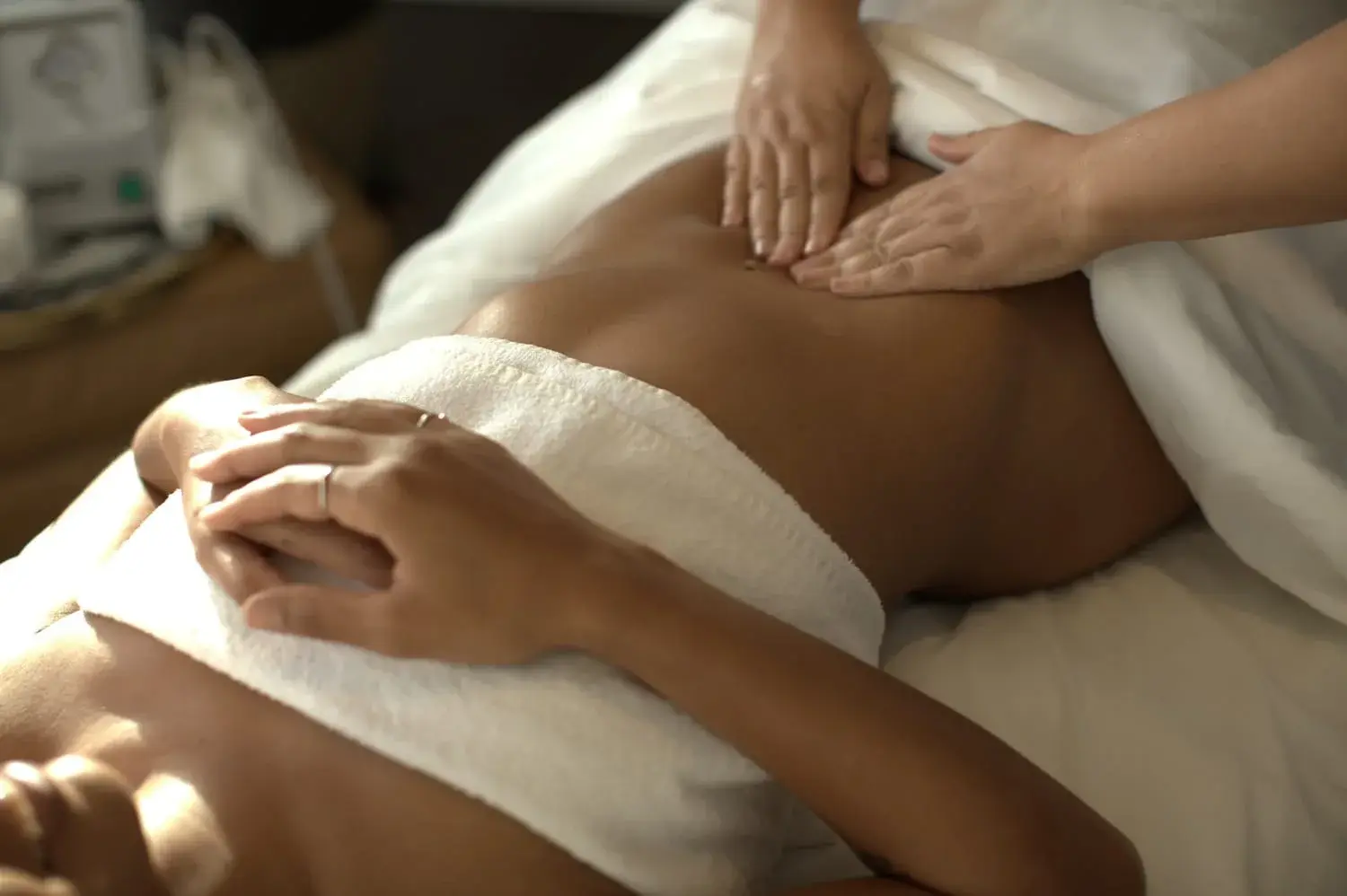
- Breathe. Hands over your abdomen, breathe in slowly and deeply. Breathe out through pursed lips and let your hands sink into your abdomen. Repeat 2 to 5 times. (The fuller version of this step is on our abdomen page.)
- Brush up the lower torso. Starting around the lower torso, brush firmly up the body to aid drainage.
- Pump the groin while marching. Place a small ball, or the flat part of your hand, in the groin area. Keep pressure there and march the leg up and down 10 times. Sitting or standing both work. Both sides if both legs are affected; only the affected side if one leg is.
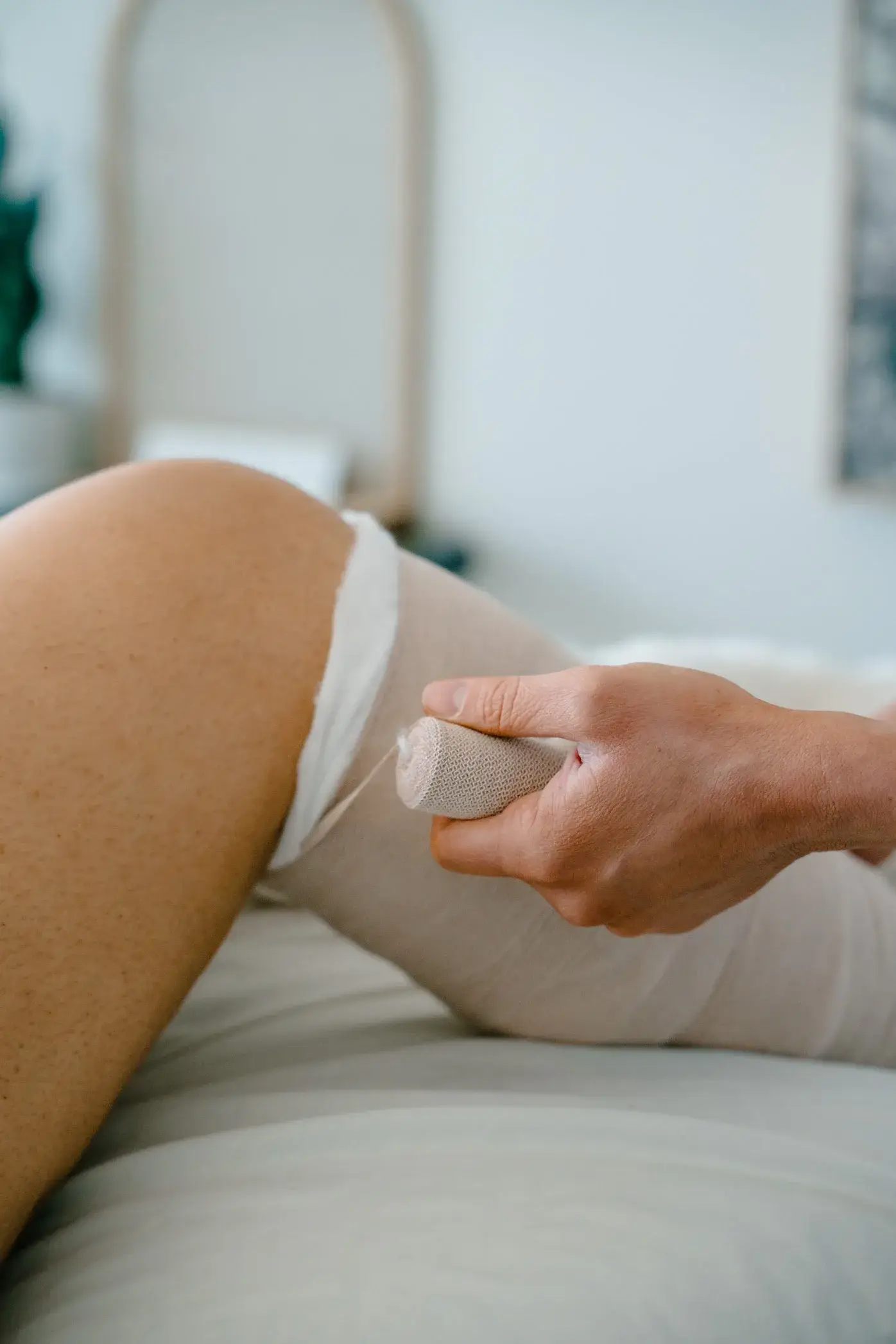
- Work down the thigh to the knee. From the top of the limb, stroke firmly in an upward direction while progressing down the leg. At the back of the knee, add some firm pressure and flex and extend the knee 10 times. Then continue the upward stroking down toward the foot.
- Clear the ankle, foot and toes. At the base of the limb, stroke the ankle, foot and toes, and flex and extend the ankle to drain those areas.
- Return up the leg. Stroke back up toward the top of the limb, clearing again at each joint and point.
- Finish in reverse. Repeat steps 3, 2 and 1 in that order to close the routine.
The direction matters more than the force. Macmillan’s rule for simple lymphatic drainage is that you always move the skin away from the swelling, and that if your skin is red when you have finished, the movement was too much.
Pressure, skin and timing
The leaflet’s own words: although the massage is firm you must not cause pain or redness to the skin, it must be performed on bare skin, and you do not use moisturizing cream or oils. If your legs are dry, moisturize at a different time of day; Macmillan suggests finishing each moisturizer stroke downward, in the direction of hair growth, so hair follicles do not block.
For timing, Cancer Research UK gives the usual simple lymphatic drainage routine as twice a day for about 20 minutes each time, and says it might vary. Macmillan’s advice is to pick a time and place where you can be relaxed, and to do deep breathing first.
Pairing the routine with elevation and movement
The routine moves fluid for the minutes you are doing it; what you do with your legs the rest of the day matters as much. The NHS says you will usually be advised to elevate the affected body part whenever possible. Macmillan is specific for legs: sit with your legs uncrossed, raise them as often as you can when sitting, get up and move about at least once an hour if you can, and avoid standing still for long periods. Its standing suggestions include calf raises and shifting your weight from foot to foot.
Movement does part of the routine’s work for free. Cancer Research UK explains that exercise makes the muscles contract and pushes lymph through the lymph vessels, that the evidence suggests exercise does not cause or worsen lymphedema, and that you should wear your compression garment while exercising if you have one. Macmillan adds one limit: do not exercise during a skin infection, and stop if the swelling gets worse. Our pages on elevating a leg and remedial exercises for leg lymphedema build on this, and Meeghan Mackenzie’s five ways to decrease leg swelling covers the everyday habits.
Stop and call
Skip the routine and seek advice when any of these are true:
- Signs of a clot. The NHS lists throbbing pain in one leg, usually the calf or thigh, swelling in one leg, red, blue or darkened skin around the painful area, and swollen veins as symptoms of deep vein thrombosis, and says to ask for an urgent GP appointment or urgent care. If you also feel short of breath or have chest pain, call emergency services. Recent surgery, three or more days in bed and journeys over four hours are among the risk factors it names.
- Signs of cellulitis. Macmillan says to contact your GP immediately if the area becomes red and hot, painful or more swollen, or you notice red streaks, fever or flu-like symptoms. See lymphatic drainage during cellulitis.
- You feel unwell or have any infection. The leaflet says not to perform the massage, and to contact your lymphedema clinician if unsure.
- Fluid is weeping through the skin. Macmillan says to tell your lymphedema specialist; we explain the symptom in why clear fluid leaks from a swollen leg.
- Any step is painful.
Between routines
The NHS pathway is manual lymphatic drainage from a specialist first, then the simplified home version to maintain the result. If you want to see the sequence performed, the Lymphoedema Support Network publishes a free self-lymphatic drainage video for the legs, presented by patients with the team from Kendal Lymphology.
At Renu, a classic lymphatic drainage session is 60 minutes for $130, lipedema management is 30 minutes for $105 or 60 minutes full body for $140, and compression fitting with Meeghan Mackenzie, a Certified Compression Fitter, is 30 minutes for $25. Our Learning Centre has a fuller introduction to lymphedema and lipedema, and because feet with lymphedema need their own attention, read foot and nail care with leg lymphedema alongside this routine.
Questions people ask
Do I massage both legs or only the swollen one?
The West Suffolk leaflet is specific: if both legs are affected, complete the groin step on both sides; if only one leg is affected, do it only on that side. The torso brushing and the breathing are the same either way. Your therapist can tell you which group you fall into if it is not obvious.
Can I use a ball instead of my hand on the groin?
Yes. The leaflet says to place a small ball or the flat part of your hand in the groin area and keep pressure there while marching the leg up and down 10 times. A ball is easier if reaching is awkward or your hands tire. Keep the pressure steady and comfortable, never painful.
Should I sit, stand or lie down?
The leaflet gives sitting or standing for the breathing step and for the groin marching step. It does not describe lying down. If balance is a concern, sit. Macmillan separately recommends raising your legs whenever you sit and getting up to move at least once an hour, which pairs well with the routine.
What if one leg suddenly swells more than the other?
Do not massage it. The NHS lists throbbing pain in one leg, swelling in one leg, red, blue or darkened skin around the painful area and swollen veins as symptoms of a deep vein thrombosis, and says to ask for an urgent GP appointment. If you are also short of breath or have chest pain, call emergency services.
How long should the leg routine take?
Cancer Research UK gives the usual simple lymphatic drainage routine as twice a day for about 20 minutes, with the note that it might vary. The leg sequence has more stops than the arm one, so do not rush the counts. If you cannot manage both sessions, tell your therapist rather than doubling the pressure.
Sources
- West Suffolk NHS Foundation Trust: Simple lymphatic drainage, legs (leaflet 6466)
- Cancer Research UK: Manual lymphatic drainage (MLD) for lymphoedema
- Macmillan Cancer Support: Lymphatic drainage for lymphoedema
- Macmillan Cancer Support: Managing lymphoedema with exercise
- NHS: Deep vein thrombosis (DVT)
- Macmillan Cancer Support: Managing and treating lymphoedema
- Lymphoedema Support Network: Self-management videos
Page reviewed October 4, 2026. This page is education, not a diagnosis. For your own situation, talk to your doctor, surgeon or care team, or ask us.
Keep reading
Related pages