

Self-lymphatic drainage for the abdomen: breathing and belly strokes
The abdominal opening of every NHS self-drainage routine: hands on the belly, pursed-lip breaths that let them sink in, then upward brushing of the torso.
By The Renu lymphatic and massage team · 6 min read
Self-lymphatic drainage for the abdomen is the opening move of every NHS simple lymphatic drainage leaflet: sitting or standing, you rest both hands on your belly, breathe in slowly and deeply, and let the hands sink into the abdomen as you breathe out through pursed lips, two to five times. Then you brush firmly up the lower torso to help drainage before moving on to the groin or the limb. It works because breathing changes the pressure in the abdomen and chest, which encourages lymph to flow back toward the bloodstream, and because the lymphatic system has no pump of its own.
Open any NHS simple lymphatic drainage leaflet, whether it is written for the leg, the arm or the breast, and the first step is the same: hands on the belly, a slow breath in, and a pursed-lip breath out that lets the hands sink into the abdomen. Only then does the routine move to the lower torso, the groin or the limb. This page is about that opening on its own, why it comes first, and how to use it when the abdomen itself is the part that feels full or swollen.
Why the abdomen is cleared before anything else
The short answer is that the belly is the junction box. Fluid from the legs and the lower body has to pass through the abdomen and chest on its way back to the bloodstream, and Cancer Research UK explains that deep breathing helps the flow of lymph through the body by changing the pressure in your tummy and chest, which encourages lymph to flow back into the blood system.
The West Suffolk NHS lymphoedema service puts it another way in its daily-care leaflet: your lymphatic system does not have a natural pump the way the circulation has the heart, so it needs movement or muscle contraction to move fluid, and breathing exercises change the pressure in the chest and so aid drainage toward it. If that central route is sluggish, a limb has nowhere to send its fluid. Clear the centre, and the leg or arm work that follows has a road to travel.
That is also the logic a therapist follows on the table. Cancer Research UK describes the specialist first clearing the area they want the fluid to drain into before treating the swollen part, and Macmillan says breathing exercises are done before and after a manual lymphatic drainage session. Our page on understanding your lymphatic system covers the map in more detail.
The abdominal routine, step by step
This is the opening of the West Suffolk leg leaflet, with the breast leaflet’s version noted where it differs. Sit or stand, with the belly bare.
- Place both hands over your abdomen. Relax your shoulders. Cancer Research UK suggests resting one hand just below the ribs so you can feel it rise.
- Breathe in slowly and deeply through the nose. Let the belly push out against your hands; Cleveland Clinic says the hand on the chest should stay as still as possible while the lower hand rises.
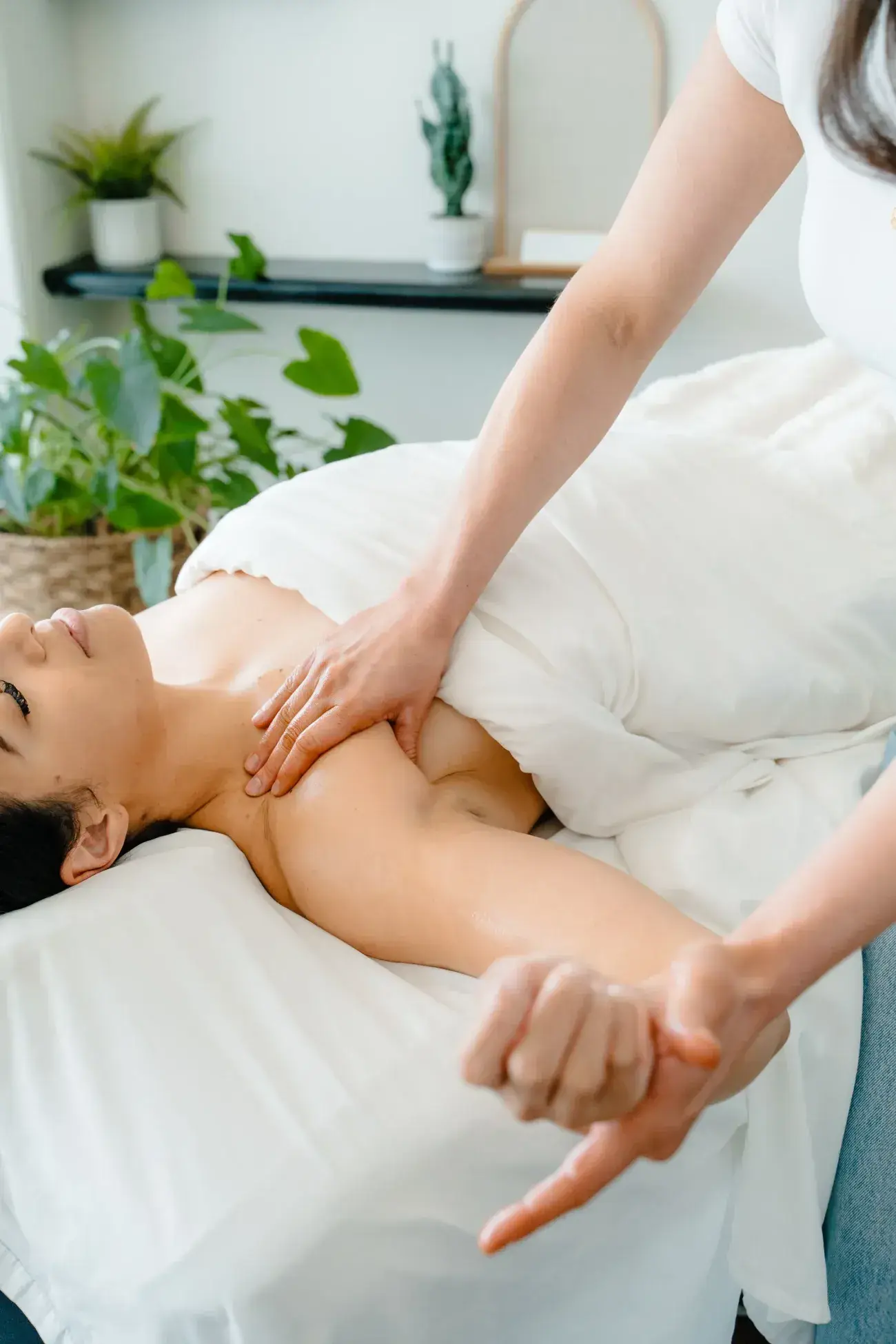
- Breathe out through pursed lips, and as you do, let your hands sink deeply into the abdomen. The breath softens the belly and the hands follow it down; you are not pushing.
- Repeat two to five times. The leg leaflet gives that range; the breast leaflet asks for five.
- Brush firmly up the lower torso. Starting around the lower abdomen and flanks, stroke upward along the body to aid drainage. Firm is allowed; the leaflet says you must not cause pain or redness to the skin.
- Carry on, or finish. If this is the start of a leg routine, the next step is the groin; our leg self-drainage page picks up there. If the abdomen is all you are treating, close with another set of breaths, which is how the leaflets end every sequence.
Done on its own, the whole thing takes a few minutes. Done as the start and finish of a full limb routine, the West Suffolk daily-care leaflet says simple lymphatic drainage takes about 20 minutes, and Cancer Research UK gives twice a day as the usual rhythm.
Lying down instead of sitting
The leaflets describe the routine sitting or standing, but if you want to practise the breath itself, Cleveland Clinic’s instructions are for lying on your back with the knees bent and the head supported, a pillow under the knees, one hand on the upper chest and the other just below the rib cage. Breathe in slowly through the nose so the stomach moves out and the lower hand rises; then tighten the stomach muscles so it moves back in as you exhale through pursed lips. Cleveland Clinic suggests five to ten minutes, three to four times a day, moving to a seated version once it feels natural, and later placing a book on the abdomen for a little extra effort. Our five-minute breathing routine builds on exactly that.
Skin, pressure and what not to use
Three rules carry over from the full leaflets. The strokes are done on bare skin, with no moisturising cream or oil, because the hand is meant to move the skin rather than slide across it. Macmillan’s version is that you use your hand to very gently move the skin in a particular direction, always away from the swelling, and that if your skin is red when you have finished, the movement was too much. And the brushing stroke may be firm, but nothing in the routine should hurt.
Macmillan adds one more useful point for the abdomen specifically: pelvic floor and tummy exercises, combined with deep breathing, can help reduce swelling. So the breath is not only a warm-up; gentle abdominal muscle work is part of the pump.
When the abdomen itself is swollen
People come to this page for three different reasons, and the routine suits each of them a little differently.
- Bloating and a heavy, full belly. The breathing and brushing are gentle enough for most people to try. What they can realistically do, and what they cannot, is on our page on lymphatic drainage and bloating.
- Swelling after abdominal surgery or liposuction. We ask you to wait for your surgeon’s go-ahead before any hands-on work over the operated area, and to keep the strokes away from incisions and drains. The post-liposuction self-care page spells out what is safe between clinic visits.
- Leg lymphedema. Here the abdominal step is the start of the leg sequence rather than the whole routine, and it matters most: the fluid you move out of the leg has to pass through this territory.
Stop and call
Do not do the routine, and contact your doctor or lymphedema clinician, if any of these apply:
- Your abdomen is painful, hard, hot or tender, or you have a fever or feel unwell. The West Suffolk leaflets say not to perform the massage at all if you feel unwell or have an infection.
- You have had abdominal surgery recently and your surgeon has not cleared hands-on work over the area.
- A blood clot is suspected, you have heart problems, there is cancer in the area, or you have a blockage of the large vein returning blood to the heart. Cancer Research UK lists each of these as reasons not to have lymphatic drainage.
- You feel dizzy or breathless during the breathing. Slow down, breathe normally, and ask your doctor before trying again.
- The skin over your belly is red when you finish. Macmillan’s test: the movement was too much.
If you are pregnant, talk with your care provider before starting any new routine over the abdomen.
Where this fits with clinic care
The abdominal opening is something we teach, not something we expect you to work out from a leaflet. In a classic lymphatic drainage session at Renu, the therapist spends time over the abdomen for the same reason the leaflets do, and will show you the home version if you want it. For people drawn to the firmer, shaping style of abdominal work, Brazilian lymphatic drainage is a different treatment with a different purpose, and the page explains the distinction.
Meeghan Mackenzie, our Certified Lymphedema Therapist, maps the full self-drainage route for anyone with diagnosed lymphedema, because the sequence after the belly depends on which nodes are still working for you.
Questions people ask
Why does every self-drainage routine start with the belly and not the swollen part?
Because the deep vessels the limbs drain into run through the abdomen and chest, and the breath is what moves fluid through them. Cancer Research UK explains that deep breathing changes the pressure in your tummy and chest, which encourages lymph to flow back into the blood system. The West Suffolk NHS leaflets put the breathing step first and repeat it last for the same reason.
How many belly breaths should I do?
The West Suffolk leg leaflet says two to five, the breast leaflet says five, and Cancer Research UK's breathing exercise is done five times. If you are using breathing on its own as a daily practice, Cleveland Clinic suggests five to ten minutes, three to four times a day. More is not better if it makes you light-headed; slow and comfortable is the goal.
Can I do the abdominal routine for bloating if I do not have lymphedema?
The breathing and brushing steps are gentle and the sources we read describe them as safe self-care for people managing swelling. They are not a treatment for bloating with pain, a hard abdomen or a fever, which need a doctor first. If your belly is simply full and sluggish, the routine is a reasonable thing to try, and our bloating page explains what lymphatic work can and cannot do for it.
Do I press hard into my stomach?
No. The leaflet's instruction is to let your hands sink into the abdomen as you breathe out, which means the breath does the work and the hands follow it. The brushing stroke that comes next is firm, but the leaflet is clear that you must not cause pain or redness to the skin.
Should I wear my compression garment while I do it?
You can. The West Suffolk daily-care guidance says simple lymphatic drainage takes about 20 minutes and can be carried out while wearing your compression hosiery. The belly and torso are usually bare anyway, because the strokes are done on skin without cream or oil.
Sources
- West Suffolk NHS Foundation Trust: Simple lymphatic drainage, legs (leaflet 6466)
- West Suffolk NHS Foundation Trust: Simple lymphatic drainage, breast (leaflet 6773)
- West Suffolk NHS Foundation Trust: Lymphoedema guidance on daily care (leaflet 6467)
- Cleveland Clinic: Diaphragmatic breathing
- Cancer Research UK: Exercise and lymphoedema
- Cancer Research UK: Manual lymphatic drainage (MLD) for lymphoedema
- Macmillan Cancer Support: Lymphatic drainage for lymphoedema
- Macmillan Cancer Support: Managing and treating lymphoedema
Page reviewed October 4, 2026. This page is education, not a diagnosis. For your own situation, talk to your doctor, surgeon or care team, or ask us.
Keep reading
Related pages