
Sciatica in pregnancy
Sciatica in pregnancy is burning pain shooting from the buttock down one leg. Why the nerve is irritated, what eases it, what massage can do, the red flags.
By The Renu lymphatic and massage team · 6 min read
Sciatica in pregnancy is pain from irritation or compression of the sciatic nerve, felt as a burning or electric-shock sensation that shoots from the lower back or buttock down the back of one leg, sometimes with numbness or tingling. Pregnancy hormones loosen the ligaments of the spine and the growing baby can press on the nerve, so it is common, and it usually improves after birth. Most episodes settle within four to six weeks with side-lying rest, heat or cold, gentle stretching and light activity. Side-lying massage of the buttock and hip can ease the muscles around the nerve, but loss of feeling in a leg or any change in bladder or bowel control is an emergency, not a massage.
A hot wire of pain running from one buttock down the back of the leg is alarming the first time it happens, especially when you are carrying a baby and cannot take the usual painkillers. It is almost always sciatica, it is common in pregnancy, and it has a short natural course. Here is what is happening to the nerve, what Cleveland Clinic and ACOG suggest you do about it, and how we work on it from the side.
The nerve, and why pregnancy irritates it
The sciatic nerve starts near the base of the spine in the lower back, passes through the pelvis and the buttock, and runs down the back of each thigh into the lower leg. Cleveland Clinic defines sciatica simply as pain caused by irritation or compression of that nerve. Outside pregnancy the usual culprits are a herniated disc, narrowing of the spinal canal or wear in the discs and joints.
In pregnancy two extra factors appear. Cleveland Clinic explains that pregnancy hormones can loosen the ligaments of the spine, and that the growing fetus can also press on the sciatic nerve. The NHS describes the same hormonal softening: ligaments become softer and stretch to prepare you for labour, which puts strain on the joints of the lower back and pelvis. A spine with looser ligaments and a heavier load in front of it is a spine whose nerves are more easily pinched.
For scale, a 2023 meta-analysis of 38 studies and 21,533 pregnant women found that 63 percent experienced lumbopelvic pain, about three in five, with the figure for North America at 71 percent and little difference between the second and third trimesters. Sciatica is only one slice of that total, but it tells you how ordinary pain in this region is.
How sciatica feels, and what it is not
Cleveland Clinic describes the signature as a burning or electric-shock feeling that shoots down one leg, often worse with coughing, sneezing, bending or lifting the leg, and sometimes accompanied by numbness and tingling. The one-sidedness and the travelling quality are what mark it out.
Two neighbours can be confused with it. Pelvic girdle pain stays in the pelvic joints and bites on stairs and when turning in bed. Plain low back pain aches across the lumbar spine without the leg. All three can coexist, and the treatment overlaps, so the label matters less than the warning signs below.
What to do at home
Cleveland Clinic and ACOG agree on the home measures, and none of them need a prescription:
- Side-lying with pillows. ACOG says sleeping on your side is best later in pregnancy, with one or both knees bent, a pillow between the knees and another under the belly, or a full-length body pillow.
- Cold first, then heat. Cleveland Clinic suggests ice to reduce pain and swelling in the first few days, then heat, for about 20 minutes at a time. ACOG adds that a heating pad should be on its lowest setting, wrapped in a towel, and used for limited periods.
- Keep moving gently. Cleveland Clinic recommends stretching and light activity rather than bed rest. ACOG says walking is generally safe in pregnancy and good for the back, and that water exercise is especially helpful because the water carries your weight.
- Protect the back when lifting. Squat, bend the knees and keep the back straight, rather than bending at the waist (ACOG). The NHS adds: move your feet when you turn so you do not twist the spine.
- Rest a foot on a step. If you must stand for a long time, ACOG suggests resting one foot on a stool or box to take the strain off the back.
Over-the-counter anti-inflammatories are on Cleveland Clinic’s general list, but in pregnancy medication is a conversation with your midwife or doctor; the NHS notes paracetamol is the usual choice.
What a side-lying massage can and cannot do
Cleveland Clinic lists physical therapy, massage, heat and warm showers among the ways sciatica is managed during pregnancy. That is the honest extent of the endorsement: massage is a recognised comfort measure, not a treatment that frees a trapped nerve.
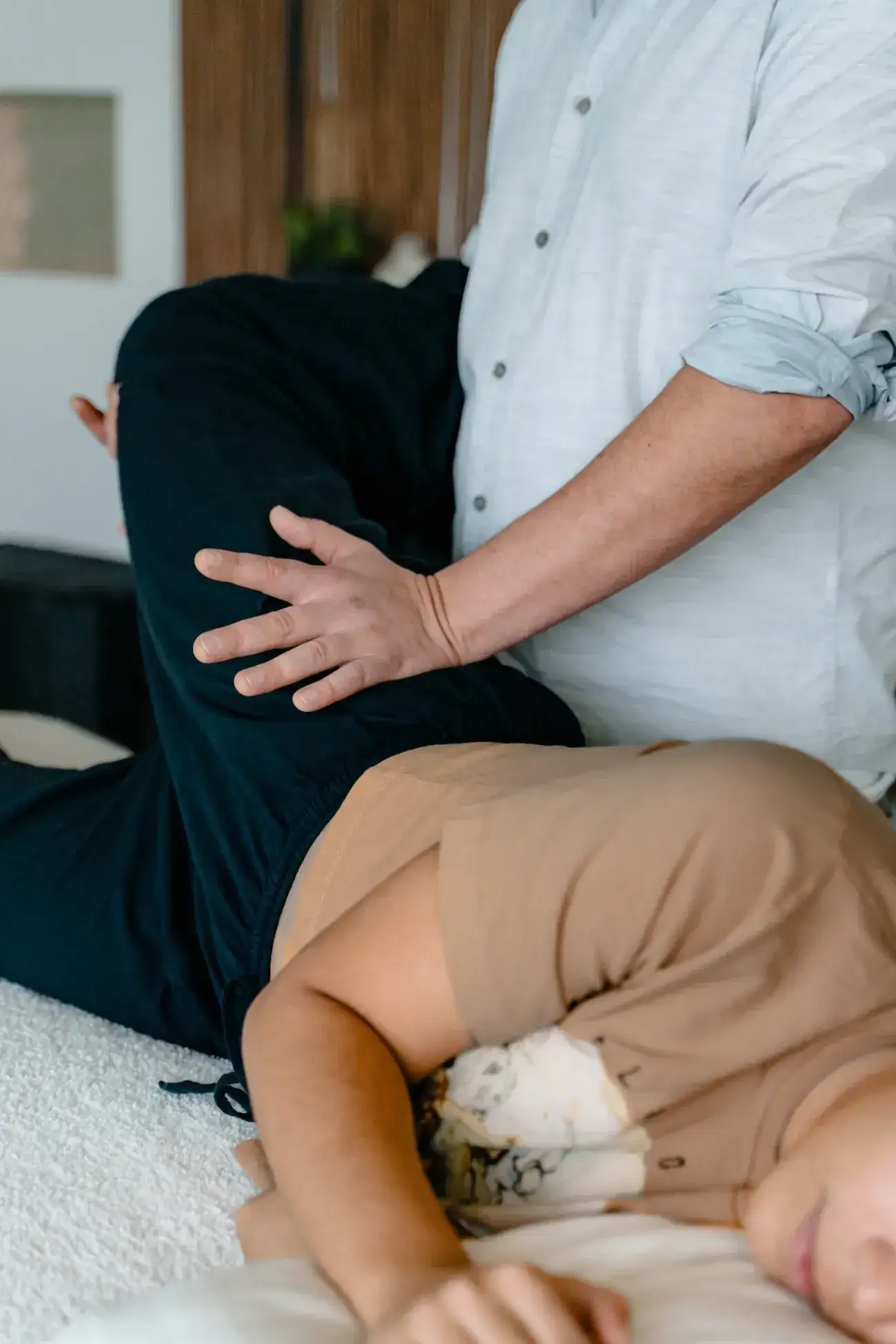
In a prenatal massage for sciatica you lie on your side with the belly, back and top knee supported, as described in how you lie on the table. The painful side is uppermost so we can reach the gluteal muscles and the deep rotators beneath them, including the piriformis, which lies close to the path of the nerve and tends to clamp down when the nerve is irritated. We use slow, sustained pressure and gentle movement of the hip, never anything sharp or sudden, and we stay off the line of the nerve itself. The low back and the hamstring often get some attention as well, because they are usually guarding.
Two things we do not do. We do not work prone over a pregnant belly, and we do not press into a leg that is numb or weak rather than painful; that needs a doctor’s assessment first. For stubborn muscular guarding, Monica’s RAPID NeuroFascial Reset is a brisker option that some clients prefer, and a general massage therapy session with any of our therapists can be adapted the same way.
How long it lasts
Cleveland Clinic says many cases of sciatica improve within four to six weeks without medical treatment, and that it often does not last longer than six weeks. For pregnancy-related sciatica it adds that the pain typically improves after the baby is born, once the hormones settle and the pressure on the nerve is gone. If your symptoms persist beyond a few weeks or get worse, Cleveland Clinic’s advice is to contact a healthcare provider, and ACOG says that severe back pain or pain lasting more than two weeks should be assessed so other causes can be ruled out.
When it is an emergency
Most sciatica is miserable but safe. A small number of symptoms are not, and the NHS is explicit about them. Call 999 (911 in Calgary) or go to emergency if you have back pain and:
- you lose feeling in one or both legs, your bottom or your genitals
Cleveland Clinic adds loss of bladder or bowel control and muscle weakness to the serious list. These can indicate pressure on the nerves at the base of the spine and need same-day assessment, not a massage appointment.
Separately, the NHS says to contact your GP or midwife urgently if back pain comes with a fever, bleeding from the vagina or pain when you pee, pain in one or both sides, or if it begins in the second or third trimester, because back pain can be a sign of early labour. ACOG’s version of the same list is fever, burning during urination and vaginal bleeding, since back pain can also signal preterm labour or a urinary tract infection.
If any of that is happening, call before you come. We would far rather reschedule than treat a leg that needed a doctor.
Questions people ask
How do I know it is sciatica and not pelvic girdle pain?
Sciatica follows the nerve: a burning or electric pain that travels from the buttock down the back of the thigh, often into the calf, usually on one side, and it can be set off by coughing or sneezing. Pelvic girdle pain stays at the pubic bone or across the back of the pelvis and flares with stairs, standing on one leg and turning in bed. The two can overlap, and a physiotherapist can sort out which you have.
Is it safe to have my buttock and hip massaged while pregnant?
Yes, in side-lying with the belly supported, and Cleveland Clinic lists massage among the options for sciatica in pregnancy. We work the gluteal and deep hip muscles with steady pressure rather than anything sharp, and we keep away from direct pressure on the nerve itself. If the leg is numb or weak rather than painful, we ask you to see your doctor first.
What sleeping position helps sciatica in pregnancy?
On your side with the knees bent and a pillow between them, which is what ACOG recommends for back pain later in pregnancy. A second pillow under the belly stops the pelvis rolling forward. Try the painful side up and then down, and keep whichever is more comfortable.
How long will pregnancy sciatica last?
Cleveland Clinic says many cases improve within four to six weeks without medical treatment and that sciatica often does not last longer than six weeks, and pregnancy-related cases typically improve after birth. If yours is still there after a few weeks, or getting worse, see your care provider.
Sources
Page reviewed October 4, 2026. This page is education, not a diagnosis. For your own situation, talk to your doctor, surgeon or care team, or ask us.
Keep reading
Related pages