
Massage for chemotherapy-related fatigue
Massage is a recognized option for cancer-related fatigue: one trial showed relief, a Cochrane review calls the evidence weak. What a session looks like.
By The Renu lymphatic and massage team · 6 min read
Massage therapy is listed by the NCCN, as reported in the National Cancer Institute's fatigue summary, as a category 1 intervention for cancer-related fatigue, alongside physical activity and psychological support. The evidence is mixed: a 2018 randomised trial found six weekly Swedish massages reduced fatigue scores in breast cancer survivors by about twice as much as light touch, while a 2016 Cochrane review found no reliable difference in fatigue across the small trials it could pool. Massage is safe to try with your oncology team's agreement, in a shorter, lighter, oncology-adapted session, and it sits beside exercise and sleep care rather than replacing them.
Fatigue is the side effect people apologise for. It does not show on a scan, it is hard to describe to family, and it can make a massage feel like an indulgence you have not earned. We see it differently. Fatigue is the most common side effect of cancer treatment, it has a name and a definition, and the question of whether massage helps has been studied. Here is what the studies found, and what an oncology-adapted session involves.
How common cancer-related fatigue is
The National Cancer Institute (NCI) defines cancer-related fatigue as “a distressing, persistent, subjective sense of physical, emotional, and/or cognitive tiredness or exhaustion related to cancer or cancer treatment that is not proportional to recent activity and interferes with usual functioning.” That last clause is the one most people recognise.
The NCI’s figures:
- about 80 percent of people report fatigue while receiving chemotherapy or radiation, with studies ranging from 39 percent to more than 90 percent during treatment
- 19 to 82 percent still report it after treatment ends
- in one study of breast cancer, more than 30 percent of women had severe fatigue at one, two and four years after diagnosis
People on cyclic chemotherapy generally feel the worst in the days after each treatment, then improve until the next cycle. People having radiation tend to describe fatigue that builds steadily across the course. The American Cancer Society adds that for some people it “lasts for weeks, months, or even years” after treatment finishes.
What the research says about massage
Two pieces of evidence pull in different directions, and you deserve both.
The trial that found a benefit. In 2018, Kinkead and colleagues at Emory published a randomised early-phase trial in the journal Cancer. Sixty-six women who had finished treatment for stage 0 to III breast cancer and still had significant fatigue were assigned to six weekly Swedish massages, six weekly sessions of light touch (the same time on the table, without the pressure and technique), or a waiting list. On the Multidimensional Fatigue Inventory, the massage group improved by 16.5 points, the light-touch group by about 8, and the waiting-list group got slightly worse. The authors called the relief clinically significant.
The review that found the evidence weak. The 2016 Cochrane review by Shin and colleagues pooled 19 randomised trials of massage, with or without aromatherapy, in 1,274 people with cancer. The authors graded the overall quality of evidence as very low, found no difference in fatigue between massage and no massage, and concluded that “there was a lack of evidence on the clinical effectiveness of massage for symptom relief in people with cancer.” Most studies were too small to be reliable. Only two reported adverse events at all (physical distress, rash and general malaise), and the other 17 said nothing about safety either way.
Where guidelines land. Despite the thin trial base, the NCI reports that the NCCN lists massage therapy as a category 1 intervention for cancer-related fatigue, in the same tier as physical activity and psychological therapies. The Society for Oncology Massage lists reduced fatigue among the benefits of “clinically reasoned and thoughtfully adapted massage.”
Our honest reading: one well-designed small trial says weekly massage helped survivors with persistent fatigue; the broader literature cannot yet confirm or deny it. Massage is low-risk when adapted, it is recognised by the guideline most oncologists use, and whether it helps you is something you will know within a session or two.
What an oncology-adapted session changes
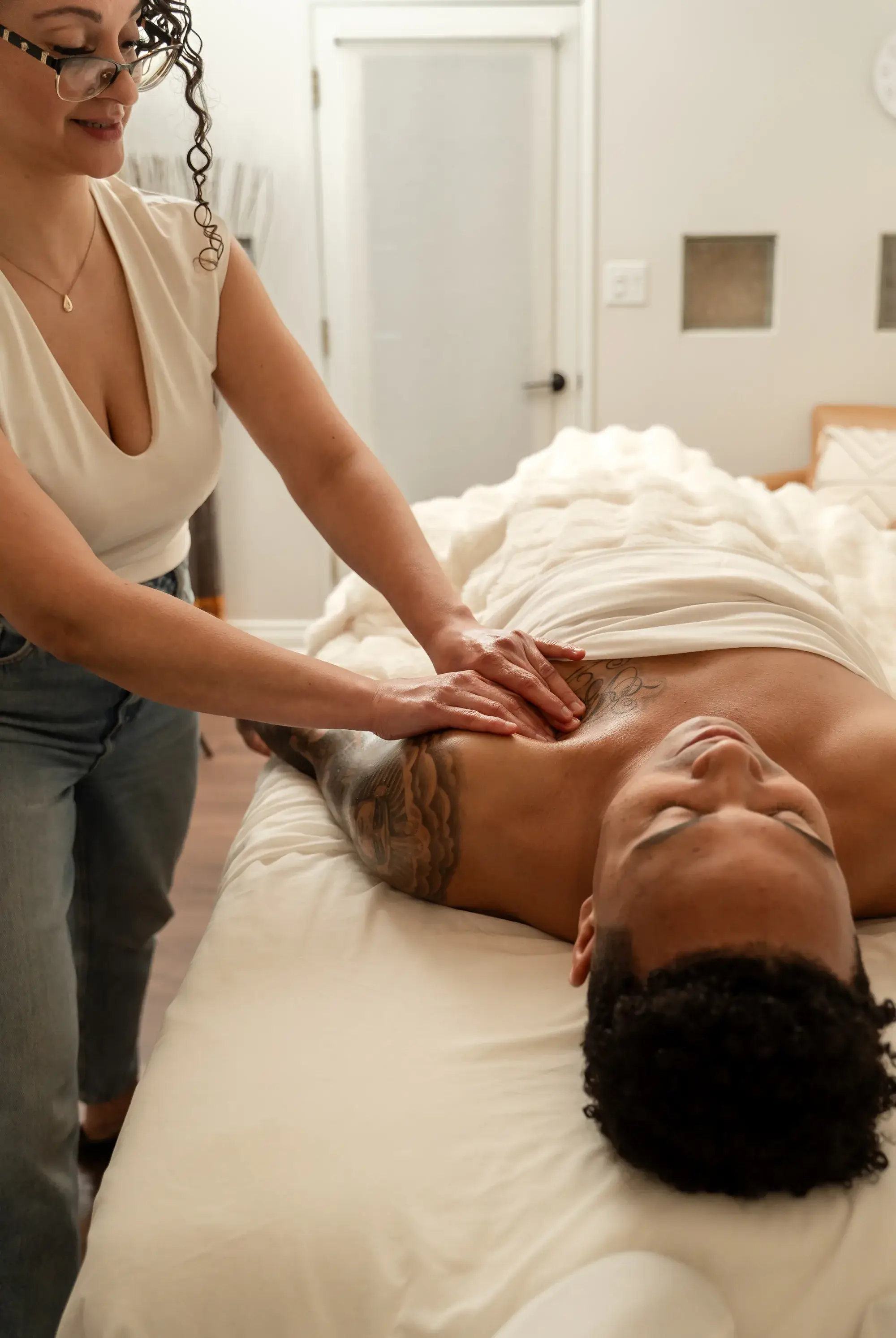
Fatigue changes how a massage should be delivered, not just whether. Here is how we approach it at Renu.
- Shorter. A 30- or 45-minute massage therapy session is often enough. Lying still for 90 minutes can leave an exhausted body feeling worse, not better.
- Lighter. The trial that helped used Swedish massage: long, rhythmic, moderate strokes, not deep tissue work. During or soon after chemotherapy we keep pressure lighter still, for reasons covered on our pressure and safety page.
- Positioned for comfort. Side-lying or semi-reclined if lying flat is uncomfortable, pillows wherever you need them, and the freedom to stop early.
- Timed to your cycle. If your worst days are the three after infusion, book for the week you feel most like yourself. Our massage during chemotherapy page covers timing in more detail.
- No heat. The NLN recommends that people at risk of lymphedema avoid saunas, and we do not combine our infrared cocoon with a massage for anyone who has had lymph nodes removed or irradiated.
Tell your therapist how you are sleeping, what medications you take and whether your blood counts are low this week. All of it shapes the session.
What has stronger evidence than massage
We would be doing you a disservice to let you leave thinking a massage is the main tool. The NCI summary is clear that the best-supported approaches are behavioural.
- Exercise. A Cochrane review of 56 studies with 4,068 participants found aerobic exercise significantly reduced fatigue during and after cancer treatment. A 2018 meta-analysis of 245 studies found combined aerobic and resistance exercise had the largest effect. The NCI suggests building toward three to five hours of moderate activity a week, starting lighter and shorter, and confirms this can be done safely during active treatment. The American Cancer Society adds that too much time resting “can lead to fatigue, loss of body function, and muscle weakness.”
- Sleep. Disrupted sleep, poor sleep habits and daytime inactivity all feed fatigue. In one trial, cognitive behavioural therapy for insomnia reduced daytime fatigue in survivors with chronic insomnia; a stimulant drug did not. The ACS suggests aiming for seven to eight hours with consistent bed and wake times.
- Treating what can be treated. The NCI lists anemia, hypothyroidism, infection, electrolyte imbalance, pain, depression and sedating medications as contributors that can be identified and corrected. None of those are things a massage addresses, which is why the next section matters.
When fatigue needs your oncology team, not a massage
Fatigue is expected. Some patterns of fatigue are not, and they belong at the cancer centre rather than on our table. The American Cancer Society asks you to contact your care team if you are too tired to get out of bed for a 24-hour period, or if you have trouble catching your breath when you are active, and to seek emergency care if you feel confused, dizzy, lose your balance or fall. We would add, from the NCI’s list of causes, that fatigue arriving suddenly or alongside fever, a racing heart, chest pain or unusual bleeding should be assessed the same day, because anemia, infection and heart or lung problems can present as tiredness.
If you are unsure whether to book or to call your team, call your team first. We are glad to see you afterwards, and our when to seek medical care guide lists the signs we always send people back for.
Who you will see
Every therapist on our team is a Registered Massage Therapist, and we ask you at intake about your diagnosis, treatments, current blood counts and the areas of your body your oncology team has asked us to avoid. If you would like a particular therapist or a particular time of day when your energy is best, say so when you book.
Questions people ask
How is cancer-related fatigue different from being tired?
The National Cancer Institute describes healthy fatigue as something sleep and rest fix, and cancer-related fatigue as a chronic state that persists, interferes with daily life and is not fully relieved by sleep. It is also out of proportion to what you have actually done. If a full night in bed leaves you as drained as before, that is the pattern your team should hear about.
How many massage sessions did the research use?
The 2018 trial that showed a benefit used one 45-minute Swedish massage a week for six weeks, delivered to breast cancer survivors who had finished surgery and radiation or chemotherapy. It was a small early-phase study with 66 participants, so it tells you what was tested rather than what you need. One or two sessions is a reasonable way to find out whether it helps you.
Is an infrared sauna a good idea for cancer fatigue?
Not if you have had lymph nodes removed or irradiated. The National Lymphedema Network recommends that people at risk of lymphedema avoid saunas, because heat can transiently increase limb fluid. If you are not at lymphedema risk, ask your oncology team before using any heat therapy during or soon after chemotherapy.
What kind of exercise helps fatigue most?
The NCI summary reports a Cochrane review of 56 studies in which aerobic exercise significantly reduced fatigue during or after treatment, and a large 2018 meta-analysis in which combining aerobic and resistance exercise had the largest effect. The suggested target is three to five hours of moderate activity a week, built up gradually from lighter, shorter sessions. Ask your team for a referral if you want supervision.
Sources
- National Cancer Institute PDQ: Fatigue (health professional version)
- Kinkead et al., Cancer 2018: Massage therapy decreases cancer-related fatigue, results from a randomized early phase trial
- Shin et al., Cochrane Database of Systematic Reviews 2016: Massage with or without aromatherapy for symptom relief in people with cancer
- Society for Oncology Massage: Benefits of oncology massage
- American Cancer Society: What is cancer-related fatigue?
- National Lymphedema Network: Evidence-based practices for lymphedema risk reduction, March 2026
Page reviewed October 4, 2026. This page is education, not a diagnosis. For your own situation, talk to your doctor, surgeon or care team, or ask us.
Keep reading
Related pages