
How does lymph move if there is no pump?
Lymph has no heart behind it. It moves on muscle contraction, breathing, arterial pulsing and vessel squeeze, with valves to stop backflow.
By The Renu lymphatic and massage team · 7 min read
Lymph has no heart behind it. It is pushed along by the muscles you move, the breath you take, the pulse of nearby arteries and a slow rhythmic squeeze built into the lymph vessels themselves, with one-way valves keeping each step from sliding back. That is why hours of sitting still leave your ankles puffy and a walk clears them.
Lymph has no heart behind it. It is pushed along by the muscles you move, the breath you take, the pulse of nearby arteries and a slow rhythmic squeeze built into the lymph vessels themselves, with one-way valves keeping each step from sliding back. That is why hours of sitting still leave your ankles puffy and a walk clears them.
People are often surprised by this. Blood has a four-chambered engine driving it around the body many times an hour. Lymph, which has to make a one-way trip from the tissues back to the veins, is left to borrow its energy from everything happening around it. Once you see how that borrowing works, a lot of everyday swelling starts to make sense.
The job: about three litres a day
Every day, roughly 20 litres of plasma leak out through the thin walls of the blood capillaries into the spaces between your cells. About 17 litres are pulled straight back into the capillaries. The remaining 3 litres are left in the tissues, and that is the lymphatic system’s daily workload. It collects this fluid, along with the proteins, fats, cell debris and any germs riding in it, filters it through hundreds of lymph nodes, and returns it to the bloodstream near the base of the neck.
The largest trunk, the thoracic duct, carries up to three-quarters of the body’s lymph into the left subclavian vein. A smaller right lymphatic duct handles most of the right upper quarter of the body. Everything below the waist, and the whole of the left side, funnels up through the chest to get home.
Four forces that stand in for a heart
Physiologists divide lymph propulsion into two families: extrinsic forces, which come from outside the vessel, and an intrinsic pump built into the vessel wall. In daily life you feel them as four things.
Muscle contraction
Collecting lymph vessels run between and around skeletal muscles. Every time a calf, thigh or forearm muscle contracts, it squeezes the vessels beside it. In studies on the hind limb of sheep, these outside forces raised lymph flow about fourfold compared with the vessels contracting alone. In the rat diaphragm, muscle contraction increased flow up to tenfold. Joint movement and simple changes of posture add to the same effect.
Breathing
The diaphragm and the chest wall are extrinsic pumps too. Each inhalation changes the pressure around the lymph vessels of the diaphragm and the thoracic duct, which encourages lymph to move through them in steps. Researchers who study the diaphragm describe breathing movements as the main force driving lymph in parts of that muscle. This is the physiological reason a lymphatic drainage session usually opens with slow diaphragmatic breathing, and why we send people home with it.
Arterial pulsing
Many lymph vessels travel alongside arteries. The pulse that passes down the artery with every heartbeat nudges the lymph vessel next to it. The Cleveland Clinic lists this “pulsing of nearby arteries” together with the “squeezing of nearby muscles” as the two everyday forces that move lymph.
The vessels’ own rhythm
The larger collecting vessels are lined with muscle cells and contract on their own, slowly and rhythmically. Each segment between two valves, called a lymphangion, contracts at about 6 to 10 beats a minute, and the pressure change triggers the next segment along the chain. This intrinsic pump matters most in soft tissues that do not move much, such as the gut, where there is little outside squeezing to rely on. It also adapts quickly: laboratory work shows the rhythm changes with pressure, with the flow passing through, and with local temperature.
Why the valves matter
None of these pushes would get fluid anywhere without the valves. Lymph enters blind-ended capillaries through overlapping cell flaps that act as primary one-way doors, then moves through collecting vessels fitted with internal valves every few millimetres. A squeeze from any direction raises the pressure in one segment, the valve ahead opens, the valve behind stays shut, and the fluid moves one step toward the neck.
In animal studies the valves open on a pressure difference of only about 1 to 1.5 centimetres of water, yet they hold against roughly 27 centimetres of water when flow tries to run backward. That asymmetry is the whole design: tiny forward pushes add up, while gravity cannot undo them.
What switches the pump off
The system is quietly dependent on movement, so anything that removes movement removes the pump.
- Sitting still. The NHS lists “standing or sitting in the same position for too long” as a common cause of swollen ankles, feet and legs, and its first piece of advice is not to stand or sit for long periods.
- Standing still. Standing uses the calf muscles very little. Gravity pulls fluid into the lowest tissues and nothing squeezes it back up.
- Shallow breathing. A tense upper chest does little for the thoracic duct. Slow breathing that moves the belly does more.
- Reduced mobility of any kind. After injury, surgery or illness, the extrinsic pump is simply absent, and swelling that is otherwise harmless can build.
A long drive or flight combines two of these, which is why shoes feel tight when you stand up at the end. Our pages on sitting or standing all day and swelling that builds toward evening walk through what that pattern means.
What switches it on
The reverse is equally plain, and the NHS self-help list reads like a description of the pump: get some gentle exercise such as walking, raise your legs when you can, and avoid clothes, socks or shoes that are tight enough to press on the vessels. The Lymphoedema Support Network puts it simply: muscle activity helps promote lymphatic drainage. A few habits that use each force:
| Force | A habit that uses it |
|---|---|
| Muscle contraction | A ten-minute walk; calf raises at a standing desk; ankle circles in a chair |
| Breathing | Five slow belly breaths before getting out of bed and again mid-afternoon |
| Gravity (removing it) | Legs on a cushion in the evening, higher than the hip if you can |
| The vessels’ own rhythm | Keeping warm enough that circulation is comfortable, and keeping tight waistbands and sock tops off the vessels |
Our at-home lymphatic health guide and the five ways to decrease leg swelling article from Meeghan Mackenzie go further.
Why manual lymphatic drainage looks the way it does
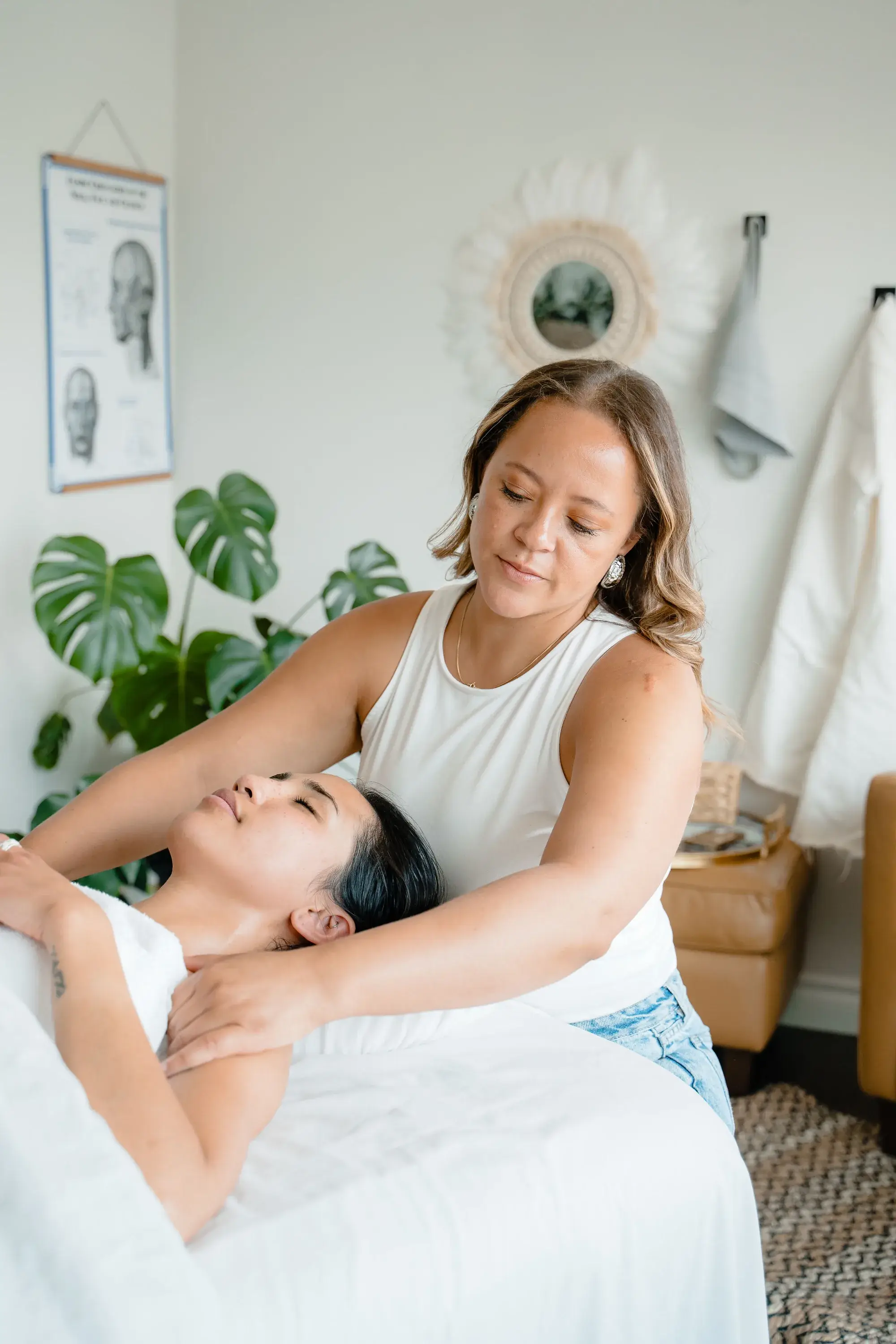
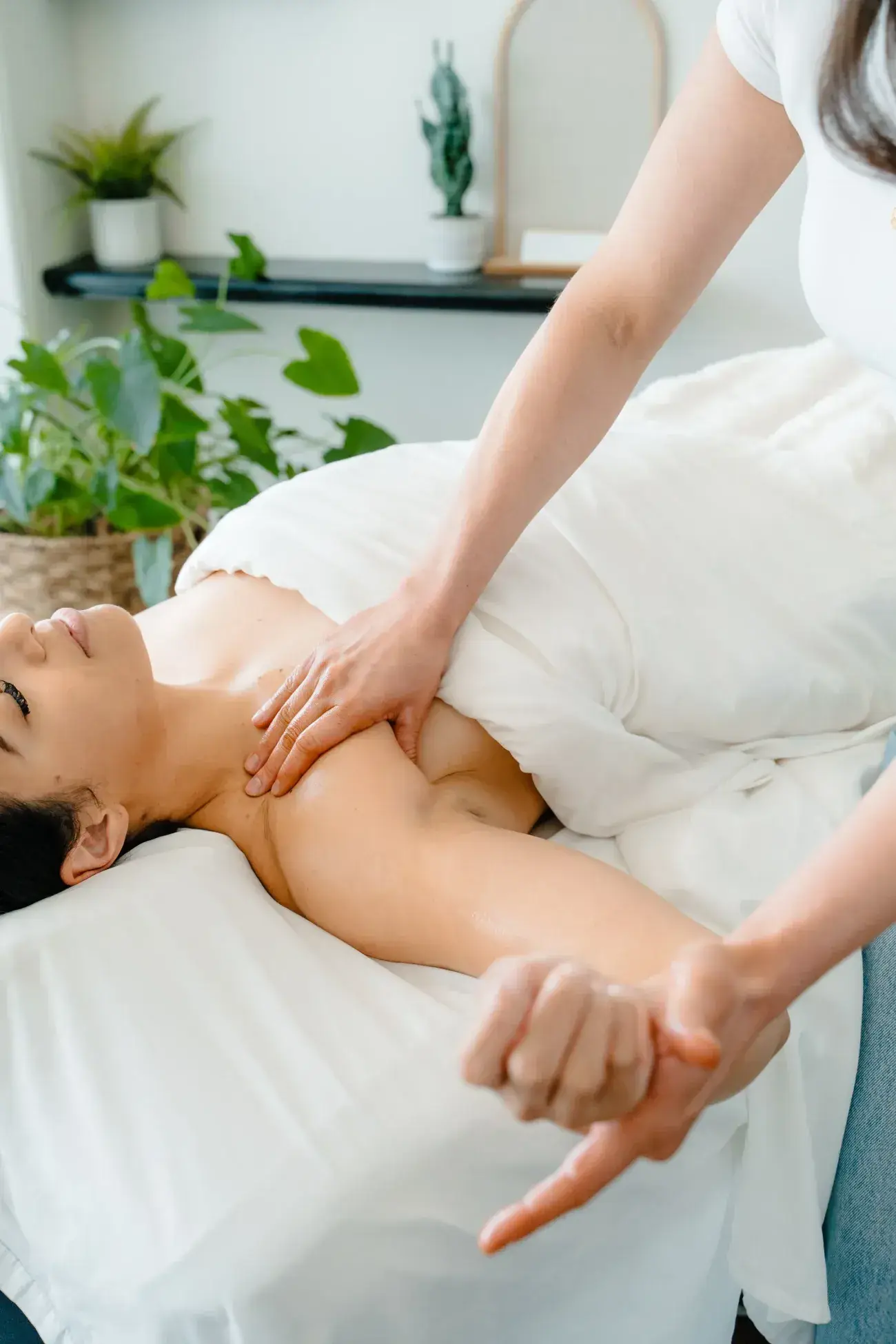
Once you know that lymph moves in slow, valve-by-valve steps driven by stretch and release, the strokes of manual lymphatic drainage stop looking strange. The Lymphoedema Support Network describes MLD as “light, rhythmical pumping hand movements to stretch the skin and to encourage lymphatic drainage.” Cedars-Sinai describes the same work as gently coaxing lymph from the tissues toward areas with working lymph vessels, using light pressure and a set sequence that begins at the body’s main drains in the neck, armpits and groin.
The therapist is supplying an extrinsic force the body is short of, at the pace the vessels actually run, in the direction the valves allow. Pressure deep enough to feel like a conventional massage would compress the superficial vessels rather than fill and empty them, which is why the touch is so light. There is a whole page on why the pressure is so light.
One honest caveat from the same Cedars-Sinai guide: if your lymphatic system is healthy, the benefit of a session is mainly relaxation. The strokes do the most for people whose own pumps are compromised by surgery, illness or injury.
When swelling needs a doctor rather than a walk
Everyday pooling clears overnight and with movement. The NHS asks you to see a GP if swelling in both legs has not improved after a few days of home care, and to seek urgent help if swelling is in one limb without an obvious cause, is red or hot, comes with a fever, or follows an injury. Call emergency services for swelling with breathlessness, chest tightness or coughing up blood, which can be signs of a blood clot. Our page on one leg being more swollen than the other explains why a single swollen leg is treated differently.
The lymphatic system has no heart, but it has you. Moving, breathing and lifting your legs are not alternatives to the pump. They are the pump.
Questions people ask
How much lymph does the body move in a day?
Roughly 20 litres of plasma leave the blood capillaries each day and about 17 litres are drawn straight back in. The remaining 3 litres sit in the tissues and have to be collected by the lymphatic vessels and returned to the bloodstream. That is the daily workload the system handles without a heart of its own.
Do lymph vessels contract on their own?
Yes. The larger collecting vessels have muscle cells in their walls and contract in a slow, pacemaker-like rhythm of roughly 6 to 10 beats a minute, section by section. Laboratory studies show this rhythm speeds up or slows down in response to pressure, flow and temperature, so the vessels are never completely passive.
Does breathing really move lymph?
It does. The thoracic duct, the main lymph trunk, runs through the chest, and each breath changes the pressure around it. Studies on diaphragm lymphatics show that breathing movements are one of the main forces driving lymph in that region. Slow diaphragmatic breathing is one reason a lymphatic session begins with a few deep breaths.
Why does walking reduce swollen ankles?
Calf and thigh muscles squeeze the lymph vessels running between them, and the valves turn each squeeze into a step forward. In animal studies, outside forces from surrounding tissue raised lymph flow about fourfold compared with the vessels working alone. Sitting or standing still takes that pump away, so fluid pools where gravity leaves it.
Sources
- Cleveland Clinic: Lymphatic system
- Biology (Basel), 2020: Lymphatic vessels and their surroundings, how local physical factors affect lymph flow (Solari, Marcozzi, Negrini, Moriondo)
- Cureus, 2021: The lymphatic system, an osteopathic review
- Better Health Channel (Victoria): Lymphatic system
- Cedars-Sinai: Lymphatic drainage massage FAQs
- NHS: Swollen ankles, feet and legs (oedema)
- Lymphoedema Support Network: Your questions answered
Page reviewed October 4, 2026. This page is education, not a diagnosis. For your own situation, talk to your doctor, surgeon or care team, or ask us.
Keep reading
Related pages