
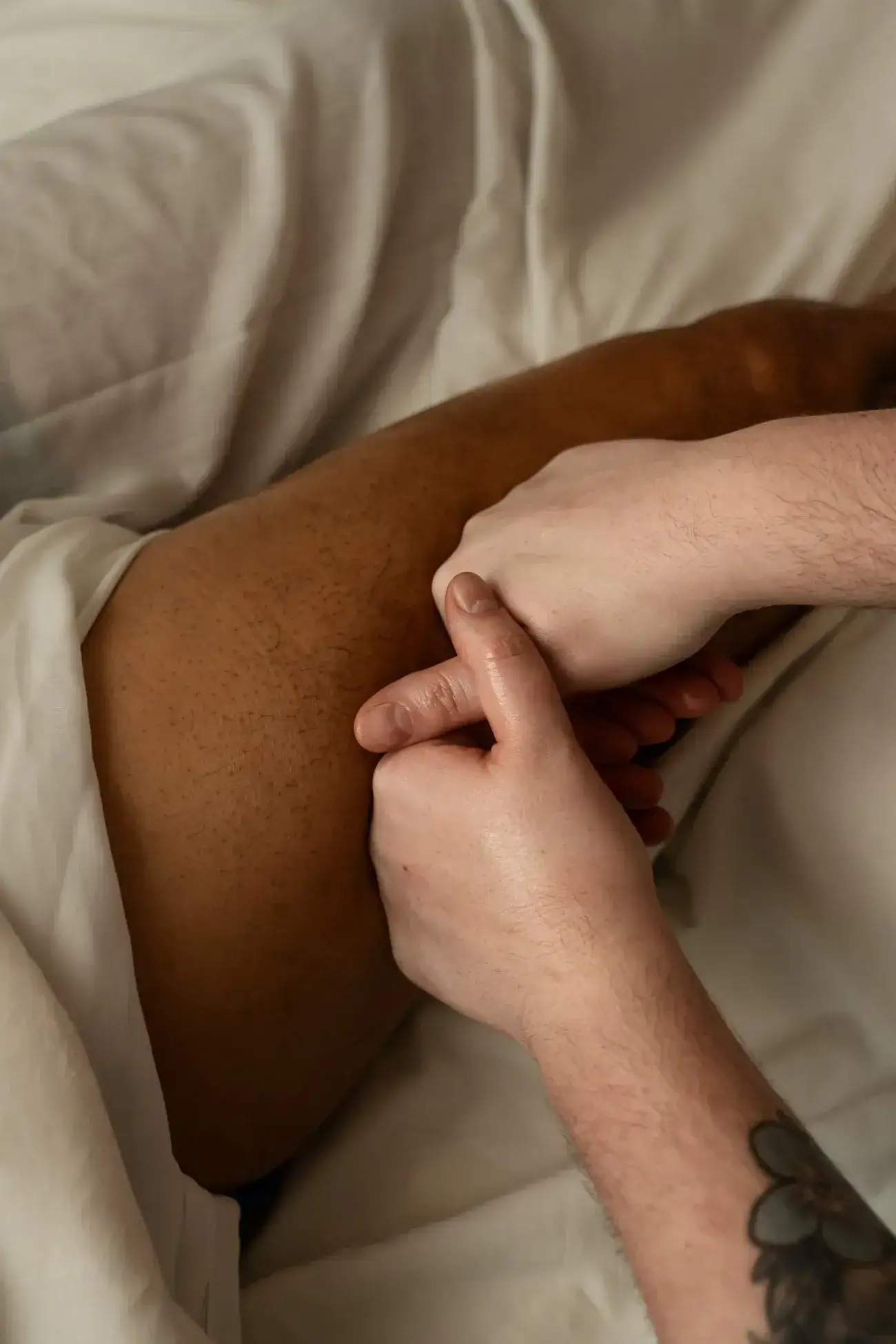
Can I get a massage with a pulled muscle?
Not on the injury in the first few days. A pulled muscle is a tear; early on the job is rest, ice and gentle movement. Massage starts around it, then on it.
By The Renu lymphatic and massage team · 5 min read
Usually yes, but not on the injury itself in the first few days. A pulled muscle is a tear in the muscle fibres, and Cleveland Clinic's advice for the early period is rest, ice, compression and elevation, with gentle movement reintroduced after that. A Registered Massage Therapist can work around a fresh strain to ease the muscles that are compensating, then work more directly as the tissue settles. Anything that might be more than a strain, such as a pop you felt, a visible gap or a limb you cannot use, needs a doctor before a massage.
A pulled muscle has a way of arriving mid-stride or mid-lift: a sudden grab in the hamstring, calf or low back, then a few days of moving carefully. Massage is often the first thing people think of. It can help, but the timing and the target matter more here than for almost any other reason someone books with us.
What a pulled muscle is
Cleveland Clinic defines a muscle strain as a tear in the muscle fibres, one of the most common soft tissue injuries, which happens when fibres are pulled beyond their limit. It grades strains in three steps:
| Grade | What has happened | Typical healing |
|---|---|---|
| I, mild | The muscle is stretched and pulled enough to cause minor damage, but not torn through | A few weeks |
| II, moderate | Torn through some or even most of the muscle, affecting strength and range of motion | Several weeks to months |
| III, severe | Torn all the way through | May need surgery; four to six months afterwards |
The usual sites are the abdominal, back, groin, hip flexor, calf and hamstring muscles. Symptoms include pain, spasm, bruising, swelling, weakness, a limited range of motion, hearing or feeling a pop, and in bad cases a visible gap or change in the shape of the muscle.
Most of what we see is grade I: a sore, guarded muscle that hurts to stretch or load. That is the strain this page is about. Grade II and III injuries belong with a physician first.
The first few days: around, not on
Cleveland Clinic’s early plan is rest, ice, compression and elevation to relieve pain and inflammation during the first few days, with gradual movement resumed after that and physical therapy to reintroduce gentle movement under guidance.
The Integrative Healthcare guide to massage for injuries gives the two rules we work by. Massage is contraindicated for fractures, and a suspected fracture needs imaging before anyone treats it. And massage should not be done on tissue that is acutely inflamed, because the inflammatory response is too high and treatment then “may cause more pain than it resolves”.
A fresh strain is acute inflammation by definition. So in the first days, a session does not touch the tear. What it can do:
- Ease the muscles that are working overtime to protect the injured one (the other hamstring, the hip, the low back after a calf strain)
- Settle the general tension that comes from moving stiffly for days
- Check how the area is behaving, so we can advise on when direct work makes sense
If you are in the first day or two with swelling and bruising still developing, it is reasonable to wait. Rest and ice will do more than we can, and nothing is lost by booking for the following week.
Later: working the strain itself
Once the sharp pain has eased, the swelling has stopped growing and the muscle tolerates a gentle stretch, direct work becomes useful. The Integrative Healthcare guide describes the toolkit for soft tissue injuries around the shoulder, and the same ideas transfer to a hamstring or back strain: lengthening the muscle and tendon, releasing the tension that is pulling on the healing tissue, range-of-motion stretches, and specific friction techniques on tendons once they can tolerate it, with ice afterwards.
Pressure stays well inside what you can relax under. NCCIH’s safety summary notes that the rare serious harms from massage are more likely with vigorous techniques such as deep tissue work, and a healing muscle is the last place to be vigorous. A good session on a recovering strain feels like the muscle being coaxed into trusting movement again, not like being worked over. Our page on whether deep tissue massage can make pain worse explains how to tell a normal day-after ache from a setback.
For a strain that has healed on paper but still feels guarded, RAPID NeuroFascial Reset takes a different route: precise pressure with small guided movements, aimed at the protective holding the nervous system keeps up after an injury. Monica delivers it for upper body concerns; for a leg or back strain, our massage therapy team is the place to start.
What to tell us at booking
Three things change how we plan the session: when it happened, what you felt at the time (a pop, a sudden give), and what you can and cannot do now (walk normally, bear weight, bend). Mention bruising, swelling and any numbness. If you have seen a doctor or physiotherapist, bring what they said; we will fit the session around their plan rather than duplicating or contradicting it.
Runner’s World’s reminder is worth repeating: a massage therapist is not your GP, and therapists do not diagnose. If the injury has not been looked at and you are unsure how serious it is, a doctor first is the safer order.
When to see a doctor before booking
Cleveland Clinic’s list of reasons to see a provider for a strain is the one we use, and we will ask you to follow it if any apply:
- You heard or felt a pop when it happened
- You cannot move or use the limb or area at all
- Symptoms are not improving after a few days
- New nerve symptoms appear: numbness, tingling or weakness
- The muscle looks different, with a visible dent or gap, or the swelling and bruising are severe
The Integrative Healthcare guide adds that any suspected fracture needs imaging before treatment, and NCCIH’s standing advice is not to use massage to put off seeing a health care provider about a medical problem. None of this means a massage is off the table. It means that for a grade I strain, a gentle session that starts around the injury and works toward it as healing allows is a sensible part of recovery, and for anything worse, a diagnosis comes first and the massage follows it.
Questions people ask
How long should I wait after pulling a muscle before a massage?
Cleveland Clinic describes the first few days as the rest, ice, compression and elevation period, with gentle movement after that, and we treat those first few days as hands-off for the injured spot. Work around it can start sooner; work on it waits until the sharp pain, swelling and bruising are settling. There is no fixed number of days that fits every strain.
Can massage make a pulled muscle worse?
Pressing into a fresh tear can. The Integrative Healthcare guide's rule for acute inflammation is that massage then can cause more pain than it resolves, and NCCIH notes that vigorous techniques carry the higher risk of harm. That is why early sessions stay off the injury and keep the pressure light.
Should I use heat or ice on a pulled muscle?
Ice in the first few days, as part of rest, ice, compression and elevation, which Cleveland Clinic lists for relieving pain and inflammation early on. Heat is a later tool, once the acute phase has passed and the aim is comfort and movement rather than calming inflammation.
Do I need a doctor's note to book a massage for a strain?
No referral is needed to book at Renu. If anything suggests a more serious injury, we may ask you to see a doctor first, because therapists do not diagnose and a suspected fracture or a complete tear needs imaging rather than massage.
Sources
Page reviewed October 4, 2026. This page is education, not a diagnosis. For your own situation, talk to your doctor, surgeon or care team, or ask us.
Keep reading
Related pages