
Massage while breastfeeding
Massage while breastfeeding suits the neck, shoulders, arms and back. Why a lactating breast is never massaged deeply, and the signs of mastitis.
By The Renu lymphatic and massage team · 7 min read
Massage while breastfeeding is a good idea for the parts of you that feeding loads: the neck, shoulders, upper back, forearms and wrists. The breast itself is different. The Academy of Breastfeeding Medicine's mastitis protocol says deep massage of a lactating breast increases inflammation, tissue oedema and microvascular injury, so we do not massage breasts, and we set you up side-lying or semi-reclined so full breasts are never pressed into the table. A hot, hard, painful area with fever or chills is mastitis, and the right call is your doctor, not a massage.
Feeding a baby means sitting many times a day holding a growing weight still, head bent, shoulders rounded, one wrist cocked. It is no surprise that the neck, upper back and arms complain, and those are exactly the places massage does well. The breast is the exception, and this page explains why we keep our hands off it, what actually helps a hard or hot breast, and when a sore breast is a doctor’s job.
Feeding is a repetitive strain, and the numbers say so
A 2026 cross-sectional study in BMC Women’s Health surveyed 471 breastfeeding mothers and found that 81.7 percent reported breastfeeding-related musculoskeletal pain. The back was the most common site (40.4 percent), then the upper limbs (36.8 percent) and the neck (22.8 percent). Feeds longer than 30 minutes and more frequent feeds were linked with more pain, the cradle hold used by 76.2 percent of mothers was flagged as a position that may promote strain, and mothers who received ergonomic support had 65 percent lower odds of pain than those who never did. The authors called for ergonomic education before and after birth and for physiotherapists, occupational therapists and lactation consultants to work together on it.
The NHS positioning advice points the same way: get comfortable before a feed, use pillows or cushions, keep your shoulders and arms relaxed, hold the baby close and facing the breast, and always bring the baby to the breast rather than leaning your breast forward into the baby’s mouth. Every one of those lines is also a way of sparing your neck.
Why no one should massage a lactating breast deeply
The Academy of Breastfeeding Medicine’s Clinical Protocol #36 on the mastitis spectrum, revised in 2022, is unusually blunt for a clinical document. Its recommendation reads: avoid deep massage of the lactating breast. Deep massage causes increased inflammation, tissue oedema and microvascular injury. It also says to avoid electric toothbrushes and other commercial vibrating or massaging devices. In the section on phlegmon, the protocol warns that excessive deep tissue massage in the setting of ductal narrowing and inflammatory mastitis may propagate phlegmon formation, because deep massage potentiates worsened oedema and microvascular injury.
The protocol cites a systematic review which concluded that although breast massage may reduce pain, it should not be recommended as standard of care, because it requires extensive training to master an atraumatic approach. The most successful technique, it says, approximates manual lymphatic drainage with light sweeping of the skin rather than deep tissue massage (level of evidence 1 to 2, strength of recommendation B).
The protocol also retires a familiar idea. Ducts in the breast are innumerable and interlacing, and it is not physiologically or anatomically possible for a single duct to become obstructed with a macroscopic milk plug. What people call a “plugged duct” is microscopic ductal inflammation and narrowing, and squeezing or aggressively massaging the breast to clear it is described as ineffective and a cause of tissue trauma.
Our position follows from this. Registered Massage Therapists at Renu do not perform breast massage, and we do not offer lymphatic sweeping of the breast as a service; if a lactation clinician has shown you a light sweeping technique, that is yours to do at home under their guidance. Our lymphatic drainage sessions work the neck, arms, trunk and legs and simply route around the chest.
What actually eases a hard, hot or lumpy breast
The ABM protocol describes engorgement as bilateral breast pain, firmness and swelling related to interstitial oedema and congestion, usually between days three and five after birth and occasionally as late as days nine or ten. Its spectrum-wide advice, in order:
- Feed the baby on demand, and do not “pump to empty”. Overfeeding from the affected breast or pumping to empty perpetuates a cycle of oversupply and is a major risk factor for worsening tissue oedema and inflammation. Hand express small volumes for comfort; if you pump, express only what the baby takes.
- Ice. Ice and anti-inflammatory medication reduce oedema and inflammation; ice can be applied every hour or more often if wanted. Heat widens the vessels and may worsen symptoms, though it comforts some people. Cabbage leaves have not been shown to be more effective than ice, which the protocol takes to mean the benefit is the cold, not the cabbage.
- A supportive, properly fitting bra. The protocol’s reasoning is one we would underline: lactating breasts are highly vascular and require support to avoid dependent lymphoedema as well as progressive back and neck pain.
- Lymphatic drainage, meaning light sweeping of the skin, to alleviate interstitial oedema, as a consideration rather than a prescription.
The NHS mastitis page adds the practical version: continue feeding when the baby wants and for as long as they want, check positioning and attachment, apply a cold compress for 10 minutes every hour, take paracetamol or ibuprofen, rest, wear a comfortable supportive bra, and do not apply firm pressure to the breast, express more than the baby needs, apply oils or creams, or stop breastfeeding suddenly.
How strong is the evidence for any of this? A 2020 Cochrane review of 21 trials with 2,170 women looked at cabbage leaves, herbal compresses, massage, acupuncture, ultrasound, scraping therapy, cold packs and several medicines, and rated the evidence for all of them low or very low certainty; the authors wrote that they could not draw robust conclusions about the true effects. That is why the ABM’s physiology-based advice (feed, ice, support, no deep pressure) carries the day.
What a session looks like while you are feeding
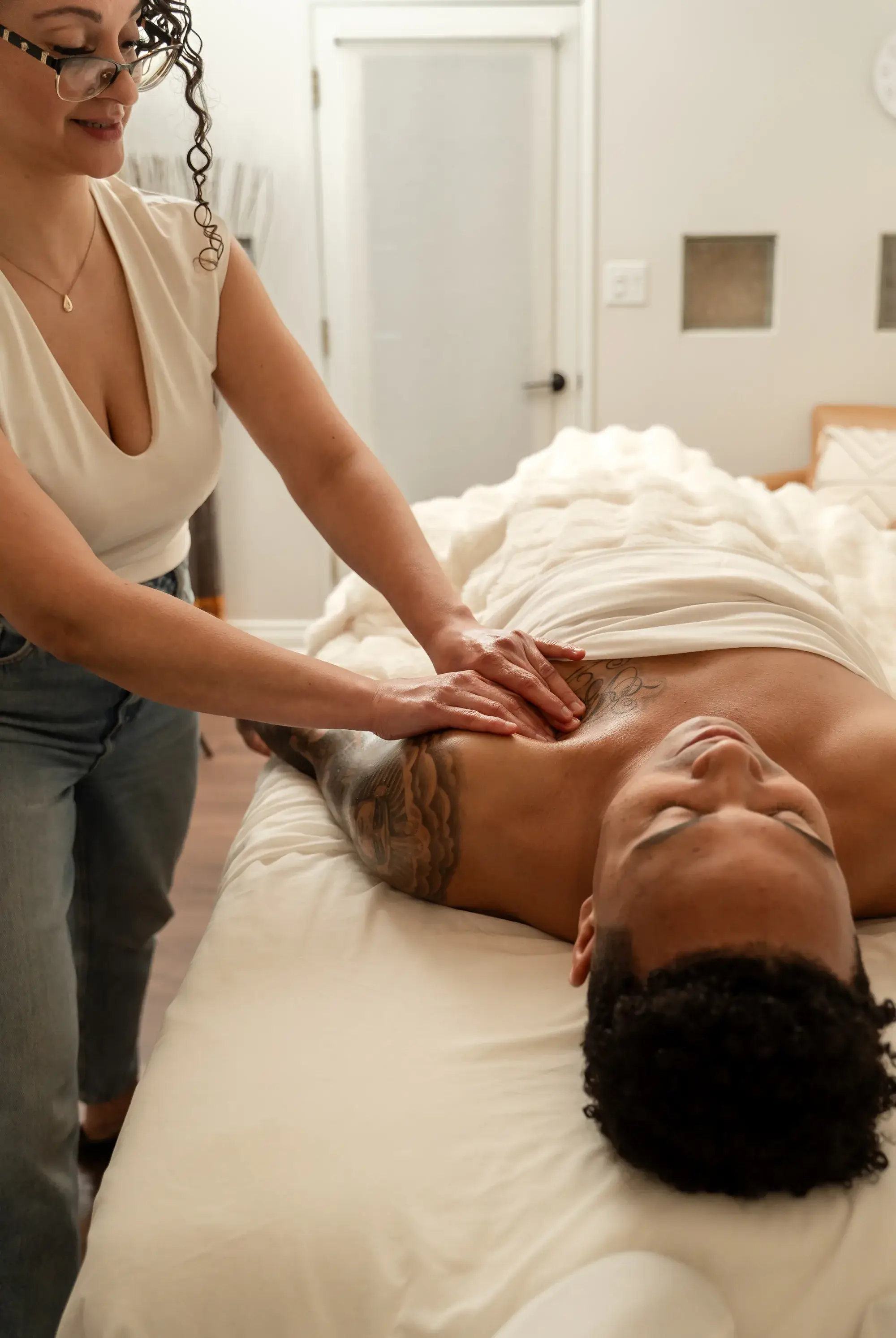
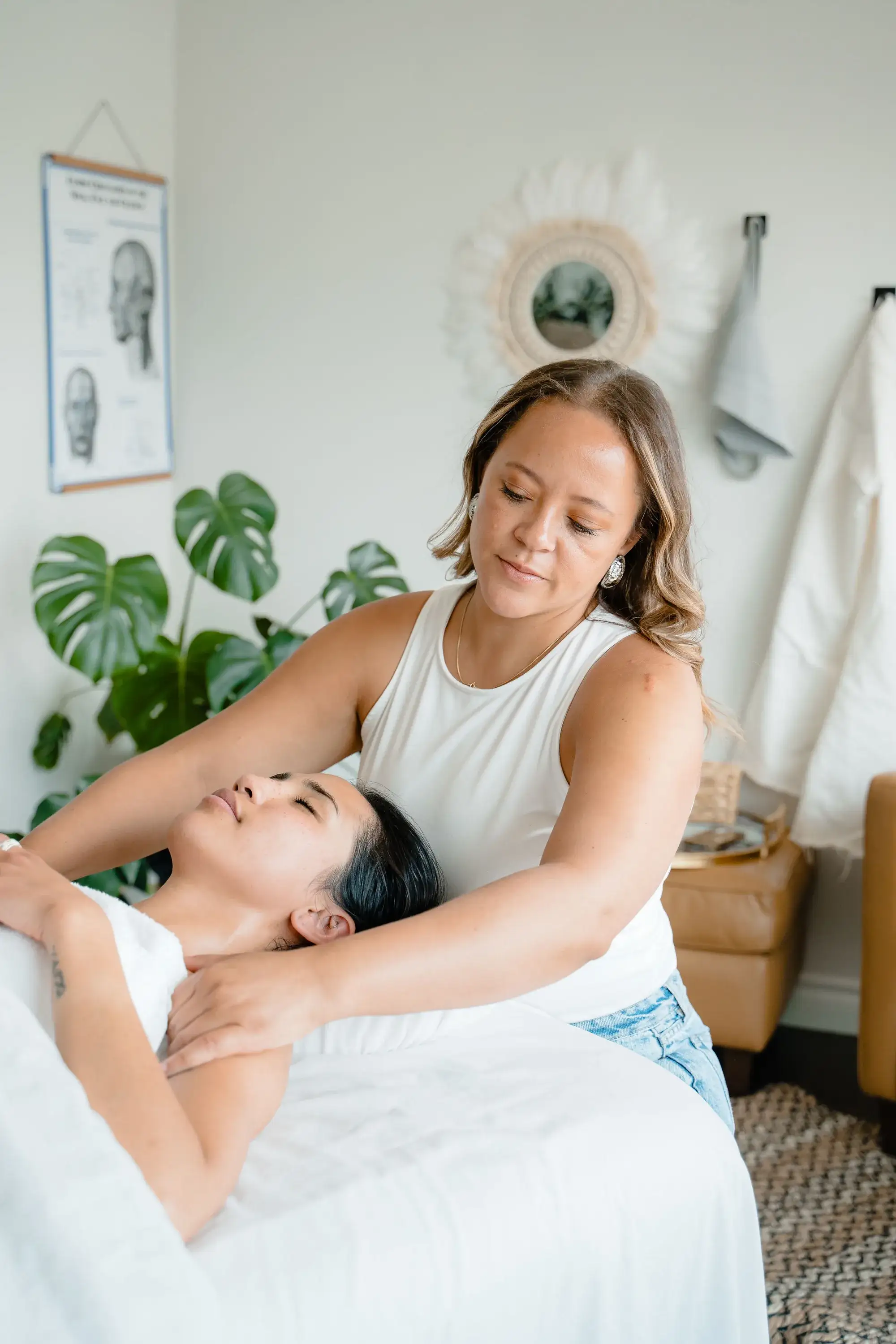
- You lie on your side or semi-reclined on your back, never face down with weight on the chest. In side-lying the top knee and arm are supported so the shoulder can drop.
- The work goes where feeding loads you: the neck and the base of the skull, the tops of the shoulders, the muscles between the shoulder blades, the forearms and thumbs. If the wrists and hands are the main complaint, carpal tunnel in pregnancy explains why they are often still sore after birth.
- Feed just before you come if you can, so the breasts are comfortable for the length of the session. We are open seven days, until 8:30 pm on weekdays, which makes it easier to fit a session between feeds.
- Leaking is normal and not a problem for us; wear nursing pads if it makes you more comfortable.
- A massage therapy session is 60 minutes for $120 or 90 minutes for $157. Sasha Bernard is trained in prenatal and postnatal massage, and massage after birth covers the wider questions of timing after a vaginal or caesarean birth.
Nothing here is a treatment for the breast. If what is bothering you is the breast itself, the next section is the one that matters.
Mastitis: when it is time for your doctor
The ABM protocol describes inflammatory mastitis as an increasingly red, swollen and painful region of the breast with systemic signs and symptoms such as fever, chills and a fast heart rate, and notes that about 3 to 11 percent of women with acute mastitis go on to develop an abscess. The NHS lists a swollen area that may feel hot and painful to touch, a wedge-shaped lump or hard area, burning pain that may be constant or only during feeds, nipple discharge that may be white or streaked with blood, and flu-like symptoms.
The NHS timeline is simple: see a GP if your symptoms do not get better 12 to 24 hours after treating it at home, and again if they do not improve 48 hours after starting antibiotics. Breastfeeding can continue; the ABM says bacterial mastitis is not contagious, does not pose a risk to the infant and does not require an interruption of feeding.
We will not work on anyone with a fever, and we will not work near a breast that is red, hard and painful. If that is you, call your doctor or a lactation clinician today, and come to us when you are well; the sore shoulders will keep.
Questions people ask
Can I have a massage when my breasts are engorged?
Yes, for the rest of you. Engorgement usually occurs between days three and five after birth, and we position you on your side or semi-reclined so nothing presses on the breasts. Feed or hand express for comfort before you come, and bring an ice pack if that is what you are using; we do not touch the breasts themselves.
Should I massage out a blocked duct?
Not with force. The Academy of Breastfeeding Medicine explains that a macroscopic milk plug blocking a single duct is not anatomically possible; what people feel is microscopic ductal inflammation and narrowing, and squeezing or deep massage makes the swelling and injury worse. The protocol's preferred approach is light skin sweeping in the manner of lymphatic drainage, with ice, which is work for a lactation clinician who has shown you how, not a massage table.
Is heat or ice better for a sore breast?
Ice. The ABM protocol says ice and anti-inflammatory medication reduce oedema and inflammation, with ice applied every hour or more often if wanted, and the NHS suggests a cold compress for 10 minutes every hour. Heat widens blood vessels and may worsen symptoms, though the protocol allows that it comforts some people. Cabbage leaves have not been shown to beat ice.
How do you position me so my breasts are not squashed?
Side-lying, with the top knee and arm supported, or semi-reclined on the back. Both give full access to the neck, shoulders, upper back, arms and hips without any weight on the chest. If leaking is a worry, wear a nursing pad; it is not a problem for us.
What feeding position is easiest on my neck and shoulders?
The NHS advice is to get comfortable before the feed with pillows or cushions, keep your shoulders and arms relaxed, and bring the baby to the breast rather than leaning your breast forward. In a 2026 survey of 471 breastfeeding mothers, those who received ergonomic support had 65 percent lower odds of feeding-related pain, so a cushion and a chair with arms are not fussing; they are prevention.
Sources
- Academy of Breastfeeding Medicine: Clinical Protocol #36, The Mastitis Spectrum, revised 2022 (Mitchell et al., Breastfeeding Medicine)
- Cochrane (Zakarija-Grkovic and Stewart 2020): Treatments for breast engorgement during lactation
- NHS: Mastitis
- AlMohri et al. 2026, BMC Women's Health: Breastfeeding-related musculoskeletal pain among lactating mothers in Arabic-speaking countries
- NHS: Breastfeeding, positioning and attachment
Page reviewed October 4, 2026. This page is education, not a diagnosis. For your own situation, talk to your doctor, surgeon or care team, or ask us.
Keep reading
Related pages