

Do lymph nodes grow back after they are removed?
A removed lymph node is not replaced. Vessels can open new routes and surgeons can transplant nodes, but the filter is gone. What it means for swelling risk.
By The Renu lymphatic and massage team · 7 min read
A lymph node that has been removed is not replaced. None of the clinical sources we rely on describes a removed node growing back; what they describe is the body's workaround. Lymph vessels that once drained into that node run into a dead end, and over time the system may open side branches, called collaterals, that carry fluid to other nodes. Surgeons can also move living nodes from elsewhere in the body into the gap. How well those workarounds cope decides whether swelling develops, and that varies a great deal from person to person.
What is left behind at the site
A lymph node is a filter on a pipe. Fluid from a region, the fingers and arm, say, is drawn up by lymph vessels and passed through a chain of nodes on its way to the chest, where it drains into a large vein near the heart. The American Cancer Society describes what happens when nodes are taken out: many of the lymph vessels now run into a dead end where the node used to be, and fluid can back up. The more lymph nodes removed, the more likely that is to occur.
That dead end is the honest answer to the question. The node is not rebuilt, and the vessels that fed it do not reconnect to a new filter in the same place. What the body has instead is a set of workarounds, some of its own and some surgical.
Surgeons try to limit the loss in the first place. Cancer Research UK explains sentinel lymph node biopsy: a dye finds the first node or nodes the cancer area drains to, and only those are removed and checked. If they are clear, the rest of the group can often be left alone, which lowers the risk of lymphoedema. The National Cancer Institute makes the same point: removing fewer nodes decreases the risk.
How the body works around a missing node
Lymph vessels are not a single pipe each. A 2025 review in Frontiers in Medicine notes that lymphatic side branches are present in both affected and unaffected limbs, and that establishing collateral circulation pathways is at the core of lymphedema treatment. When imaging such as lymphoscintigraphy is used, clinicians look specifically for collateral pathways, for fluid backing up into the skin (dermal backflow) and for delayed uptake in the nodes that remain.
So after a node is removed, fluid may find its way along those side branches to other nodes in the chain, and new lymphatic vessels can sprout from existing ones, a process called lymphangiogenesis. Whether that is enough depends on how much was removed, what else happened to the area, and on the tissue itself. The same review describes a self-perpetuating cycle in which stagnant lymph triggers inflammation, inflammation drives scarring, and the inflammatory signals suppress the growth of the new vessels that would relieve it. Radiotherapy makes this worse by causing fibrosis that blocks the remaining pathways.
Two things follow. First, the body’s adaptation is real, which is why many people who lose nodes never swell. Second, it is fragile, which is why the risk never quite goes away. Cancer Research UK adds that a skin infection such as cellulitis in a limb at risk can itself tip the balance.
Why swelling risk varies so much from person to person
Two people can have the same operation and very different outcomes. The sources agree on what shifts the odds:
- How many nodes were removed. The American Cancer Society, Macmillan and Cancer Research UK all draw the line between a sentinel biopsy of one or two nodes and removal of a group. The 2025 review states that higher nodal counts predict both higher incidence and greater severity.
- Radiotherapy to the area. The National Cancer Institute explains that radiation causes scar tissue that blocks the flow of lymph; the review says surgery plus radiotherapy raises risk synergistically.
- Infection and slow healing. The NCI lists having an infection and healing slowly after surgery among its risk factors; Cancer Research UK adds a seroma, a build-up of fluid near the wound.
- Body weight. The NCI, Cancer Research UK and the review all list being overweight or having obesity, with the review adding older age and recurrent cellulitis.
- Time. The NCI says lymphedema may arise soon after treatment or years after it has ended, and most often develops slowly over months or years. The review found risk peaked 12 to 30 months after surgery.
Our page on lymphedema starting years after surgery or injury explains why the delay happens.
What surgeons can do
When the body’s own rerouting is not enough, there are operations that build new routes. The National Cancer Institute describes two physiological procedures: lymphovenous bypass, which connects lymph vessels directly to a vein so fluid has a new path out, and vascularized lymph node transfer, which moves healthy nodes with their blood supply from elsewhere in the body into the affected region to improve flow.
A 2026 surgical review from Cedars-Sinai explains two theories of how transferred nodes help: they may stimulate new vessel growth in a node-depleted region through growth factors such as VEGF-C, and they may act as a low-pressure pump that pulls fluid into the transplanted tissue and on into the veins. It notes that regeneration is less effective in advanced disease where the vessels have stopped pumping. The 2025 review adds that transfer has been shown to reduce cellulitis episodes and limb volume, but that neither bypass nor transfer does much for the fat and hardened tissue of late-stage lymphedema.
The Cleveland Clinic’s framing is the one to keep: surgery is done at specialist centres, usually only when lymphedema is severe, it is not a complete answer, and not everyone can have it. These are repairs, not restorations.
The stages to watch for
Because a missing node cannot be replaced, the useful knowledge is what early trouble looks like. The National Cancer Institute’s staging:
| Stage | What you would notice |
|---|---|
| 0 | Lymph is not moving as it should; you may or may not have symptoms |
| I | The area is swollen and feels heavy; pressing leaves a dent; rest and elevation reduce it |
| II | More swollen and firmer than the surrounding area; pressing no longer leaves a dent; elevation no longer helps |
| III | Extremely swollen, with hard, thick skin and reduced movement |
The signs the NCI asks you to report are a heavy, full or tight feeling where you had surgery or radiation, swelling, numbness or tingling, and clothes or jewellery fitting more tightly. The Cleveland Clinic suggests asking your provider to measure the at-risk limb so that small changes are caught before you can see them. If your legs or arm feel heavy without looking swollen, read why legs feel heavy but not swollen.
Living well with fewer nodes
The NCI’s self-care list is designed for exactly this situation: protect the skin from cuts, burns and insect bites so bacteria have no way in; moisturise to prevent cracks; exercise, which it calls a natural pump for the lymph system; elevate the limb when you can; keep to a healthy weight; avoid tight bands and heavy bags on the affected arm; have blood pressure and blood draws done on the other arm; avoid extreme heat; stay hydrated; and go easy on salt.
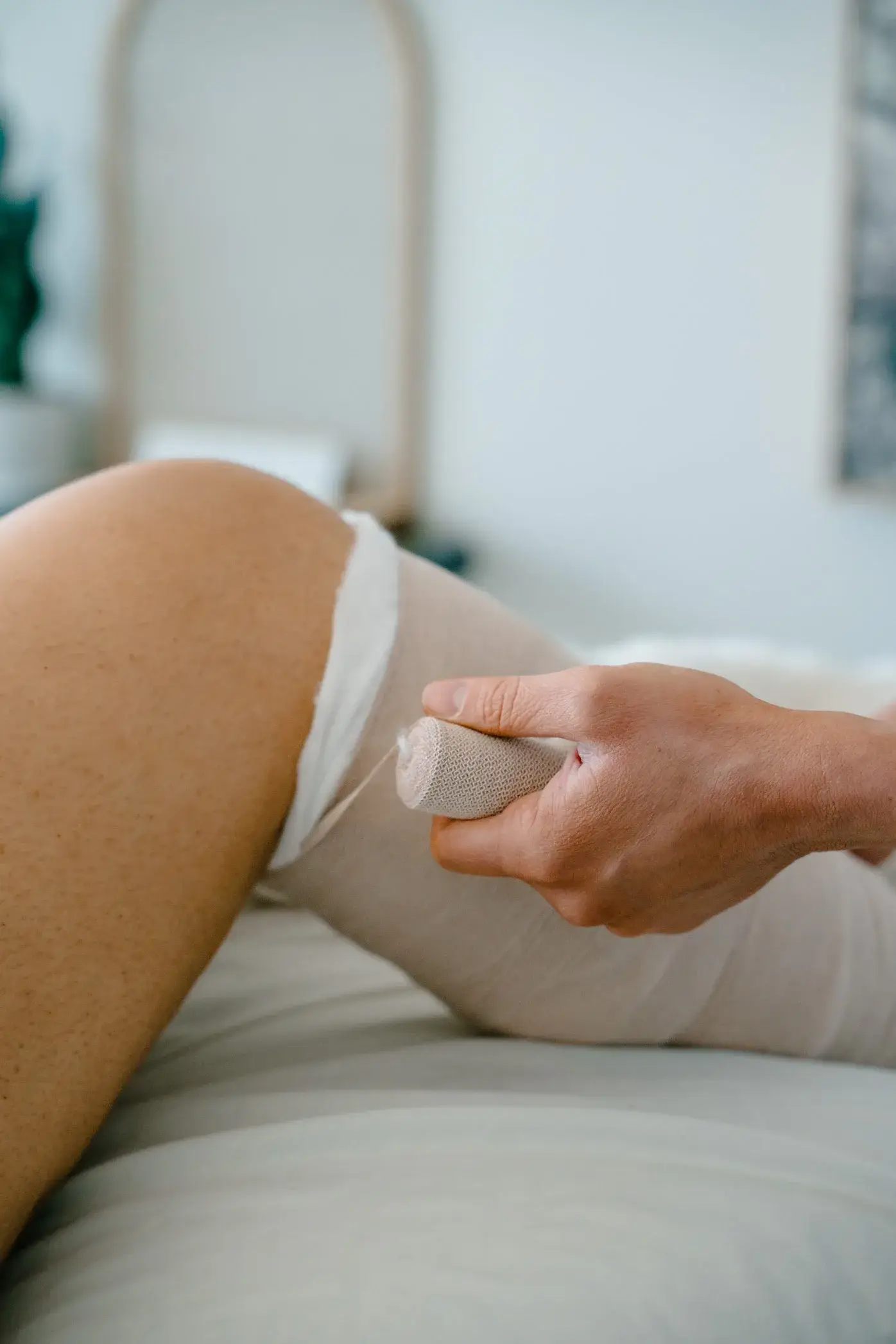
If swelling does develop, the treatment is the program Meeghan Mackenzie, our Certified Lymphedema Therapist, trained in: manual lymphatic drainage to redirect fluid toward the nodes that remain, compression to keep it from returning, exercise and skin care. The NCI describes that combination as complete decongestive therapy. Our complete decongestive therapy page explains how it is delivered here, and the Learning Centre’s lymphedema and lipedema and understanding the lymphatic system pages fill in the background.
When to call your doctor or surgeon
Call your surgical or oncology team if the limb on the operated side feels heavy, full or tight, if it looks larger than the other, or if rings, sleeves or shoes have become snug. The NCI says lymphedema is easier to control when treatment starts early. Call the same day if the skin becomes red, warm, painful or more swollen, or if you develop a fever: those are the signs of cellulitis, which the NCI describes as a potentially life-threatening infection that people with lymphedema are more prone to because stretched skin lets bacteria in. Macmillan reminds us that swelling, aching and redness in an arm or leg can also be a blood clot, which needs the same urgency. Our Learning Centre page on when to seek medical care lists every red flag in one place.
Questions people ask
I only had one sentinel node removed. Am I still at risk of lymphedema?
A smaller risk, not no risk. Cancer Research UK explains that removing the sentinel node or nodes can still damage the lymph system and cause lymphoedema, but the risk is lower than when most of the nodes in an area are removed. Macmillan puts the same point as one or two nodes versus a group. Watch the limb and report heaviness or tightness early.
Does losing lymph nodes weaken my immune system?
The American Cancer Society says removing lymph nodes during cancer surgery is highly unlikely to weaken a person's immune system, because the immune system is large and complex and is located throughout the body. The local effect is on drainage, not on your ability to fight infection in general, although a limb with lymphedema is more prone to skin infection.
Can lymph node transfer surgery replace what was removed?
It can move healthy nodes into the area, but surgery is not a return to how things were. The National Cancer Institute describes vascularized lymph node transfer as replacing damaged nodes with healthy ones from elsewhere to improve lymph flow, and the Cleveland Clinic notes that lymphedema surgery is done at specialist centres, usually for severe cases, is not a complete answer, and is not possible for everyone.
How long after surgery can swelling start?
The National Cancer Institute says lymphedema may arise soon after cancer treatment or develop years after it has ended, and most often develops slowly over months or years. A 2025 review found that risk peaked 12 to 30 months after surgery. Swelling in the first days after an operation is ordinary surgical swelling, which Macmillan says can take several weeks to clear and is not the same thing.
Can a lymphatic therapist tell whether my vessels have found new routes?
Not by hand. Collateral pathways are seen on imaging such as lymphoscintigraphy, indocyanine green lymphography or magnetic resonance lymphangiography, which are ordered by doctors. What a Certified Lymphedema Therapist can do is measure the limb, note changes in tissue and skin, and teach you what to watch for between appointments.
Sources
- American Cancer Society: Lymph nodes and cancer
- National Cancer Institute: Lymphedema and cancer
- Cleveland Clinic: Lymphedema
- Macmillan Cancer Support: Lymphoedema
- Cancer Research UK: About lymphoedema
- Wu et al., Front Med 2025: Advances in etiology, pathophysiology, diagnosis, and management of lymphedema, a comprehensive review
- Monzy et al., Cancers 2026: Delayed lymphatic reconstruction for breast cancer-related lymphedema
- Cleveland Clinic: Lymphatic system
Page reviewed October 4, 2026. This page is education, not a diagnosis. For your own situation, talk to your doctor, surgeon or care team, or ask us.
Keep reading
Related pages