
Can you massage swollen lymph nodes?
No. A tender, swollen node is doing its job against an infection, and rubbing it will not shrink it. The signs that mean a doctor should see it first.
By The Renu lymphatic and massage team · 6 min read
No, and there is no need to. A lymph node swells because immune cells are gathering inside it to fight an infection nearby, and the Cleveland Clinic describes that swelling as a normal immune response that settles as you recover, usually within one to two weeks according to the NHS. Rubbing a tender node will not shrink it and lymphatic drainage is postponed during any active infection. A node that is hard, fixed, larger than two centimetres, in more than one region, or comes with night sweats or weight loss needs a doctor before anyone touches it.
Why a node swells in the first place
Lymph nodes are small filters, usually oval and about one to two centimetres across, strung along the lymph vessels in clusters at the neck, armpits, chest, abdomen and groin. Lymph passes through them on its way back to the bloodstream, and the nodes clear out germs, damaged cells and cancer cells while storing the white blood cells that attack them. The American Cancer Society counts them in the hundreds, some just under the skin and some deep inside the body.
When an infection starts nearby, the Cleveland Clinic explains, immune cells meet up in the node before being sent where they are needed. They pile in, the pressure rises, and the node swells. That is why the glands on either side of the neck come up with a sore throat or a cold: upper respiratory infections are the leading cause of swollen nodes. The swelling is, in the Cleveland Clinic’s words, a normal immune response and actually a good thing. You do not want to prevent it.
So the lump you can feel is not trapped fluid. It is a working organ, temporarily crowded.
Why rubbing it does nothing useful
Because the node is swollen with cells rather than with fluid, there is nothing for a massage stroke to move. Pressing on an inflamed node hurts, and the pain is the body’s own signal to leave it alone.
The Cleveland Clinic’s advice for the discomfort is warmth, from a heating pad or a microwavable rice sock, and over-the-counter pain relief such as acetaminophen or an anti-inflammatory like ibuprofen. The NHS adds rest and plenty of fluids, and expects glands swollen by an infection to go down on their own within one to two weeks. Neither source suggests massaging the node, and both describe treatment of the underlying cause, not the lump, as what brings it down.
There is also a reason not to book a lymphatic session while a node is tender from infection. The Cleveland Clinic lists infection and fever among the conditions in which you should avoid lymphatic drainage massage. The technique increases the movement of lymph through the vessels and nodes, and nobody wants to speed up traffic leaving an area where bacteria are being contained. Our page on lymphatic drainage when you have a cold covers the day-of decision.
The signs that mean a doctor should see it first
Most swollen nodes are a minor infection and settle. A smaller number are not, and the features below are the ones clinicians use to tell the difference. The Cleveland Clinic asks you to talk to a healthcare provider about swollen lymph nodes that are:
- Larger than 2 centimetres (0.8 inches) across
- Hard, rubbery, or fixed, meaning they do not move back and forth when you press on them
- In more than one place on the body, especially regions that are not next to each other, such as the neck and the groin
- Present without a cause you can find, such as a current or recent infection
- Very painful or growing rapidly
- Draining pus or other substances
- Accompanied by weight loss, night sweats, long-lasting fever, difficulty breathing or fatigue
- Causing red or inflamed skin over the node
The NHS list overlaps and adds two of its own: a gland that has not gone down within a week or is getting bigger, and a swollen gland just above or below the collarbone. It asks for an urgent appointment if swollen glands make it very difficult to swallow or breathe.
| Likely a node fighting an infection | Have a doctor feel it first |
|---|---|
| Soft, tender, moves under the finger | Hard, rubbery or fixed |
| Came up with a cold, sore throat, ear or skin infection | No infection you can point to |
| One area, near the infection | Two or more regions not next to each other |
| Settling within one to two weeks | Still there or growing after two weeks |
| No other symptoms once the infection passes | Night sweats, weight loss, persistent fever |
| Smaller than about 2 centimetres | Larger than 2 centimetres, or above the collarbone |
None of the right-hand column means cancer. The American Cancer Society is direct that lymph node swelling is often caused by something other than cancer, and that a biopsy is the only way to know. It does mean the lump needs a diagnosis before it needs a therapist.
What lymphatic drainage does near nodes, once the cause is known
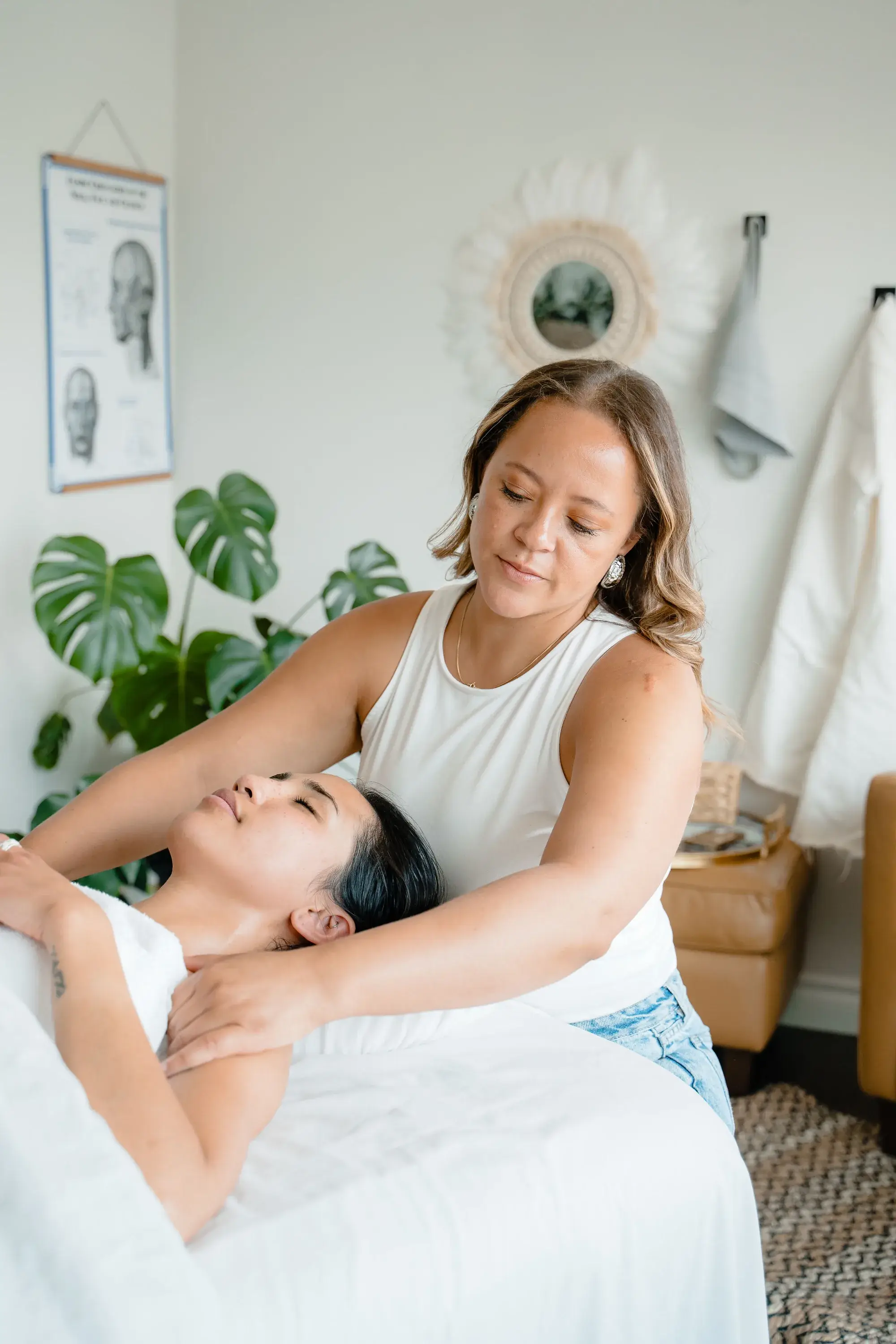
Lymph nodes are central to how lymphatic drainage works, which is probably why people wonder about massaging them. The Cleveland Clinic describes a session beginning with work over the areas that house the nodes, the armpits, neck and, with consent, the groin, before coaxing fluid from swollen tissues toward those nodes. Cedars-Sinai describes the same sequence: start with the main drains at the neck, groin and armpits so that congested fluid has somewhere to go. Our page on why lymphatic drainage starts at the neck explains the logic.
Notice what is being treated. The strokes over a node group are light, rhythmic skin movements intended to encourage healthy nodes to take up more fluid from the tissue around them. They are not an attempt to squeeze, drain or shrink an enlarged node. The target is swelling in the tissue, after surgery, injury or in lymphedema, and the nodes are the destination for that fluid, not the problem.
That is also why nodes matter so much when they are missing. The American Cancer Society explains that when nodes are removed, lymph vessels run into a dead end where the node used to be and fluid can back up, which is lymphedema. In that situation lymphatic drainage is a mainstay of care, and it is the one Meeghan Mackenzie, our Certified Lymphedema Therapist, trained for. Those are the clients we see in the lymphatic drainage massage room. A person with a tender gland from a throat infection is not one of them, until the infection has gone.
When to see a doctor
See your GP if a swollen gland has not gone down within a week or is getting bigger, feels hard or does not move when pressed, sits just above or below your collarbone, or comes with night sweats, a very high temperature, or no other sign of illness. See a doctor promptly if nodes are swollen in more than one region, are larger than two centimetres, are draining, or come with weight loss, persistent fever or fatigue. Ask for urgent care if a swollen gland makes swallowing or breathing difficult.
If a node has been checked, the cause is known and your doctor has no objection, we are glad to see you. The Learning Centre’s understanding the lymphatic system explains what the nodes are doing for you in the meantime, and when to seek medical care gathers the red flags for swelling of every kind.
Questions people ask
My swollen gland has been there for three weeks since a cold. Is that normal?
The NHS expects swollen glands from an infection to go down within one to two weeks, and asks you to see a GP if they are getting bigger or have not gone down within a week, if they feel hard or do not move when pressed, or if you have night sweats or a very high temperature. Three weeks is past that line. It is probably still harmless, and that is exactly the kind of lump a GP should feel.
Can lymphatic drainage shrink a swollen lymph node?
No. The node is enlarged because it is full of immune cells doing their work, not because fluid is trapped around it. Lymphatic drainage moves tissue fluid toward working nodes; it is not a treatment for the node itself, and we do not offer it while any infection is active.
Is it dangerous to massage my neck when I have swollen glands?
Firm rubbing of a tender node is painful and achieves nothing, and the Cleveland Clinic lists infection and fever among the reasons to avoid lymphatic massage altogether. A warm compress and an over-the-counter painkiller are what it recommends for the discomfort. Leave the lump alone and let the infection run its course.
I have a lump in my armpit after a vaccine. Should I worry?
The Cleveland Clinic says swollen lymph nodes are a possible side effect of some vaccines, usually temporary and not serious. If it is still there after a couple of weeks, is growing, or feels hard and fixed, have your doctor check it. We would not work on that armpit until it has settled.
Could a swollen lymph node be cancer?
It can, but the American Cancer Society is clear that lymph node swelling is often caused by something other than cancer, and that a biopsy is the only way to know whether cancer is in a node. The features that make a doctor look harder are a node that is hard or fixed, painless and persistent, larger than two centimetres, in more than one region of the body, or accompanied by weight loss, night sweats or fever.
Sources
- Cleveland Clinic: Swollen lymph nodes (lymphadenopathy)
- NHS: Swollen glands
- Cleveland Clinic: Lymphatic system
- American Cancer Society: Lymph nodes and cancer
- Cancer Research UK: The lymphatic system and cancer
- Cleveland Clinic: Lymphatic drainage massage
- Cedars-Sinai: FAQs about lymphatic drainage massage
Page reviewed October 4, 2026. This page is education, not a diagnosis. For your own situation, talk to your doctor, surgeon or care team, or ask us.
Keep reading
Related pages