

Gentle self-care after breast augmentation or reduction: self-drainage between appointments
After breast surgery: support bra round the clock, belly breathing, slow armpit circles, light strokes toward the centre of the chest, nothing over incisions.
By The Renu lymphatic and massage team · 6 min read
After breast augmentation or reduction, the gentle self-care that fits between clinic appointments is the breathing and node work from the NHS breast routine: belly breaths, slow circles over the armpit lymph nodes, and light skin strokes from the outer breast and chest wall toward the centre of the chest. Nothing crosses an incision, nothing presses on an implant pocket, and none of it starts until your surgeon has cleared hands-on work. The American Society of Plastic Surgeons' basics come first: wear your support bra or bandeau around the clock as instructed, take it easy until you have permission to do more, and follow your surgeon's incision plan.
Cosmetic breast surgery leaves you with a surgeon’s sheet of instructions and a lot of quiet hours in which the chest feels tight and heavy. People ask us what they can do in those hours. The honest answer is: less than you might hope in the first days, then a short, gentle routine once your surgeon agrees. This page separates the two clearly, so nothing you do at home undoes the work.
The surgeon’s basics come before anything else
The American Society of Plastic Surgeons (ASPS) sets out the recovery essentials for breast augmentation. Immediately after surgery the breasts are wrapped in gauze dressings, with an elastic bandage or a support bra to minimise swelling. You wear that support garment, a bra or a bandeau, around the clock as instructed. Acute pain typically subsides after one to five days, but soreness and swelling can continue for a few weeks. You take it easy until you have permission to increase your activity, because bleeding into the breast pockets is possible in the first several days. Incision care varies: some surgeons ask you to cleanse the incision sites and apply ointment, others want tape or a bandage left in place. Exercise and normal activity resume according to your plastic surgeon’s directions.
ASPS also lists the complications to watch for, among them bleeding, hematoma, seroma (fluid accumulation), infection, capsular contracture, changes in nipple or breast sensation and persistent pain, and says that if any complication develops you should consult your plastic surgeon in a timely manner. We leave all of that to the surgeon. Our breast surgery recovery page explains how clinic drainage fits around those weeks.
Breast reduction follows the same shape of recovery, but the ASPS material we read was written for augmentation, so we have not borrowed its timelines for reduction. Your own surgeon’s sheet is the authority.
What self-drainage can and cannot do here
Simple lymphatic drainage is a way of moving skin, not tissue. Macmillan describes it as using your hand to very gently move the skin in a particular direction, away from the swelling, and says you usually do not massage the swollen area itself. Cancer Research UK says the specialist clears the area the fluid will drain into first, and that at home you apply only the light pressure you were taught.
Around an implant or a reduction, that means the routine avoids the breast mound and the incisions almost entirely. It works the breath, the armpit nodes and the skin of the outer breast and chest wall, sending fluid toward the centre of the chest. It does not try to shape the breast, move an implant or soften a scar; those are surgical questions.
The between-appointments routine, step by step
Start only when your surgeon has cleared gentle hands-on care and the incisions are closed. Bare skin, no cream or oil, support garment off only for the minutes you need and back on afterward.
- Five belly breaths. Hands on the tummy, slow breath in, pursed-lip breath out letting the hands sink into the abdomen. The West Suffolk NHS breast leaflet opens with this and repeats it to finish. In the first week, when nothing else is allowed, this step on its own is worth doing.
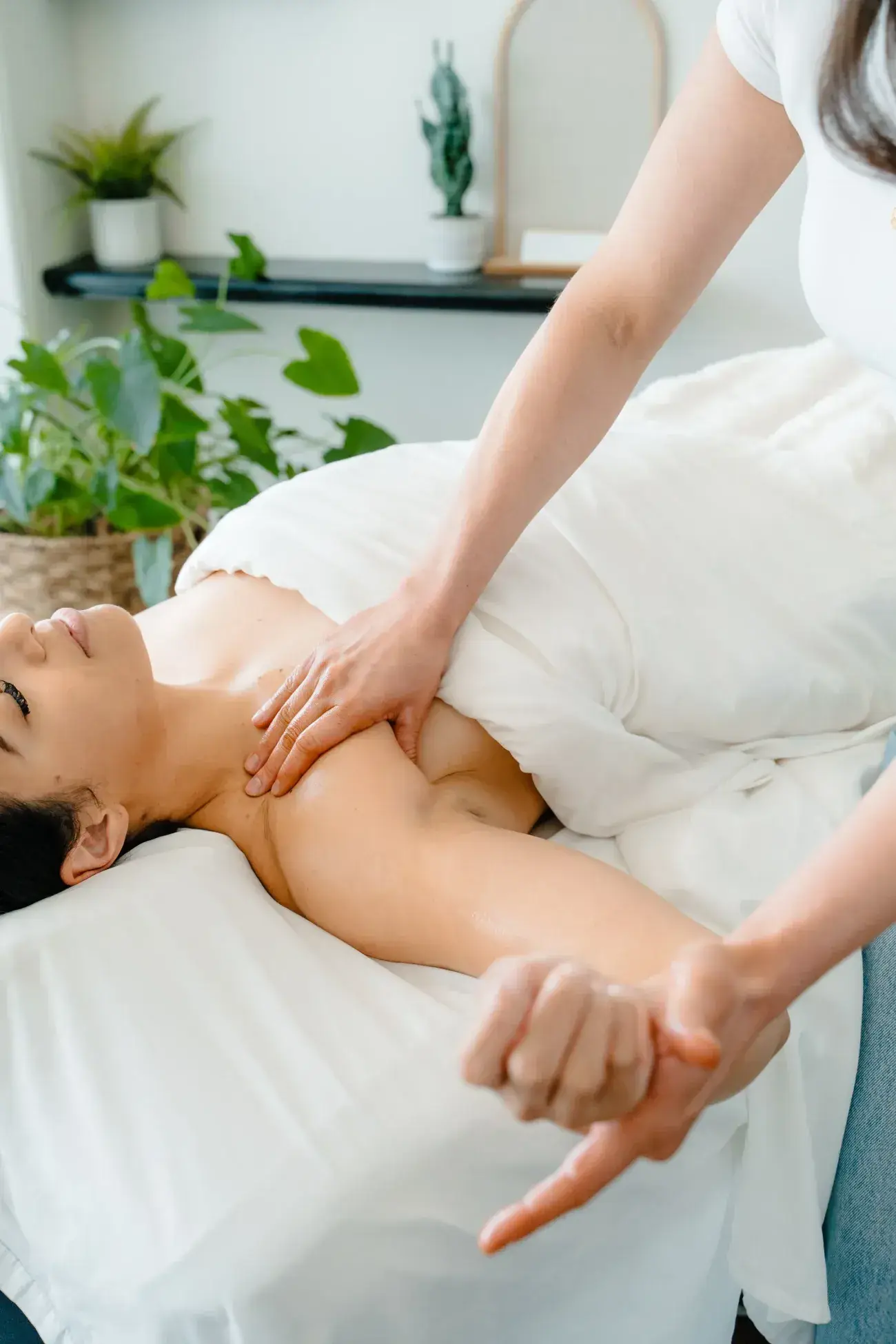
- Armpit circles, both sides. With the flat of the other hand, or a small soft ball, slow circular movements over the lymph nodes in the armpit, five times on each side, unless painful. Keep the hand in the armpit itself, away from any incision in the fold.
- Outer breast toward the centre. The leaflet’s second and fourth routes run from the outside of the breast to the centre of the chest. Use the flat of the hand on the skin of the outer chest wall, stretch it gently toward the sternum, let it return. Ten to twenty light repetitions. Stay on skin that was not cut and is not over the implant pocket.
- Upper chest toward the centre. A light version of the leaflet’s midline route, on the skin above the breast below the collarbone, stroking toward the centre of the chest, ten to twenty times.
- Leave the rest alone. The leaflet’s underside route and anything over the incision lines or the breast mound wait until your surgeon and therapist clear them, which for many people is never needed; swelling settles on its own with support and time.
- Armpits again, then breathe. The leaflet ends by repeating steps two and one in that order.
Twice a day at most, a few minutes each time. Macmillan suggests a time and place where you can do it in a relaxed way. If the skin is red when you have finished, the movement was too much.
Sensations, numbness and sleep
ASPS notes that changes in nipple or breast sensation are a recognised outcome of augmentation. Numb skin cannot warn you that a stroke is too firm, which is one more reason to keep every movement feather-light and to watch the skin rather than trust the feel. Tell your surgeon about any sensation change that is new or spreading.
Sleeping position is the surgeon’s call. Where elevation of the upper body has been suggested, stacking pillows so you do not roll onto the chest is a practical set-up, and the breathing step is a calm way to settle before sleep.
Stop and call your surgeon
Call the surgeon’s office the same day, and skip the routine, if you notice:
- Sudden swelling on one side, or one breast becoming larger, tighter or more painful than the other. ASPS lists bleeding, hematoma and seroma among the complications of augmentation.
- Heat, redness, spreading pain or fever. Infection is on the ASPS risk list, and Macmillan says to contact your GP straight away if an area becomes red, warm, painful or newly swollen, or you have flu-like symptoms.
- Fluid or blood leaking from an incision, or an incision that is opening.
- A breast that feels hard or looks misshapen. ASPS describes capsular contracture as tight scar tissue forming around the implant.
- Feeling unwell. The West Suffolk leaflet says not to perform the massage at all if you feel unwell or have an infection.
- Any pain during a step. The leaflet’s caution is to seek your clinician’s advice rather than continue.
Cancer Research UK adds that lymphatic drainage of any kind should not be used if a blood clot is suspected or you have heart problems. The when to seek medical care page covers the broader red flags.
Where Renu fits
Once your surgeon is happy for you to have hands-on care, post-op lymphatic drainage at Renu is 30, 45 or 60 minutes ($105, $115 or $140). The therapist clears the neck and both armpits, works the chest wall with pressure matched to the stage of healing, and shows you how the home routine above fits your incisions and your surgeon’s rules. The post-op recovery guide explains what to expect week by week, and if breast or chest-wall swelling lingers beyond the surgical period, the fuller breast and chest self-drainage routine is the next step.
Questions people ask
Is it safe to massage my breasts after getting implants?
Not as a lymphatic routine, and not without your surgeon's say-so. Some surgeons prescribe their own implant displacement exercises and some forbid any breast manipulation; that is their call. What this page describes is lighter and sits beside the implant rather than on it: breathing, armpit node circles and skin strokes on the outer breast and chest wall toward the centre of the chest.
How long will I be swollen after breast augmentation?
ASPS says acute pain typically subsides after one to five days but soreness and swelling can last a few weeks. Swelling that is sudden, one-sided, hot or painful is a different matter and needs the surgeon the same day.
Can I do the routine while I still have drains in?
Treat drains as a no-go zone and ask your surgeon before doing anything hands-on while they are in place. The breathing can be done at any stage. Our page on lymphatic drainage with surgical drains in explains how clinic sessions handle them.
Does this page apply after a breast reduction too?
The principles are the same, but the ASPS guidance we read was written for augmentation, so we have not stated reduction-specific timelines. Reduction incisions are usually longer, which makes the rule about never stroking across an incision even more important. Your surgeon's instructions win on every point.
What should I wear?
ASPS says to wear your support garment, a bra or an elastic band called a bandeau, around the clock as instructed. Beyond the surgical period, Macmillan's general advice for breast swelling is a bra that is not too tight around the chest, with straps that do not dig into the shoulders or under the arm.
Sources
- American Society of Plastic Surgeons: Breast augmentation recovery
- American Society of Plastic Surgeons: Breast augmentation safety
- West Suffolk NHS Foundation Trust: Simple lymphatic drainage, breast (leaflet 6773)
- Cancer Research UK: Manual lymphatic drainage (MLD) for lymphoedema
- Macmillan Cancer Support: Lymphatic drainage for lymphoedema
- Macmillan Cancer Support: Managing and treating lymphoedema
- Macmillan Cancer Support: Reducing your risk of lymphoedema
Page reviewed October 4, 2026. This page is education, not a diagnosis. For your own situation, talk to your doctor, surgeon or care team, or ask us.
Keep reading
Related pages