Why does TMJ massage go inside the mouth?
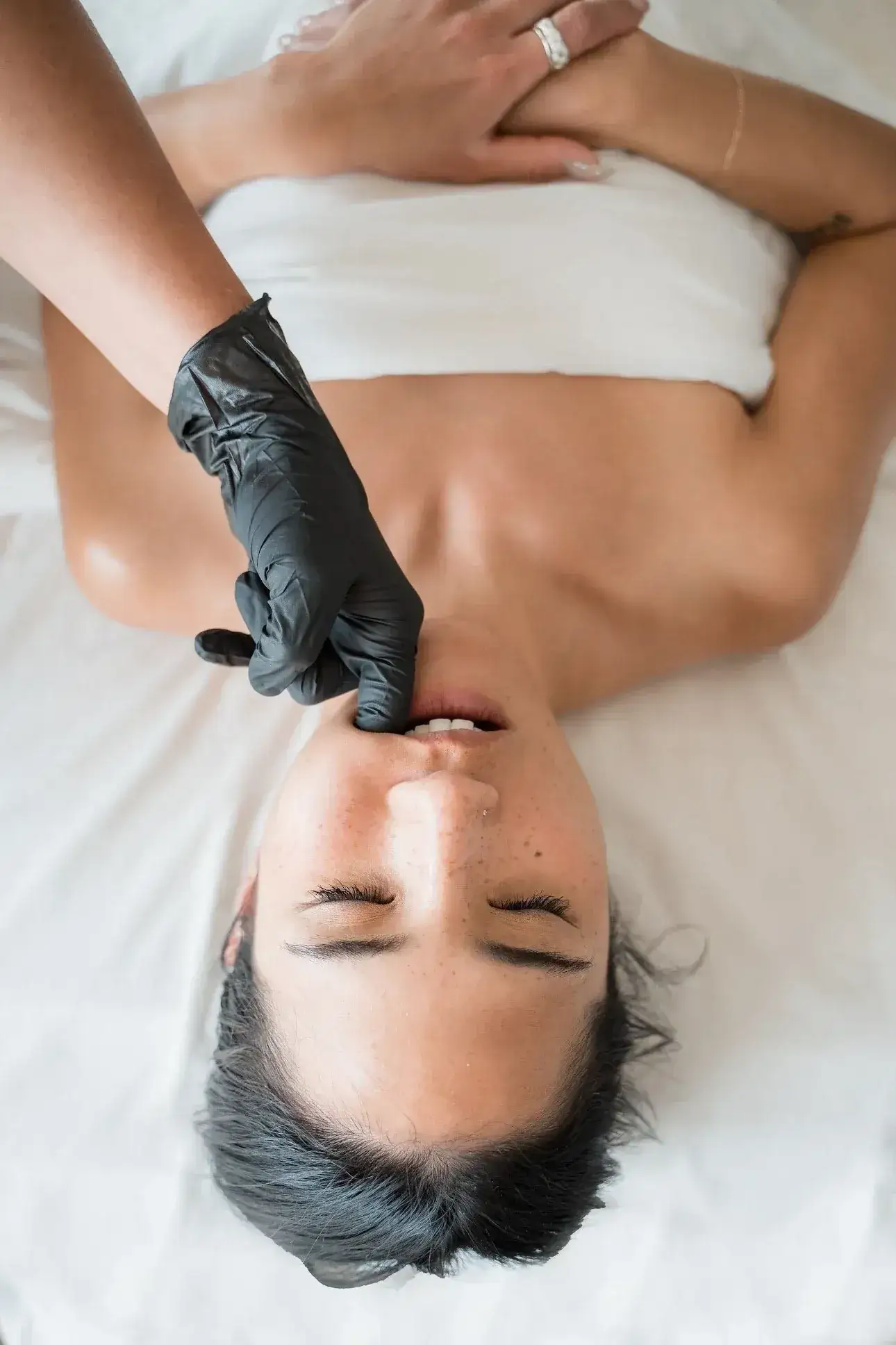
The medial and lateral pterygoids, two of the four chewing muscles, lie deep behind the jawbone. Only a gloved finger inside the cheek can reach them.
By The Renu lymphatic and massage team · 6 min read
Because two of the jaw's four chewing muscles cannot be reached from outside. The masseter and temporalis lie under the skin of the cheek and temple and respond to ordinary external massage. The medial and lateral pterygoids sit deep on the inside of the jawbone, and the only practical route to them is a gloved finger inside the cheek. At Renu, Sasha Bernard, RMT, uses that intra-oral approach alongside external work on the jaw, face and neck.
It is a reasonable thing to wonder about. Most massage happens on skin you can see, and the idea of a gloved finger inside your cheek sounds, at first, like something a dentist does. The explanation is simple anatomy: the jaw is driven by four muscles, and only two of them are on the outside.
The four muscles that move your jaw
Anatomists call them the muscles of mastication, and TeachMeAnatomy’s summary of them is the clearest we have read:
| Muscle | Where it sits | What it does |
|---|---|---|
| Masseter | Superficial, across the cheek from the cheekbone down to the angle of the jaw | Closes the mouth; the most powerful of the four |
| Temporalis | In the hollow at the side of the skull, under the temple | Closes the mouth and pulls the jaw back |
| Medial pterygoid | Deep, on the inside of the jawbone near its angle, below the lateral pterygoid | Closes the mouth |
| Lateral pterygoid | Deep, running horizontally from the skull base to the neck of the jawbone | Pulls the jaw forward and opens it; one side alone moves the jaw sideways |
The masseter and temporalis are under the skin of the face. Press your fingers into your cheek and clench, and you can feel the masseter bulge. The two pterygoids are different. They attach to the inside surface of the jawbone and to the base of the skull, with the mandible itself in the way. From outside, there is bone between your fingers and the muscle. From inside the cheek, behind the last molars, there is not.
That is the whole reason. Intra-oral work exists because the medial and lateral pterygoids are in the one place external massage cannot go.
Why the inside muscles matter for jaw pain
The lateral pterygoid is the muscle that opens and protrudes the jaw and swings it side to side. The medial pterygoid closes it, working with the masseter. Between them they are involved in every movement the jaw makes, and in the grinding and clenching that drive much jaw pain.
The National Institute of Dental and Craniofacial Research describes temporomandibular disorders as a group of more than 30 conditions causing pain and dysfunction in the jaw joint and the muscles that control jaw movement, with disorders of the chewing muscles as one of its three broad categories. Cleveland Clinic lists teeth grinding and clenching, jaw injury, arthritis and stress-related tension among the causes, and describes the problem, from a manual-therapy perspective, as jaw muscles that are “overly tight or imbalanced”.
A treatment that only reaches half the muscles involved is working with half the picture. Our TMJ massage page describes the split plainly: external work treats the masseter, temporalis and neck muscles through the skin; intra-oral treatment, performed with gloved hands inside the mouth, reaches the medial and lateral pterygoids that hold much of the joint’s tension.
What the outside work covers
The outside muscles get plenty of attention too, and most of it is familiar massage. Healthline’s TMJ guide lists the muscles a therapist works externally: the masseter above and below the cheekbone, the temporalis at the sides of the head, the sternocleidomastoid at the front of the neck, the suboccipitals under the back of the skull and the upper trapezius across the shoulders. The techniques are kneading (lifting and rolling the muscle between the fingers), friction (back-and-forth rubbing with the pads of the fingers at gentle to moderate pressure) and stretching the muscle out under the fingers or palms.
The masseter deserves its own paragraph. PainScience calls it the strongest muscle in the human body for its size, built with a multi-layered, feathered fibre arrangement that trades speed for torque. Its trigger points are among the most common anywhere, and they can refer pain into the teeth, contribute to ear pain and tinnitus, and feed headaches and jaw tension. PainScience’s self-massage spot is a notch in the cheekbone about an inch in front of the ear; Cleveland Clinic’s version is two or three fingers kneading the muscle below the cheekbone, halfway between mouth and ear.
A 60-minute session at Renu works all of this, the jaw, face and neck together, with the intra-oral portion as one part. Why the neck is included is a question of its own; our page on whether neck tension can cause jaw pain explains it.
What the inside work is like
Honest, practical details help here. Sasha wears gloves. A gloved finger goes inside the cheek, between the cheek and the teeth, and works back toward the muscles behind the molars. The work is slow rather than brisk, she checks in throughout, and the session is tailored to your comfort, as our service page describes.
It is worth agreeing a signal before anything starts. A raised hand works well, because you cannot easily speak with a finger in your cheek, and it means the work pauses the moment you want it to. You can stop at any point and the rest of the session continues on the outside muscles. Agreeing to a TMJ massage is not the same as agreeing to fingers inside the mouth, and you are entitled to say yes to one and no to the other.
The intra-oral work is one part of the session rather than the whole of it. The pterygoids are small muscles, and the jaw, face and neck all get their turn.
What it can and cannot change
Manual work on the jaw muscles has reasonable support. Healthline’s guide cites 2021 research concluding that conservative manual techniques including massage brought significant improvements in pain and in how wide the mouth could open in TMD. Cleveland Clinic’s chiropractor, Dr. Andrew Bang, puts it this way: when the jaw muscles are overly tight or imbalanced, manual therapy works well to restore normal muscle tone and balance.
Two cautions keep that honest. PainScience warns that for entrenched, chronic jaw pain “massage alone is unlikely to do the job”, and that aggressive massage can make a sensitised pain state worse; it recommends jaw rest, soft food and gentle mobilisation alongside hands-on work. And massage treats muscle; it does not reposition the joint’s disc or change a bite. NIDCR notes that clicking or popping without pain is common, normal and needs no treatment, so a click that stays after the pain has gone is not a failure of the massage.
When to see a dentist or doctor first
Some jaw symptoms need a professional opinion before anyone works on the muscles:
- A jaw that locks open or closed, or a sudden change in how your teeth meet, both of which NIDCR lists among TMD symptoms that warrant seeing a dentist or doctor
- Tooth pain, swelling, fever or ear discharge, which point to infection rather than muscle
- Pain after a blow to the jaw or face
- Jaw pain, clicking or stiffness that is not improving, which Cleveland Clinic’s advice is to raise with a health care provider
NIDCR adds a wider warning worth passing on: before considering irreversible treatments such as surgery, implants, or anything that permanently changes the teeth, bite or jaw joints, discuss the benefits, risks and alternatives with your doctor or dentist. Massage is the opposite of irreversible, which is part of why it is a sensible early step, and why our page on whether to see a dentist before booking TMJ massage exists. No referral is needed to book with Sasha, but if any of the signs above fit you, the dentist or doctor comes first, and we will say so.
Questions people ask
Can I just massage my own jaw instead?
For the masseter, yes. PainScience describes the best spot as a notch in the cheekbone about an inch in front of the ear, worked with firm thumb pressure and small circles, and Cleveland Clinic suggests two or three fingers kneading the muscle below the cheekbone. Self-massage reaches the outside muscles well; the pterygoids are another matter.
Is intra-oral massage within a massage therapist's scope?
Healthline's TMJ massage guide notes that registered massage therapists can perform intra-oral work as part of their scope of practice. At Renu it is done by Sasha Bernard, RMT, who trained in TMJ intra-oral technique, with gloves and with your consent before anything begins.
Which muscle is the strongest, and does that matter?
PainScience calls the masseter the strongest muscle in the body for its size, thanks to a multi-layered fibre arrangement built for torque. It matters because a muscle that strong, clenched all night, can create a great deal of tension, and its trigger points are among the most common in the body.
Will the intra-oral part take the whole session?
No. A 60-minute TMJ session at Renu works the jaw, neck and facial muscles together, and the intra-oral portion is one part of it. Cleveland Clinic lists neck and shoulder pain among TMD symptoms, and our page on neck tension and jaw pain explains why we treat both.
Can I stop partway through?
At any moment. Agree a signal before you start, a raised hand works well since you cannot easily speak with a finger in your cheek, and the work pauses as soon as you give it. Sasha works slowly and checks in throughout; the treatment is adjusted to you, never the other way around.
Sources
- Healthline: TMJ massage, techniques and benefits
- PainScience: Massage for jaw pain (masseter)
- Cleveland Clinic: Stubborn TMJ pain? Try trigger point massage and jaw exercises
- Cleveland Clinic: Temporomandibular disorders (TMD) overview
- NIDCR: TMD (temporomandibular disorders)
- TeachMeAnatomy: The muscles of mastication
Page reviewed October 4, 2026. This page is education, not a diagnosis. For your own situation, talk to your doctor, surgeon or care team, or ask us.
Keep reading


