

Your first post-op lymphatic drainage session in Calgary: what to expect
Your first post-op lymphatic drainage session in Calgary: what to bring, how the garment and incisions are handled, and when to call your surgeon instead.
By The Renu lymphatic and massage team · 6 min read
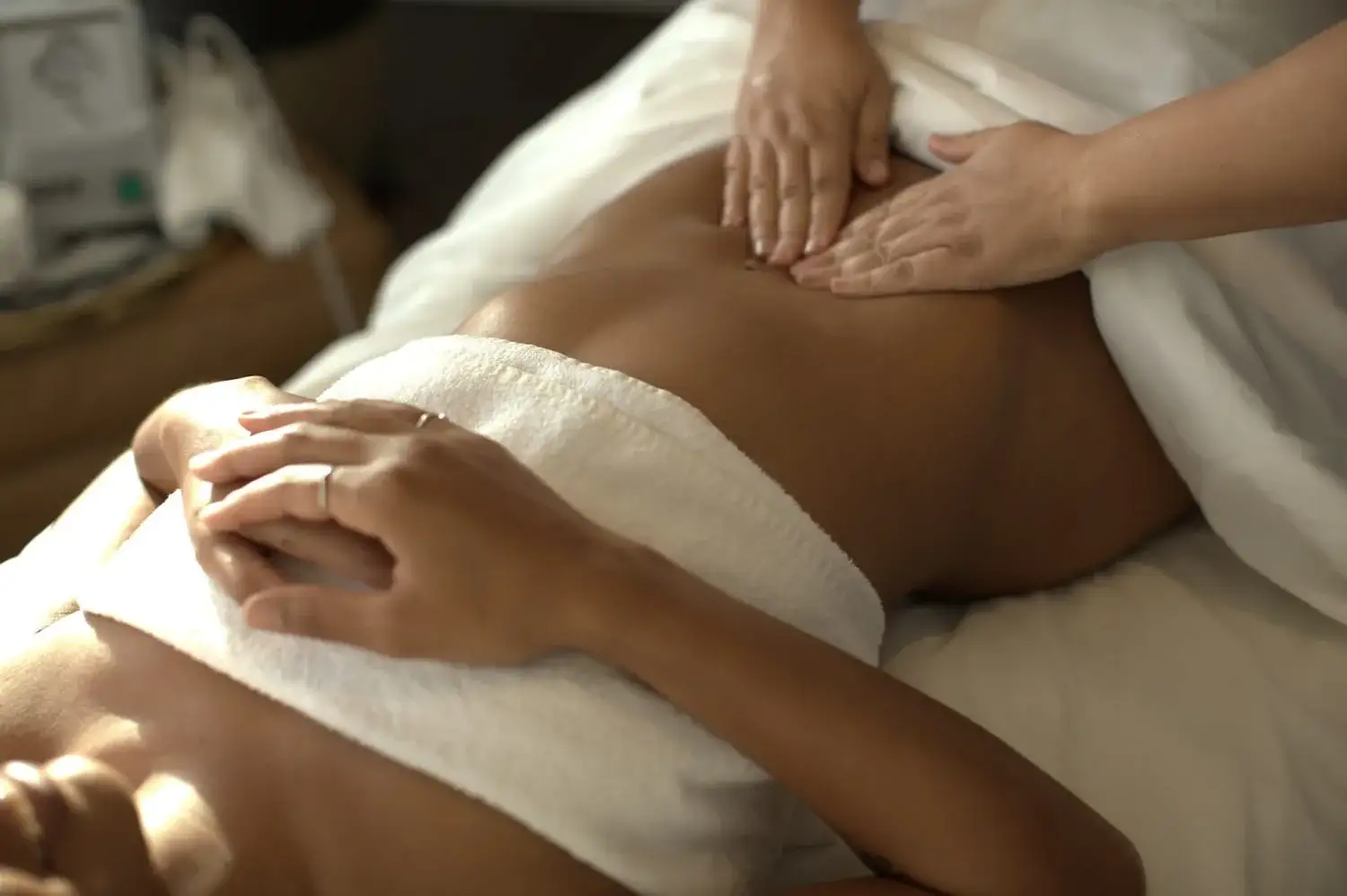
Your first post-op lymphatic drainage session starts with your surgery details: the procedure, the date, whether drains are in, and any instructions from your surgeon. Your garment comes off the area being treated, very light strokes clear the lymph node regions and then guide fluid away from the operated area while working around incisions, and the garment goes back on before you leave. Many surgical recovery protocols repeat sessions two to three times a week for the first three to four weeks.
What to bring to your first post-op appointment
Bring four things: your surgeon’s instructions, the facts of your surgery, your compression garment, and loose clothes. Everything else we can sort out together.
- Your surgeon’s instructions. You do not usually need written clearance, but surgeons differ on when lymphatic work can start, so bring any timing, activity or compression instructions and we follow them. If you are unsure, our page on when you can start lymphatic drainage after surgery explains the usual range.
- Surgery details. The procedure, the date, which areas were treated, and whether you had more than one thing done at once.
- Drain status. Whether drains are still in, and if they came out, when. The American Society of Plastic Surgeons notes that patients with drainage tubes may be asked to record how much fluid empties into the reservoir; bring that log if you have one. Drains do not automatically rule out a session; your therapist works around them, as explained on lymphatic drainage with surgical drains in.
- Your garment, and its stage. Wear it in, and tell us whether you are in the first, firmer garment or have moved to a second stage.
- Clothing that opens easily. A front-zip top and loose pull-on pants make the end of the session much easier.
If you booked ahead of surgery, a pre-op classic lymphatic drainage session (60 minutes) is also available, and the same health history applies.
Getting on and off the table
The first few minutes are about positioning, not technique. Your therapist will help you sit on the edge of the table, then lower you onto your back or side in one controlled movement, with pillows under the knees or along the body so nothing pulls on a healing incision. If you have been told not to lie flat or not to lie on your front, say so; we plan the session around the positions you are allowed.
The ASPS advises that surgical incisions should not be subjected to excessive force, swelling, abrasion or motion while they heal. That guides everything we do: no stretching of incision lines, no work directly over them, and a slow, supported roll whenever you change position. Getting up at the end is done the same way, in stages.
The garment comes off, then goes back on
For the treated area, the garment has to come off, because the strokes work on the skin itself. The NHS describes the elasticated corset or compression bandages fitted after liposuction as something to be worn constantly for several weeks, so the time it is off is kept as short as the treatment allows. Before you leave, it goes back on, with help if you need it. Foam or boards you have been given go back in the same place.
Our page on taking compression off for a lymphatic session explains why the garment matters so much straight after the session.
How it feels over incisions and swelling
It should feel very light and should not hurt. The session starts away from the surgery, at the lymph node regions, and works in a set order. Marxen and colleagues, in a 2023 review in Aesthetic Surgery Journal Open Forum, describe lymphatic drainage as usually beginning with the central or proximal region and working outward. The National Lymphedema Network describes the technique as gentle pressure and skin stretching followed by a relaxation phase.
Expect:
- Several minutes at the neck, collarbones and the node groups that will receive the fluid
- Slow, rhythmic strokes that guide fluid from the operated area toward those nodes
- Hands that skirt around incisions, drain sites and any taped areas
- Tenderness in bruised areas, which your therapist adjusts for as you go
If anything is sharp or makes you tense, say so straight away. Our page on whether lymphatic drainage after surgery should hurt covers what is normal and what is not.
Choosing a session length
Shorter sessions suit the early, tender days; longer ones suit larger or combined procedures. Post-op lymphatic drainage at Renu is booked as:
| Session | Price | Often chosen for |
|---|---|---|
| 30 min | $105 | A small area, such as the face and neck, or a very early first visit |
| 45 min | $115 | One area, such as the abdomen or breasts |
| 60 min | $140 | Abdomen with flanks, or a limb with its node regions |
| 90 min, multiple surgeries | $210 | Combined procedures, such as liposuction of several areas with a tummy tuck |
You book through Jane. You can read about our lymphatic therapists, including Meeghan Mackenzie, our Certified Lymphedema Therapist and a Registered Massage Therapist since 2005, on our team page.
How many sessions to plan for
Plan for a series rather than a single visit. The Marxen review describes general post-operative recommendations of manual lymphatic massage two to three times a week during the first three to four weeks of recovery, performed by a certified lymphedema therapist or a massage therapist with lymphatic training. The same review notes that swelling after aesthetic procedures, especially liposuction, can take three to six months to resolve, and the NHS likewise says it can take up to six months for the area to settle completely.
Your surgeon’s protocol comes first. If it is silent, we can suggest a rhythm after the first session, based on how the tissue responds. For liposuction specifically, see how many lymphatic drainage sessions you need after lipo.
When to call your surgeon instead of coming in
Some symptoms are your surgeon’s to assess, not ours, and lymphatic drainage should wait until they are cleared. The Cleveland Clinic lists fever, infection, cellulitis, blood clots and deep vein thrombosis among the reasons to avoid lymphatic drainage, and the National Lymphedema Network names acute infection, decompensated heart failure and acute deep vein thrombosis.
Call your surgeon, and let us know so we can move your appointment, if you have:
- A fever, or feel shivery and unwell
- Skin around an incision that is red, hot, swollen and increasingly painful, which the NHS describes as signs of cellulitis
- Throbbing pain and swelling in one calf or thigh, or red, blue or darkened skin around it, which the NHS lists as DVT symptoms
- Severe pain or any unexpected symptom; the NHS advises contacting the clinic that did your operation as soon as possible
If calf pain or swelling comes with shortness of breath, the NHS treats that as an emergency. Call 911.
When you are ready, our post-op lymphatic drainage page has the full service details. We are on 19 Street NW in West Hillhurst and open seven days a week.
Questions people ask
Do I need a referral for post-op lymphatic drainage in Calgary?
You do not need a referral or written clearance to book, unless your surgeon has asked you to wait or to seek clearance first. Share any instructions you were given about timing, activity or compression so we can support that plan. If your surgery was outside Calgary, bring whatever paperwork you have.
Can someone drive me and wait?
Yes, and for the first visit after a larger procedure it is a good idea. Getting in and out of a car is often harder than the session itself. There is free street parking on 19 Street.
What if I cannot lie flat or on my stomach yet?
Tell us when you book and again on arrival. The session is planned around the positions you are allowed, with pillows for support. Most early post-op work is done lying on your back or side.
Should I book the 90-minute session if I had more than one procedure?
The 90-minute multiple surgeries session exists for combined procedures, such as liposuction of several areas with a tummy tuck. If you are unsure whether you need it, a 60-minute session is a reasonable first visit, and your therapist can suggest a length for the rest of your plan.
Sources
- Marxen et al., Aesthetic Surgery Journal Open Forum 2023: The utility of lymphatic massage in cosmetic procedures
- American Society of Plastic Surgeons: Liposuction recovery
- NHS: Liposuction
- National Lymphedema Network: Position paper, Lymphedema diagnosis and treatment (2025)
- Cleveland Clinic: Lymphatic drainage massage
- NHS: DVT (deep vein thrombosis)
- NHS: Cellulitis
Page reviewed October 5, 2026. This page is education, not a diagnosis. For your own situation, talk to your doctor, surgeon or care team, or ask us.

