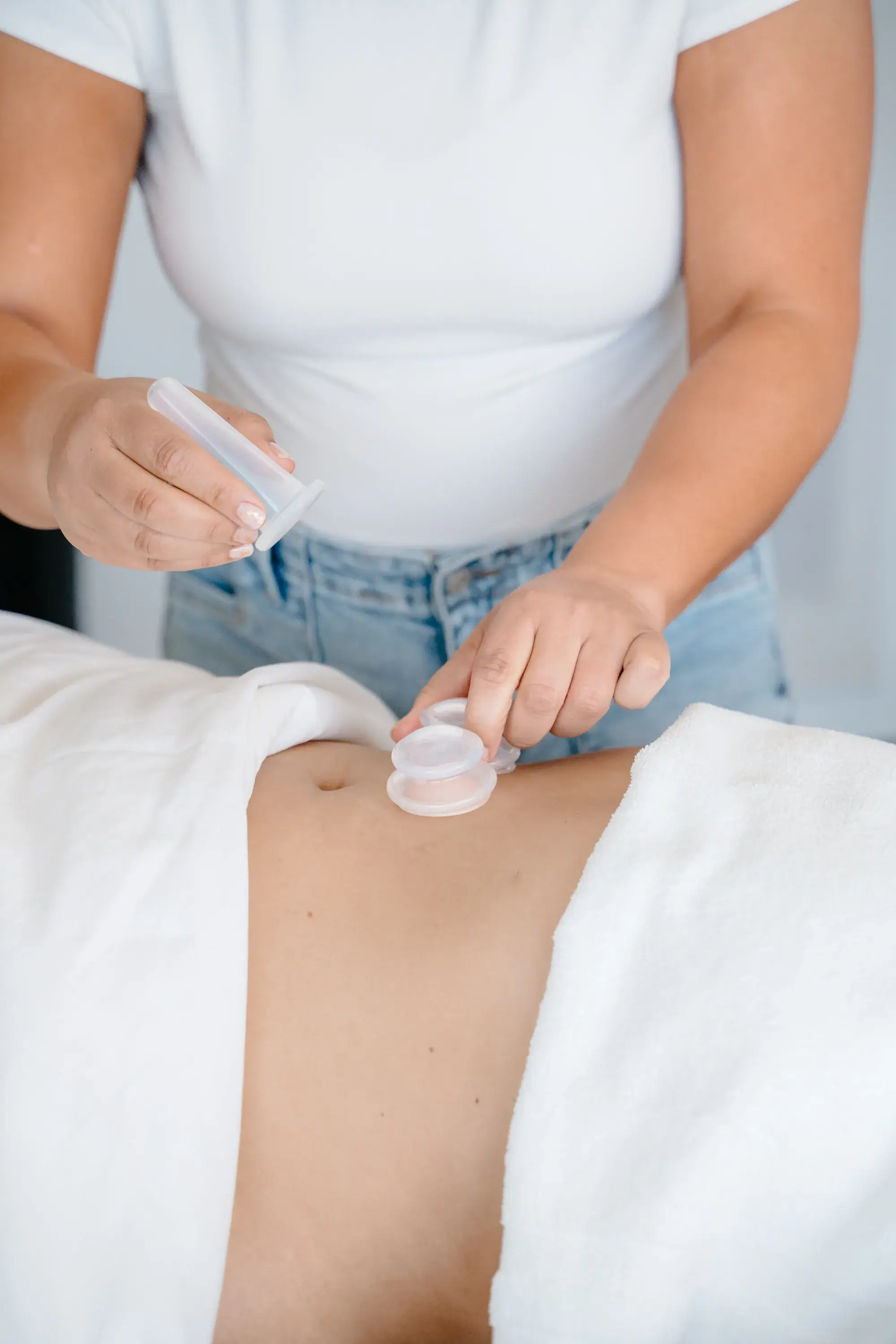


Classic vs post-op lymphatic drainage: what your healing body actually needs
Classic vs post-op lymphatic drainage: book post-op from surgeon clearance until tissue settles, classic with no surgery or before it. What studies show.
By The Renu lymphatic and massage team · Reviewed by Meeghan Mackenzie, RMT, CLT · 9 min read
If you have had surgery, book post-op lymphatic drainage, from the day your surgeon clears you until your tissue settles. If you have not, book classic, which is also how pre-op sessions are booked at Renu. That is the short answer. The longer one is worth a few minutes of your time, because the first weeks after surgery shape how your result settles.
Many of our clients find us the same way: they woke up swollen, firm and a little frightened, and their surgeon never mentioned lymphatic drainage. They found it on TikTok, or through a friend. If that’s you, you’re in the right place. This page explains what changes in your body after surgery, what the research honestly shows, and how we plan your recovery so you are never guessing.
First, what lymphatic drainage actually does
The word lymph comes from the Latin lympha, meaning clear water. Think of your lymphatic system as a city working quietly behind the scenes, with its own highways (vessels), checkpoints (nodes) and waste management (lymph fluid). Every day, fluid and proteins seep out of your blood vessels into the tissues around them. Your veins reabsorb most of that fluid, but the proteins are too large. Only the lymphatic system can carry them home. Without it, that protein-rich fluid pools, draws more water to it, and the tissue swells.
Lymph responds to a light touch, not a firm one. Most of it travels in the superficial system just under the skin, through vessels so delicate that too much pressure collapses them. That’s why lymphatic drainage uses flat, soft hands and slow, wave-like movements. Meeghan trained in the Vodder, Földi and Chikly methods; the Chikly Method teaches the therapist to feel for the lymph’s own rhythm and work with it. The slow, rhythmic touch also calms the nervous system, which can ease pain and help you rest.
Classic vs post-op: same roots, different tissue
The hands-on technique comes from the same place. What changes is the body on the table. Classic lymphatic drainage is built for a lymphatic system that is intact: light, rhythmic work for puffiness, heavy legs, fluid retention, or simply calm. Post-op lymphatic drainage is built for a system that has just been cut, stretched or suctioned, and is rebuilding.
| Classic lymphatic drainage | Post-op lymphatic drainage | |
|---|---|---|
| Who it’s for | No surgery, or surgery coming up | From surgeon clearance until your tissue settles |
| The lymphatic system | Intact; we encourage its natural flow | Disrupted; we reroute fluid around the surgical area |
| What the therapist works around | Little beyond your comfort | Incisions, drains, compression garments, numb skin, forming firmness |
| Pressure | Feather-light throughout | Feather-light early; adapted as tissue firms or softens week to week |
| Goal | Lightness, calm, general well-being | Less swelling, less firmness, a smoother result and a more comfortable recovery |
Not sure which to book? Your surgical history decides, not how swollen you feel today.
| Your situation | Book |
|---|---|
| No surgery; puffiness, heavy legs, general well-being | Classic, 30, 45 or 60 minutes |
| Surgery booked in the coming weeks | Classic 60 minutes, booked as pre-op |
| Surgery in the last days or weeks, cleared by your surgeon | Post-op |
| Still in a compression garment, or drains in place | Post-op |
| Firm, lumpy or uneven areas forming after surgery | Post-op |
| Two or more procedures in one surgery | Post-op, multiple surgeries, 90 minutes |
| Months out, tissue soft and settled | Ask us; classic or Brazilian styles may now fit |
When in doubt during the first months after surgery, choose post-op. It is the session designed for healing tissue.
Why you swell after surgery, and why it matters for your result
Surgery is controlled injury. To lift, tighten or remove tissue, a surgeon has to pass through the network of fine lymphatic vessels in that area. Liposuction tunnels through the fatty layer where many superficial vessels run. A tummy tuck or facelift lifts whole sheets of skin away from the tissue beneath. Some of those vessels are cut; others are bruised or compressed by swelling.
At the same moment, your body floods the area with fluid, proteins and immune cells to start healing. More fluid arrives just as fewer roads are open to carry it away. The result is the swelling, bruising and tightness you feel in the first weeks.
Most of that settles with time. But protein-rich fluid that sits too long can thicken and organize into firm, lumpy or ridged areas under the skin, known as fibrosis. Fibrosis can feel uncomfortable and can show on the surface, which is the last thing anyone wants after investing in surgery.
Lymphedema physical therapist Kelly Sturm of Cancer Rehab PT explains why timing matters so much: fluid that sits in tissue sets off a slow inflammatory response that thickens and hardens it over time, and the earlier you address it, the more responsive the tissue is to treatment.
This is where post-op lymphatic drainage earns its place. Your body is already growing new lymphatic connections and finding detours around the surgical area. A trained therapist knows where those detours are likely to be, and gently guides fluid toward healthy nodes and pathways that surgery didn’t touch. Nothing comes out through your skin during a session; the fluid returns to your bloodstream and leaves the way all excess fluid does, through your kidneys. If you are already months past surgery, it is not necessarily too late to start.
What the research actually says
The honest summary: the published studies point in an encouraging direction, they’re still small, and what we see in the treatment room every day goes further than the research has caught up with yet. Here’s what’s been published, followed by what we see.
| Study | What they looked at | What they found |
|---|---|---|
| Marxen et al., Aesthetic Surgery Journal Open Forum, 2023 | A review of lymphatic massage across cosmetic procedures | Studies found MLD, alongside other therapies, reduced swelling and fibrosis and eased pain after liposuction and lipoabdominoplasty. Its general recommendation is two to three sessions a week for the first three to four weeks, from a certified lymphedema therapist or a massage therapist with lymphedema training. |
| Maningas et al., American Journal of Cosmetic Surgery, 2020 | 20 women after a tummy tuck with core liposuction; half received MLD for three weeks on top of their compression garment | Those who had MLD had less swelling at six and eight weeks than compression alone, though in so small a group the difference was not statistically significant. |
| Meade et al., Aesthetic Surgery Journal, 2012 | How lymph drains from the face after a facelift, mapped in three patients | Supports the idea that swelling after a facelift is partly the lymphatic network needing time to heal, the reason drainage is used after face and neck surgery. |
| Ezzo et al., Cochrane Review, 2015 | MLD for lymphedema after breast cancer treatment | Most of the high-quality MLD research comes from oncology. The review found MLD safe, with no adverse events reported, and adding it to compression bandaging reduced arm swelling by a further 7 percent, with mild to moderate lymphedema benefiting most. |
From Meeghan’s treatment room
My years as a Certified Lymphedema Therapist have shown me the same thing over and over. When clients start lymphatic drainage early and stay with it through the first few weeks, their bodies seem to find their way back sooner. The swelling eases, the firm spots soften before they settle in, and one day they walk in and say, “I feel like me again.” I can’t hand you a study that puts a number on it. What I can tell you is what my hands feel and what my clients tell me, week after week, and it’s why I’ll always gently encourage you to start early. You’re the captain of your recovery; we’re here as your co-captains.
One thing stands out across the research: even surgeons who are cautious about the evidence agree that if you have lymphatic drainage after surgery, it should come from a certified lymphedema therapist or a massage therapist trained in lymphedema care.
Swelling resolves on its own, eventually. The American Society of Plastic Surgeons expects liposuction swelling to start easing around weeks four to five, and the NHS says the area can take up to six months to settle completely. Lymphatic drainage doesn’t replace time, rest or your compression garment. Its job is to make the journey more comfortable and to lower the chance of firm, uneven tissue along the way. Our answer on how many sessions you need after lipo goes into the numbers.
Prices and booking at Renu
The two ladders sit side by side so you can see the difference.
| Length | Classic lymphatic drainage | Post-op lymphatic drainage |
|---|---|---|
| 30 minutes | $95 | $105 |
| 45 minutes | $105 | $115 |
| 60 minutes | $130 | $140 |
| 90 minutes | Not offered | $210, for two or more procedures in one surgery |
Pre-op sessions are booked as classic lymphatic drainage, 60 minutes, $130; we offer one to three before surgery. In Jane, the 60-minute post-op session can also be booked by procedure, such as abdominoplasty, 360 lipo and mommy makeover, breast surgery, or face and neck. Post-op work is delivered by our Certified Lymphedema Therapist and lymphatic-trained RMTs, and compression garment fitting and ordering are available for every kind of surgery. Before you book, when to book post-op lymphatic drainage covers timing and how often, what to ask before booking gives you the questions, your first post-op session explains the visit, and post-op lymphatic drainage cost in Calgary adds up a full course.
When to wait, and when to call your surgeon
Lymphatic drainage is gentle, but it isn’t for every body on every day. The same reasons pause both classic and post-op sessions. Cleveland Clinic lists blood clots and deep vein thrombosis, cellulitis, fever, infection, heart disease, kidney failure and stroke as reasons to avoid it. We’ll also hold off with active, untreated cancer unless your oncology team has approved treatment.
After surgery, call your surgeon rather than your therapist if you notice:
- Throbbing pain or swelling in one leg, usually the calf or thigh, which the NHS lists as possible signs of a blood clot
- Shortness of breath or chest pain (call 911)
- A fever, or an incision that is hot, red, weeping or opening
- Severe pain, or anything that feels wrong to you
If something feels off during a session, tell us. We would always rather pause and check than push through.
You don’t have to figure out recovery on your own
If you’re swollen, sore and not sure what’s normal, or you’re planning surgery and want to go in prepared, call us. Tell us your procedure and your surgery date, and we’ll help you choose the right session and map out the first few weeks together. No pressure, just a conversation. Call 403-270-2111, or book post-op lymphatic drainage with the button below. If you are wondering why a deeper massage is not the right tool after surgery, read post-op lymphatic drainage vs regular massage.
Questions people ask
I had surgery a year ago. Is that post-op or classic?
If the area is still firm, uneven, or swells by the end of the day, book post-op so we can work on that tissue. If it feels settled and you simply enjoy lymphatic work, classic is perfect.
Can I book post-op for a non-cosmetic surgery?
Yes. We see clients after knee, hip and shoulder surgery, oncology surgery and reconstructive surgery, as well as cosmetic procedures.
What if I had two procedures at once?
Book the 90-minute multiple surgeries session ($210). It gives your therapist time to care for each area properly.
Is pre-op lymphatic drainage worth it?
Many people find it useful as a way to meet the therapist, learn what sessions feel like and prepare the tissue before surgery. Renu offers one to three pre-op sessions, booked as classic 60-minute sessions; ask your surgeon whether they suit your procedure.
Sources
- Marxen et al., Aesthetic Surgery Journal Open Forum (2023): The utility of lymphatic massage in cosmetic procedures
- Maningas et al., American Journal of Cosmetic Surgery (2020): Manual lymphatic drainage in postoperative abdominoplasty with core liposuction patients
- Meade et al., Aesthetic Surgery Journal (2012): Facelift and patterns of lymphatic drainage
- Ezzo et al., Cochrane Database of Systematic Reviews (2015): Manual lymphatic drainage for lymphedema following breast cancer treatment
- American Society of Plastic Surgeons: Liposuction recovery
- NHS: Liposuction
- NHS: Deep vein thrombosis (DVT)
- Cleveland Clinic: Lymphatic drainage massage
- Kelly Sturm, PT, DPT, CLT-LANA: Cancer Rehab PT blog
Page reviewed October 12, 2026. This page is education, not a diagnosis. For your own situation, talk to your doctor, surgeon or care team, or ask us.
Keep reading
Related pages