

Massage therapist vs kinesiologist
Massage therapist vs kinesiologist: one treats soft tissue by hand, the other builds exercise and movement plans. Training, Alberta rules, when to see which.
By The Renu lymphatic and massage team · 5 min read
A kinesiologist is a movement specialist with a four-year degree who designs exercise, rehabilitation and ergonomic plans you carry out actively. A massage therapist treats the muscles and soft tissues hands-on, after a diploma program of at least 2,200 hours. Neither is provincially regulated in Alberta. Choose a kinesiologist to build strength and capacity, a massage therapist when pain or tension is holding you back, and both when you need each.
Kinesiologists and massage therapists often end up on the same recovery plan, so it is natural to wonder which you need. The simplest way to see the difference: a kinesiologist gets you moving and a massage therapist works on you. One session is active, the other is mostly passive. Which you need first depends on what is standing between you and your goal.
The core difference is active versus hands-on
A kinesiologist plans what you do; a massage therapist treats what you feel. ALIS, Alberta’s career information service, describes kinesiologists as studying human movement and performance at home, at work, in sport and in recreation. Their work includes designing treatment plans, building fitness and exercise programs and running rehabilitation and ergonomic assessments. You leave with exercises, progressions and adjustments to how you lift, sit or train.
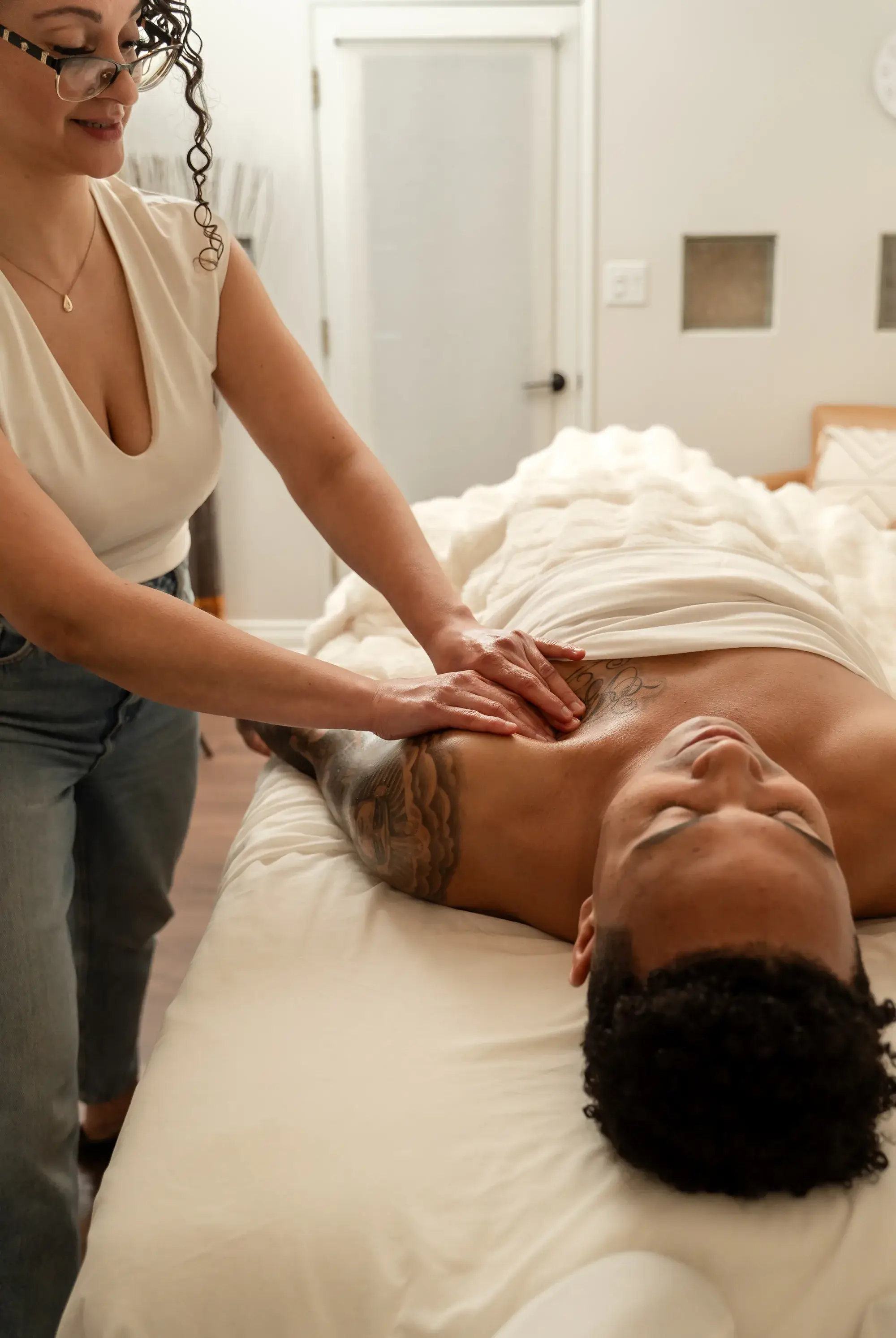
Massage therapists, by contrast, assess the soft tissues and joints and then treat them with therapeutic hands-on techniques, according to ALIS’s profile of the occupation. You lie on a table while the therapist works through tight or tender muscles, and you leave feeling looser, with perhaps a stretch or two to try.
| Kinesiologist | Massage therapist | |
|---|---|---|
| Session style | Active: you move, lift and practise | Hands-on: the therapist treats the tissues |
| Typical training | Four-year bachelor’s degree, most often in kinesiology | Diploma program of at least 2,200 hours |
| Alberta regulation | None; voluntary registration with the Alberta Kinesiology Association | None; membership in a massage association |
| Main output | Exercise, rehabilitation and ergonomic plans | Relief of muscle tension and pain, improved comfort |
| Benefit plan coverage | Varies by plan | Varies by plan; usually tied to the 2,200-hour standard |
Training and regulation in Alberta
Both are unregulated, but they are heading down different paths. ALIS states there is currently no provincial legislation regulating kinesiology in Alberta. Kinesiologists need a four-year bachelor’s degree, most often in kinesiology, and many go on to a master’s. Registration with the Alberta Kinesiology Association or certification with the Canadian Society for Exercise Physiology is voluntary.
The kinesiology association is actively working to change that. Its stated aim is regulation under the Health Professions Act, to protect the public, clarify scope and support integration into Alberta’s health system. Its 2025 to 2028 strategic plan names 2026 as a key year, and it has launched a volunteer Regulation Task Force to prepare the application.
Massage therapy is not on the province’s list of regulated professions either. ALIS explains that massage associations require a program of no less than 2,200 hours of training, which is also the bar for reimbursement through benefit plans. For both professions, asking which association a practitioner belongs to is the practical way to check training.
What the evidence says about exercise and hands-on care
Exercise has the stronger evidence for lasting change in chronic back and neck pain, which is the kinesiologist’s home ground.
- A 2021 Cochrane review of 249 trials found moderate-certainty evidence that exercise reduces pain in chronic low back pain compared with no treatment, usual care or placebo, by an amount the authors judged clinically important.
- A 2015 Cochrane review of exercise for neck pain found moderate-quality evidence that strengthening the neck, shoulder blade region and arms helps chronic neck pain.
Massage earns its place differently. It tends to bring short-term relief, which can be exactly what makes the exercise possible. Our page on whether massage works for chronic low back pain goes through that evidence in detail.
Choosing by your goal
Match the practitioner to the problem in front of you:
- You want to get stronger, return to a sport or change how you move at work. A kinesiologist is built for this: assessment, a program, progressions and accountability.
- Pain, stiffness or tension is stopping you from starting. A massage therapist can ease the tissues so the first steps feel possible.
- You keep reinjuring the same area. Usually both: hands-on care to settle things down and a kinesiologist to build capacity so it holds.
- You want ergonomic advice for a home or office desk. Kinesiologists run ergonomic assessments; this is outside a massage therapist’s training.
- The pain is new, unexplained or comes with numbness or weakness. See your doctor before either, because neither profession diagnoses medical conditions.
Checking your benefits
Read your own plan before you book either. For massage, the 2,200-hour training standard is what plans look for before they reimburse. Kinesiology coverage is less predictable: the Alberta Kinesiology Association has asked insurers and employers to share their coverage structures and the barriers to using kinesiologists in benefit plans, a sign that coverage varies widely. Our guide to extended health plans and massage therapy in Alberta walks through the questions to ask.
Where Renu fits
Renu’s team is Registered Massage Therapists, along with an acupuncturist and a licensed esthetician; we do not have a kinesiologist. If you are working with a kinesiologist or another trainer, massage can be the hands-on half of the plan.
A 60-minute massage is $120, long enough to go through your history and training load, assess, and work the areas that are limiting you. Bring your program or a list of the exercises you are doing, and tell your therapist what feels hardest. Other lengths are listed on our massage therapy page. Book through Jane online; the clinic on 19 Street NW is open every day, with free street parking on 19 Street.
Questions people ask
Is a kinesiologist the same as a physiotherapist?
No. Physiotherapists are regulated in Alberta through the College of Physiotherapists of Alberta, while kinesiology has no provincial legislation and relies on voluntary registration. Kinesiologists focus on exercise, movement and ergonomics, and do not hold the restricted activities that authorized physiotherapists can perform.
Does extended health insurance cover a kinesiologist?
It depends entirely on your plan. The Alberta Kinesiology Association itself has asked insurers to share how they cover kinesiologists and what barriers exist, which tells you coverage is not uniform. Read your plan booklet or call your insurer before booking.
Can a kinesiologist do massage?
Kinesiology training centres on movement science and exercise, not hands-on soft-tissue treatment. Some kinesiologists hold other qualifications as well, so ask about training; for a massage receipt your plan will usually want a therapist who meets the 2,200-hour association standard.
Should I get a massage before or after a kinesiology session?
There is no fixed rule. Some people like a massage a day or two before an exercise session so they feel freer to move; others prefer it afterwards to settle sore muscles. Talk it through with both practitioners.
Sources
- ALIS: Kinesiologist occupation profile
- Alberta Kinesiology Association: Regulation Task Force
- ALIS: Massage therapist occupation profile
- Government of Alberta: Regulated health professions
- Cochrane (2021): Exercise therapy for chronic low back pain
- Cochrane (2015): Exercises for mechanical neck disorders
Page reviewed October 5, 2026. This page is education, not a diagnosis. For your own situation, talk to your doctor, surgeon or care team, or ask us.
Keep reading
Related pages