

Physiotherapist, chiropractor or massage for neck pain
Physiotherapist, chiropractor or massage for neck pain: what the OPTIMa guideline and Cochrane reviews suggest by how long it has hurt, and who does what.
By The Renu lymphatic and massage team · 5 min read
For an ordinary stiff or sore neck, the best first step depends on how long it has lasted. In the first three months, the OPTIMa guideline favours education with range-of-motion exercise, or exercise combined with manipulation or mobilization, which points to a physiotherapist or chiropractor. After three months, clinical massage joins the list of reasonable options alongside strengthening exercise. Arm numbness, pins and needles or worsening symptoms mean a doctor first.
A sore neck sends people in three directions: the physiotherapist, the chiropractor and the massage therapist. Rather than ranking the professions, it helps to start with the neck itself. How long has it hurt, does anything travel into the arm, and is it improving? Those answers, and one well-built clinical guideline, point to a sensible first booking.
Start with how long the pain has lasted
The clearest guidance comes from the OPTIMa guideline, a 2016 Canadian clinical practice guideline for neck pain and associated disorders, built from systematic reviews by a multidisciplinary panel. It sorts care by severity (grades I to III) and by duration, with three months as the dividing line.
Before anything else, rule out serious causes. The guideline’s first recommendation is that clinicians exclude major structural or other pathology, then grade the neck pain. It also asks clinicians to reassure people about the usually benign, self-limited course of ordinary neck pain and the value of staying active.
Grade I or II, three months or less. Clinicians may consider structured education combined with range-of-motion exercise, multimodal care (range-of-motion exercise together with manipulation or mobilization), or muscle relaxants. The guideline advises against relaxation massage, a cervical collar, electroacupuncture, electrotherapy and clinic-based heat at this stage, because the evidence showed no benefit.
Grade I or II, more than three months. The options widen: range-of-motion and strengthening exercise, qigong, yoga, multimodal care, clinical massage, low-level laser therapy or anti-inflammatory medication, each alongside education. Relaxation massage is again not recommended.
Grade III, where nerve signs are present. Supervised strengthening exercise with education may be considered in the first three months, and people who still have neurological signs and disability after three months should be referred to a physician.
| How long it has hurt | Options the guideline supports | Who usually provides them |
|---|---|---|
| Three months or less | Education plus range-of-motion exercise, or exercise with manipulation or mobilization | Physiotherapist, chiropractor |
| More than three months | Strengthening exercise, yoga, qigong, multimodal care, clinical massage | Physiotherapist, chiropractor, Registered Massage Therapist |
| Any duration, nerve signs | Medical assessment, supervised strengthening | Physician, then physiotherapist |
What each practitioner brings to a sore neck
Each profession has a different centre of gravity, and good care often borrows from all three.
- Physiotherapist. Exercise prescription and progression is the core of the work, which matters because exercise is the thread running through every stage of the guideline. Physiotherapists can mobilize the neck, and in Alberta they may perform spinal manipulation only after approved post-entry training.
- Chiropractor. Manipulation is the signature tool. The College of Physiotherapists of Alberta defines spinal manipulation as a deliberate, brief, fast thrust moving spinal joints beyond the normal range but within the anatomical range, and chiropractors are the profession best known for it.
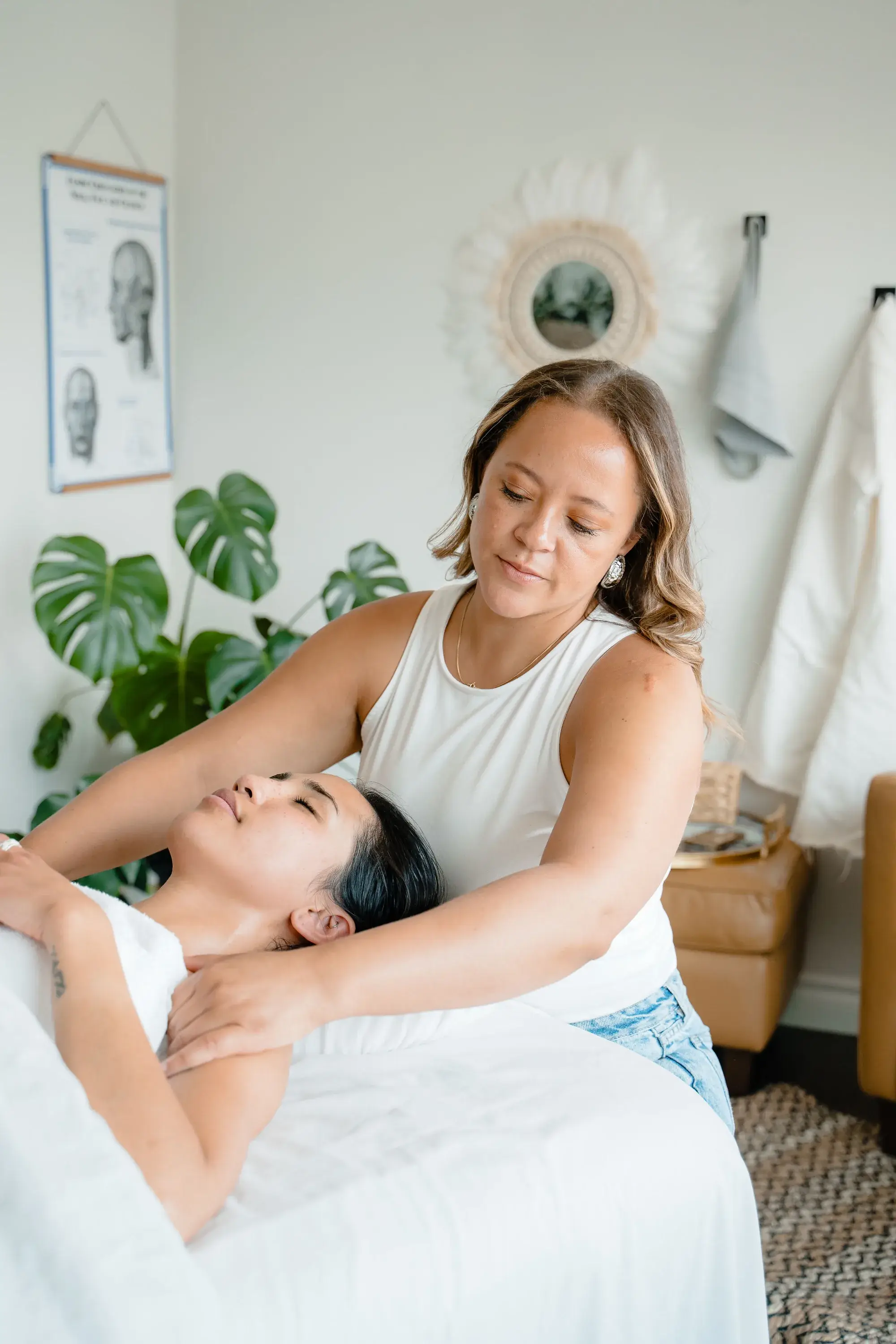
- Registered Massage Therapist. Clinical soft-tissue treatment of the neck, shoulders and upper back, with time to work slowly through tight, tender muscles.
What the Cochrane reviews add
Three Cochrane reviews fill in the detail behind the guideline.
- Exercise. For chronic neck pain, moderate-quality evidence supports strengthening of the neck, shoulder blade region and upper limb, with benefit on pain immediately after treatment and at short-term follow-up. Low-quality evidence suggests stretching alone may not change pain or function.
- Manipulation versus mobilization. For acute and chronic neck pain, several sessions of cervical manipulation produced similar changes in pain, function and satisfaction to several sessions of mobilization, the gentler joint technique. If one of them makes you uneasy, the other appears to do about as well.
- Massage. Massage gave immediate or short-term relief of pain and tenderness, but the evidence was low or very low quality and the reviewers could not make a practice recommendation.
Put together, hands-on care tends to ease how the neck feels in the short run, while strengthening is what the better evidence supports for a neck that keeps coming back. The most useful plan usually pairs the two.
When to see a doctor first
Most neck pain is not dangerous, and the NHS notes that most of it lasts only a few weeks. See a doctor before booking any of the three if:
- the pain has lasted more than a few weeks or painkillers are not helping;
- you have pins and needles, numbness or coldness in an arm;
- symptoms are getting worse, or new physical symptoms appear (OPTIMa advises referral to a physician at any point if this happens);
- the pain followed a significant fall or collision.
The NHS also advises against a neck collar unless a doctor tells you otherwise, because keeping the neck moving is better.
What Renu can offer your neck
Renu is a massage clinic, so we do not provide physiotherapy or chiropractic care. What we can offer is clinical, goal-directed massage, which suits a neck that has been sore for a while or that stiffens with desk work and stress, and which sits comfortably beside the exercise program a physiotherapist gives you.
- Massage, 60 minutes, $120 with a Registered Massage Therapist, focused on the neck, shoulders and upper back. Other lengths are on our massage therapy page.
- RAPID NeuroFascial Reset (upper body), 30 minutes $85 or 45 minutes $110 with Monica Von Gaza. It is a different style of hands-on work for the neck and shoulder region; our RAPID NeuroFascial Reset page explains it.
Tell us what your physiotherapist or doctor has found, and bring your home exercises. Book online through Jane; the clinic on 19 Street NW is open seven days, with weekday appointments until 8:30 pm for anyone coming after a day at a desk. For the self-care side, our desk stretches for the neck and shoulders are a gentle place to begin.
Questions people ask
Should I see a physio or a chiropractor for a stiff neck?
For a recent stiff neck, the OPTIMa guideline supports exercise either on its own with education or combined with manipulation or mobilization. Physiotherapists are trained in exercise prescription and can mobilize, and chiropractors manipulate; a Cochrane review found manipulation and mobilization gave similar results over several sessions. Choose the clinician you can see soonest and who will give you a home program.
Is massage good for a pinched nerve in the neck?
Arm pain, numbness or pins and needles can mean a nerve is involved, and that deserves a medical assessment before hands-on treatment. Once a doctor has ruled out anything serious, gentle massage around the neck and shoulders may be part of your care, but it is not the first step.
How long does a stiff neck usually last?
The NHS says most neck pain lasts only a few weeks. If it is still there after a few weeks, or painkillers are not helping, it is time to see a doctor.
What is the difference between clinical massage and relaxation massage for neck pain?
The OPTIMa guideline lists clinical massage as an option for neck pain lasting more than three months, but advises against relaxation massage for neck pain at any stage. The difference lies in whether the session is goal-directed treatment of the neck problem or general relaxation.
Sources
- European Spine Journal (2016): Management of neck pain and associated disorders, OPTIMa guideline
- Cochrane (2015): Exercises for mechanical neck disorders
- Cochrane (2015): Manipulation and mobilisation for neck pain
- Cochrane (2012): Massage for mechanical neck disorders
- NHS: Neck pain
- College of Physiotherapists of Alberta: Restricted activities
Page reviewed October 5, 2026. This page is education, not a diagnosis. For your own situation, talk to your doctor, surgeon or care team, or ask us.
Keep reading
Related pages