
Care for you
Massage for pilots and flight attendants in Calgary
Massage for pilots and flight attendants in Calgary: easing the low back, neck and legs after pairings, booking around a roster, and clot signs to check.
By The Renu lymphatic and massage team · 5 min read
Massage can ease the low back, neck and shoulder strain that cabin work and long hours in a flight deck seat build up, and it gives tired legs some attention between pairings. Research on massage for low back pain shows short-term relief, so most crew get more from regular sessions than from one. Before any leg work after a long duty day, rule out clot signs such as one-sided calf pain or swelling.
What massage offers aircrew
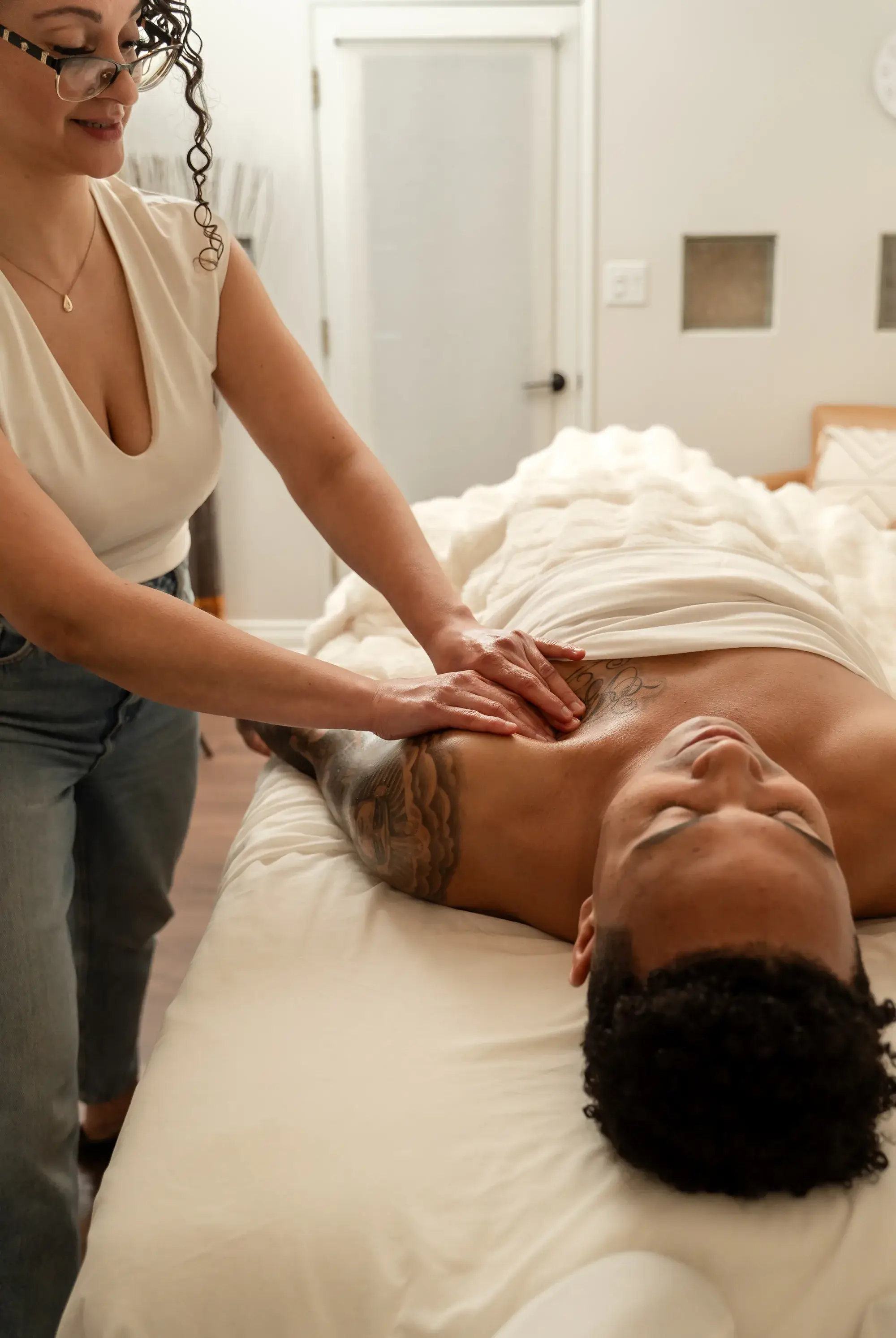
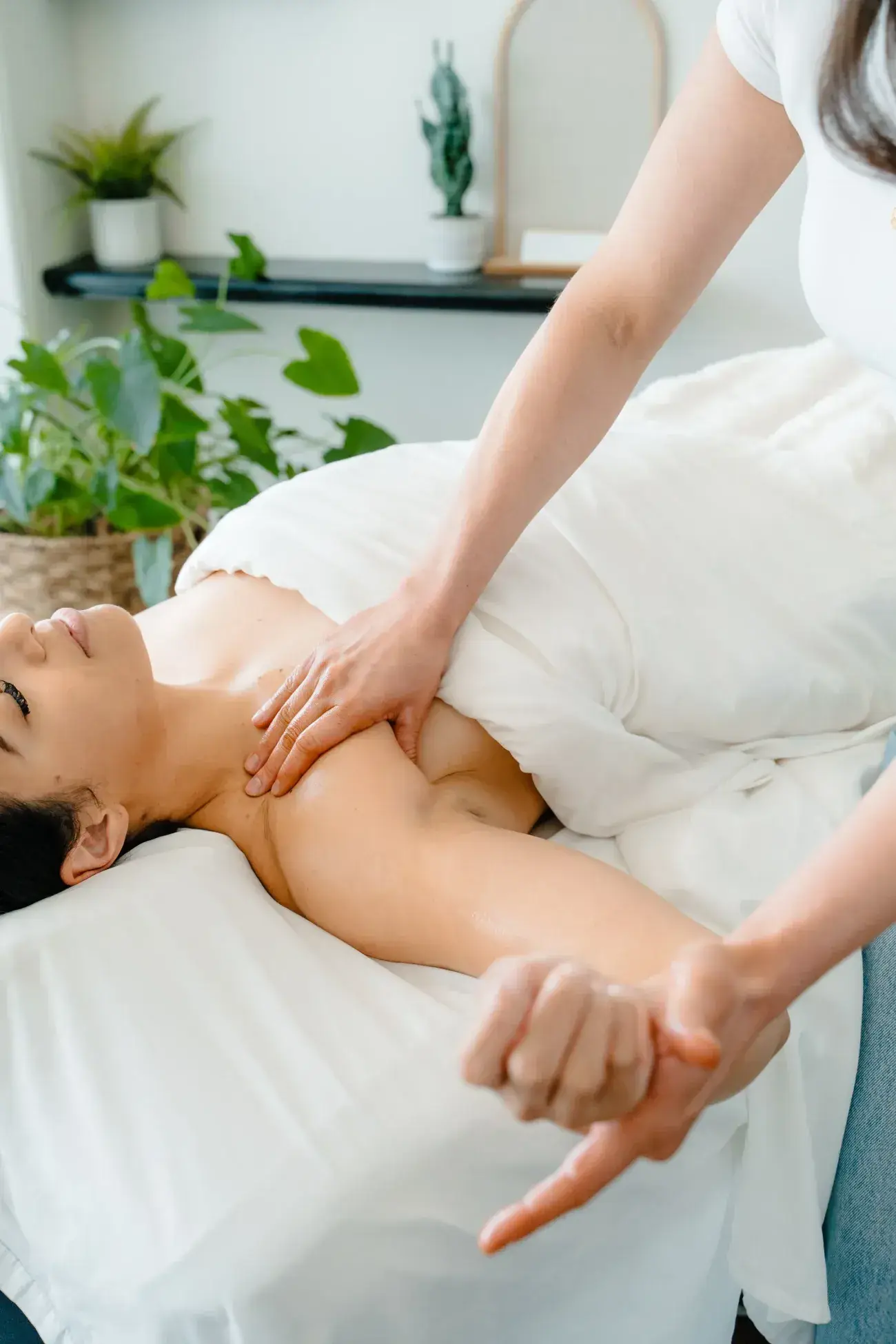
For pilots and flight attendants, massage is a way to look after the parts of the body the job loads most. That means the low back, the neck and shoulders, the arms that lift bags and push carts, and legs that spend hours either standing in a moving cabin or folded under a flight deck panel. A session eases that tension and gives you an hour on the ground with nothing to monitor.
Set expectations honestly. A Cochrane review of massage for low back pain found improvements in pain in the short term, with minor side effects. For crew, that makes massage a regular part of looking after yourself between trips, not a one-off fix.
Calgary has a large crew community for a reason: WestJet is headquartered in Calgary and uses Calgary International Airport as its exclusive global connecting hub. If you are based at YYC, our clinic in West Hillhurst, NW Calgary, is reachable after a sign-off or on a day off.
Cabin crew: lifting, reaching and confined spaces
Cabin work is physical. NIOSH lists lifting, bending, carrying, reaching, working in confined spaces and repetitive motions as the tasks that cause musculoskeletal disorders in aircrew, and adds that turbulence or sudden aircraft movement can throw you off balance and lead to falls. Its advice to crew is to avoid or limit awkward postures (a bent or twisted back, arms overhead or far in front of the body), repetitive movements and heavy or overhead lifting. It also advises crew to ask for broken equipment such as a cart with bad wheels to be fixed.
The numbers show how common the result is. In a survey of 185 female flight attendants working long-haul international flights, 97% had some work-related musculoskeletal symptoms in the past year. Symptoms often involved more than one region, and the lower back was affected most often.
For a flight attendant, a massage usually works through:
- the low back and hips, from pushing, pulling and bending in the aisle
- the shoulders and upper back, from overhead bins and reaching across rows
- forearms and hands, from carts, doors and service
- calves and feet, from standing and walking on a moving floor
Pilots: long hours in the seat
Pilots carry a different load: long periods seated with limited ability to change position. In a survey of 698 German airline pilots, 74.1% had low back pain at the time they answered, and the point prevalence of chronic nonspecific low back pain was 82.7%. Flying more than 600 hours in the previous 12 months was significantly linked with acute low back pain, although the authors note this does not prove cause.
For pilots, sessions tend to centre on the low back, glutes and hip flexors, and on the neck and shoulders from scanning and reaching to overhead panels. If neck stiffness is your main complaint, see our page on neck pain; for the back, low back pain.
Legs, long sectors and clot warning signs
Long flights affect crew the same way they affect passengers, with the difference that you do it every week. The CDC says anyone travelling more than 4 hours by air can be at risk for blood clots, and recommends moving your legs often, exercising the calf muscles and taking stretch breaks every 1 to 2 hours. Mild ankle swelling in both legs is common; our page on why feet swell on a plane explains it.
The CDC lists these as signs of a deep vein thrombosis (DVT):
- an arm or leg that has swollen
- unexplained tenderness or pain in that limb
- skin over it that feels warm
- skin that has turned red or changed colour
Contact a doctor as soon as possible if you notice them, and do not have that limb massaged. Difficulty breathing, chest pain, a fast or irregular heartbeat, coughing up blood, light-headedness or fainting can mean a clot has reached the lungs: get medical help immediately. Mention any sore or puffy leg from your last trip as soon as your session starts.
When the legs are simply heavy and tired, the massage and lymphatic combination pairs regular massage with gentle lymphatic work. It comes in 60 and 90 minute lengths.
Sleep, rosters and when to book
Crew sleep is often the first thing to suffer. NIOSH notes that aircrew may experience jet lag, a type of circadian disruption, as they work. In a 2025 survey of 101 airline personnel, sleep disturbances (71%) and fatigue (89%) were the most common symptoms reported.
Massage will not reset a body clock, but it can be a calm, scheduled hour that fits a roster. Practical timing:
- After a multi-day pairing: book for your first day off, after a proper sleep.
- Between short turns: a 60-minute massage focused on the back and shoulders.
- After a long-haul trip or a heavy month: 90 minutes, or the 90-minute massage and lymphatic combination if your legs are the problem.
- Before an early report: keep pressure moderate so you are not sore in uniform.
We are open seven days a week, until 8:30 pm on weekdays and 10:00 am to 5:00 pm on weekends, and you book online through Jane, which suits a roster that changes month to month. If you are also flying long-haul on your own time, massage after a long-haul flight covers the passenger side.
When to see a doctor first
Check with your doctor, or your company’s medical provider, before massage if you have:
- one-sided leg pain or swelling, or any of the lung symptoms above
- back pain that comes with leg numbness or weakness, or a change in bladder or bowel control
- an injury from turbulence, a fall or a door or cart that has not been assessed
- pain that keeps worsening rather than easing between trips
Everything else, including the low back that aches after every pairing, is a reasonable reason to book. Lengths and prices are on our massage therapy page.
Questions people ask
Is it better to book a massage before or after a pairing?
After is usually more useful, once you have slept, because that is when the back and legs need it. A lighter session before a trip is fine too; just avoid deep work the day before a duty you need to feel fresh for.
Why does my low back hurt more than my legs after a trip?
Both cabin crew and pilots report the low back as the most troublesome area in surveys. For cabin crew it is the lifting, bending and pushing of carts; for pilots it is long hours seated. Your therapist will focus there unless you ask otherwise.
My ankles swell on every long sector. Is that a problem?
Mild swelling in both ankles that settles after a night's rest is common after long periods of sitting or standing. Swelling in one leg with pain, warmth or redness is not, and needs a doctor before any massage.
Can I book the same day I land?
If there is an opening, yes, and our weekday hours run to 8:30 pm. Tell your therapist you have just come off a flight so they can check how your legs feel first.
Sources
- Lee et al., Aviat Space Environ Med 2006: Work-related musculoskeletal symptoms reported by female flight attendants on long-haul flights
- Albermann et al., Aerosp Med Hum Perform 2020: Low back pain in commercial airline pilots
- NIOSH: Aircrew musculoskeletal injury risks and prevention
- NIOSH: Aircrew safety and health
- Stefańska et al., 2025: Health implications of shift work in airline pilots and cabin crew
- CDC: Blood clots and travel
- Wikipedia: WestJet
- Furlan et al., Cochrane Database Syst Rev 2015: Massage for low-back pain
Page reviewed October 5, 2026. This page is education, not a diagnosis. For your own situation, talk to your doctor, surgeon or care team, or ask us.
Keep reading
Related pages