
Massage for nurses in Calgary
Massage for nurses in Calgary: what helps a low back, neck and shoulders strained by patient handling, tired legs after 12-hour shifts, and when to book.
By The Renu lymphatic and massage team · 5 min read
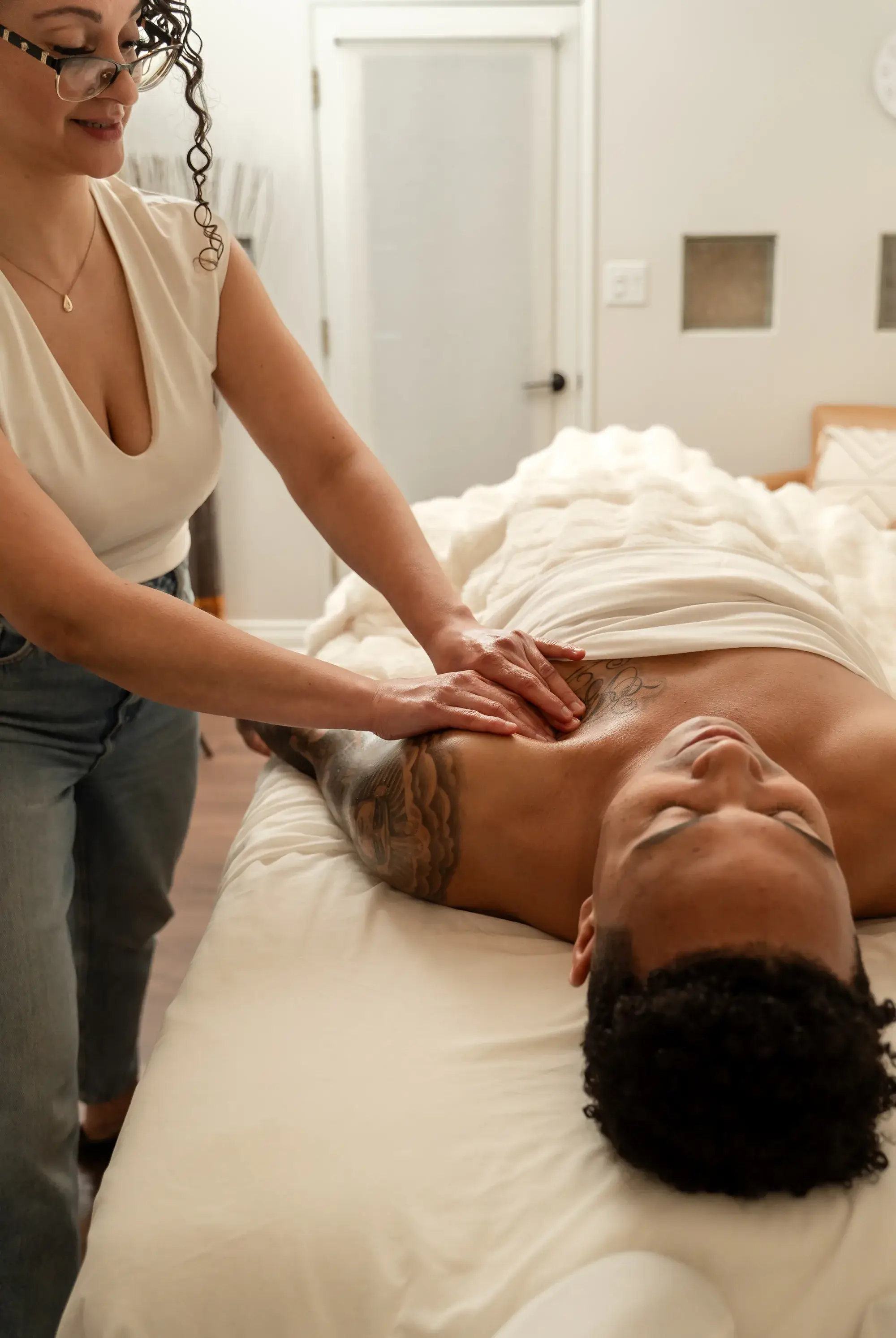
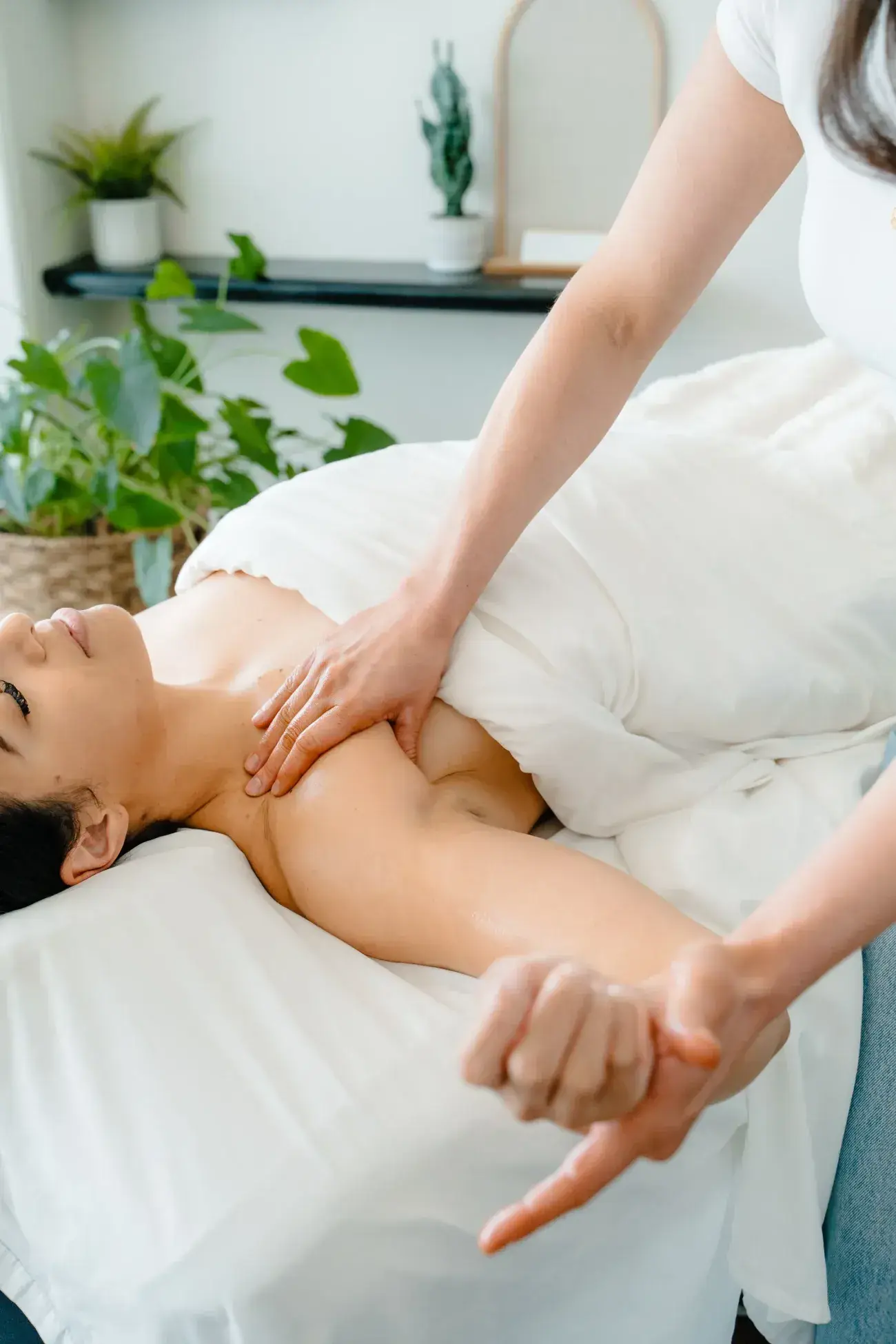
For most nurses, a 60- or 90-minute massage aimed at the low back, neck and shoulders is the right starting point, because those are the areas nursing work strains most. If your legs feel heavy and puffy after long shifts on your feet, a massage and lymphatic combination adds gentle drainage work for the legs. Book it on a day off or the afternoon before a stretch of nights, not straight after a night shift, and see a doctor first about any one-sided leg swelling.
For most nurses, the right first booking is a 60- or 90-minute massage focused on the low back, neck and shoulders, because those are the three areas nursing work loads most. If your legs feel heavy at the end of a long shift, a massage and lymphatic combination adds gentle drainage strokes for the legs. Timing matters as much as technique: book on a rest day rather than straight off a night shift.
Where nursing work shows up in the body
The low back takes the most strain, followed closely by the neck and shoulders. A 2023 meta-analysis pooling 42 studies and almost 37,000 nurses put the yearly prevalence of work-related musculoskeletal disorders at 77.2%. The most affected regions were:
| Region | Yearly prevalence in nurses |
|---|---|
| Lower back | 59.5% |
| Neck | 53.0% |
| Shoulder | 46.8% |
A larger review of 132 studies found the same order for nurses and nursing aides: low back first, then shoulders and neck. Its authors also noted that most research has looked at the low back in hospitals, and that heavier patients, early mobility programmes and home care may be shifting strain toward the shoulders and arms.
In practice, this matches what nurses describe on our table: a low back that is sore after a shift of transfers and repositioning, tight upper shoulders from charting, IV lines and leaning over beds, and a neck that never quite lets go.
What massage can and cannot do for a nurse’s back
Massage is a reasonable way to ease pain and stiffness, but the research done with nurses themselves is small, so we keep expectations honest.
- A small trial in nursing staff. Eighteen nursing employees with work-related low back pain had seven or eight massages after their shifts. Pain scores dropped significantly, and their Oswestry disability score improved from 21.33% to 16.67% over the study. There was no comparison group, so it shows change, not proof.
- A year of monthly massage. In a 2026 feasibility study, 25 Swedish nurses had a classic massage once a month for twelve months. Stress, quality of life, work ability and mental health improved at six and twelve months, while sleep and lasting pain relief changed less. The design was built to test whether a full trial is workable, not to prove the effect.
What massage does not do is change the lifting itself. If one task reliably sets off your back, it is worth raising with your unit’s safe patient handling lead as well. For broader context on the evidence, see our page on low back pain.
Tired, puffy legs at the end of a shift
Heavy legs after a 12-hour shift are common and usually come from standing without enough walking. The Canadian Centre for Occupational Health and Safety (CCOHS) lists sore feet, swollen legs, varicose veins, muscle fatigue, low back pain and neck and shoulder stiffness as effects of working on your feet. It explains that standing still for long periods, without relief from walking, lets blood pool in the legs and feet.
This is where the massage and lymphatic combination earns its place. Part of the session is regular massage for the back and shoulders; part is light, rhythmic lymphatic drainage for the legs, which is gentler than it sounds. It suits the nurse whose ankles are puffy by the end of the shift and settle overnight. Our page on why ankles swell after sitting or standing all day explains the everyday mechanics.
When to see a doctor before booking
Some leg swelling is not a massage problem. The NHS lists these signs of a deep vein thrombosis (DVT):
- throbbing pain in one leg, usually the calf or thigh;
- swelling in one leg (rarely both);
- red, blue or darkened skin around the painful area, or swollen veins.
Get an urgent medical assessment before any massage if you notice these. If leg pain and swelling come with shortness of breath or chest pain, call 911: a clot that travels to the lungs is a medical emergency. Read more on deep vein thrombosis.
Fitting massage around 12-hour rotations
The best slot is the one that does not cost you sleep. CCOHS notes that daytime sleep is seldom as deep or refreshing as night sleep, and that disrupted sleep is close to unavoidable when night work is involved. A deep massage at 9 am after a night shift can leave you wired or groggy right when you need to sleep.
Practical options that tend to work:
- First day off after a block of days. Your back is at its sorest and you have time to rest afterwards.
- The afternoon before your first night. Many nurses nap in the late afternoon anyway; an early-afternoon appointment fits before that.
- Weekday evenings after a day shift. We are open until 8:30 pm Monday to Friday, which helps when you finish at 7:30 pm and want to go straight home afterwards.
- Weekends. We are open 10:00 am to 5:00 pm on Saturdays and Sundays, useful when your days off fall on a weekend rotation.
How booking works at Renu
Our massage therapists are Registered Massage Therapists, and you can book any of them online through Jane at a time that suits your rotation. For a nurse’s usual pattern of complaints we suggest:
- Massage, 60 min ($120): back, neck and shoulders.
- Massage, 90 min ($157): the same plus hips, legs and feet.
- Massage and lymphatic combination, 60 min ($130) or 90 min ($165): when heavy, puffy legs are part of the picture.
Tell your therapist at the start where the shift hurts most and which tasks provoke it. If you have had surgery recently, have a history of clots, or are pregnant, mention that too so the session can be adapted. We are in West Hillhurst on 19 Street NW, and Foothills Medical Centre, Alberta’s largest hospital, is also in Calgary’s northwest at 1403 29 Street NW, so the two sit in the same part of the city. Free street parking is available on 19 Street.
If you work alongside paramedics or police, our page on massage for first responders covers the different strain of gear and stretcher work.
Questions people ask
Is it better to get a massage before or after a night shift?
Before is usually easier. After a night shift your body wants sleep, and daytime sleep is already lighter than night sleep, so we suggest booking on a rest day or the afternoon before your first night rather than on your way home.
Can massage help my legs after a 12-hour shift?
Massage can ease the heaviness and muscle fatigue of standing all day, and a massage and lymphatic combination adds gentle drainage strokes for the legs. Swelling that is new, in one leg only, or comes with calf pain needs a doctor before any massage.
How often should a nurse book a massage?
There is no research-based schedule for nurses specifically. In the one long-term programme we know of, Swedish nurses had a massage once a month for a year; for an active flare of back pain, closer spacing for a few weeks is common, then longer gaps once it settles.
Which session length should I choose?
Sixty minutes covers the back, neck and shoulders well. Ninety minutes, or the 90-minute massage and lymphatic combination, leaves time for the legs and feet as well.
Sources
- Iranian Journal of Public Health (2023): Prevalence of work-related musculoskeletal disorders among nurses, a meta-analysis
- Human Factors (2015): Musculoskeletal disorders for nurses in hospitals, long-term care and home care, a comprehensive review
- Revista Latino-Americana de Enfermagem (2012): Massage for occupational low back pain in nursing staff
- BMC Complementary Medicine and Therapies (2026): Feasibility of classic massage for Swedish nurses
- CCOHS: Working in a standing position, basic information
- CCOHS: Rotational shiftwork
- NHS: Deep vein thrombosis (DVT), symptoms
- Wikipedia: Foothills Medical Centre
Page reviewed October 5, 2026. This page is education, not a diagnosis. For your own situation, talk to your doctor, surgeon or care team, or ask us.
Keep reading
Related pages