
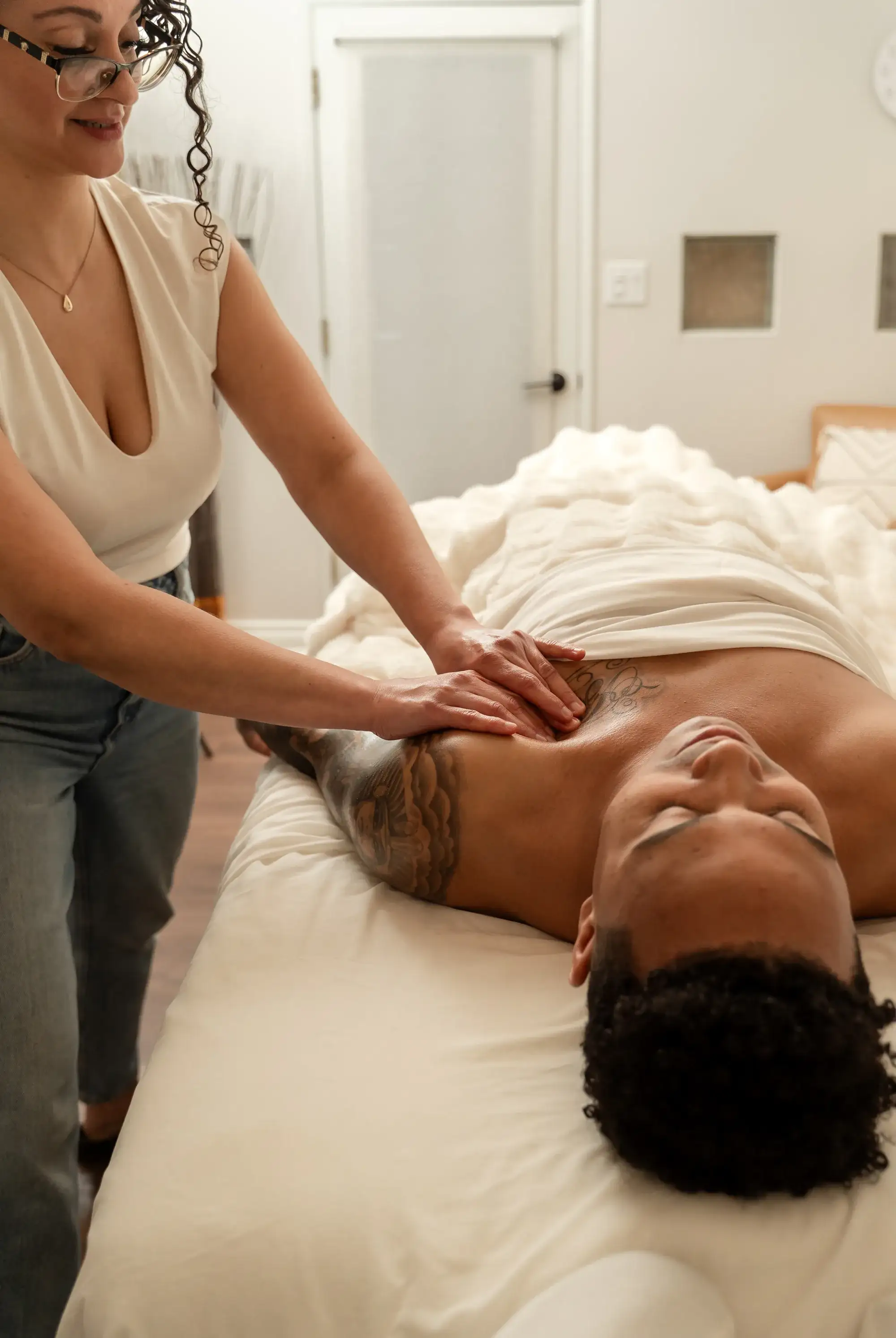
Massage for CrossFit and weightlifting in Calgary
Massage for CrossFit and weightlifting in Calgary: what it does for soreness and fatigue, what it does not do for strength, and when soreness needs a doctor.
By The Renu lymphatic and massage team · 6 min read
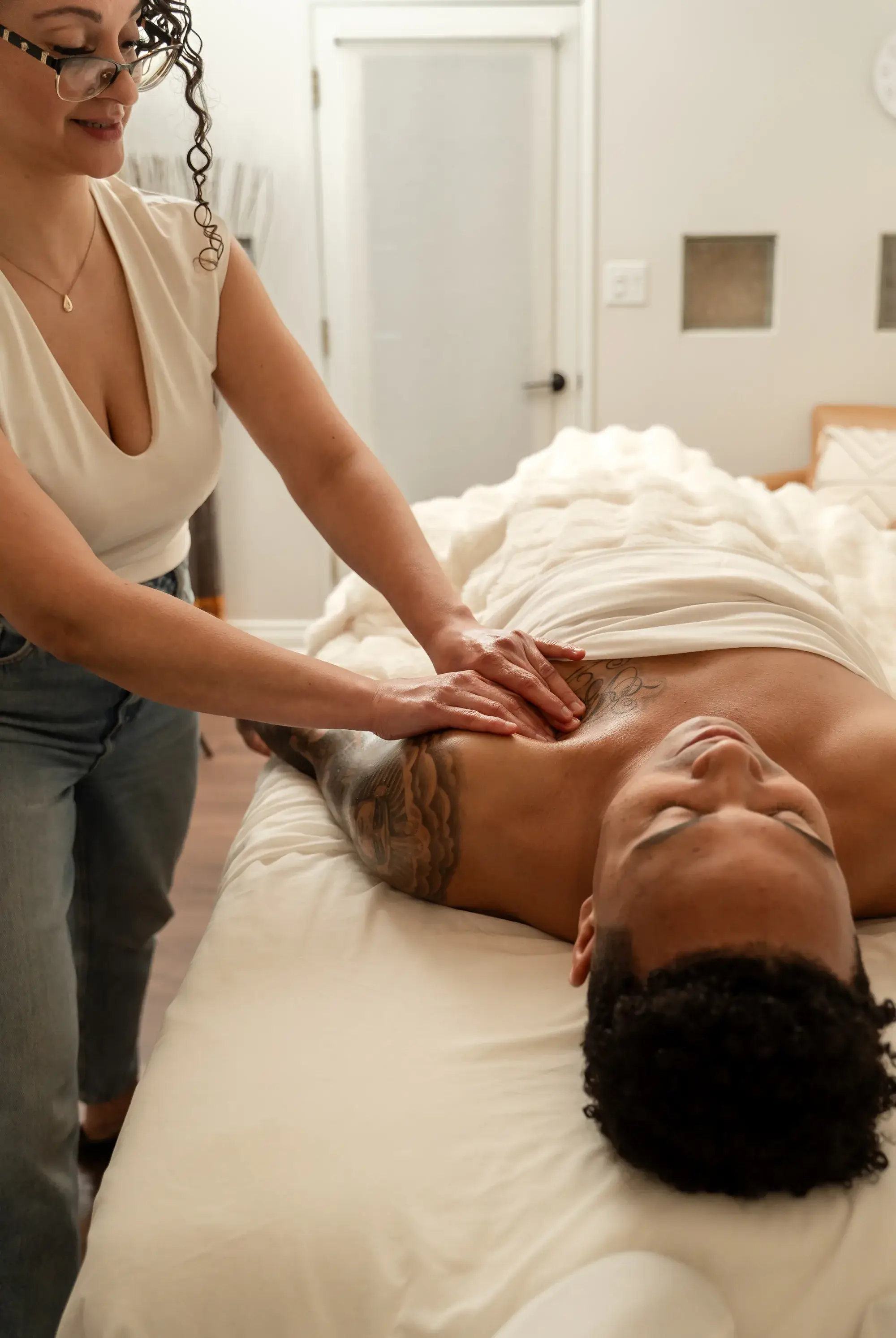
Massage is one of the better-supported ways to ease the deep soreness and tired feeling that follow a hard CrossFit, Olympic lifting or powerlifting session, but it will not add kilos to your lifts. Reviews find it reduces delayed onset muscle soreness and perceived fatigue, while strength and power are unchanged. Soreness that comes with dark, cola-coloured urine or real weakness is not a massage problem and needs urgent medical care.
Lifters tend to come to us with one of two questions. Will massage help me recover faster between sessions, and is this pain normal? The honest answers are “it helps how you feel more than how much you lift” and “usually, but there are a few signs you should never sit on”.
What massage does for a lifter, and what it does not
Massage reliably eases soreness and the heavy, drained feeling after hard training; it does not make you stronger or more powerful. That split shows up across the research.
- A 2018 meta-analysis pooled 99 studies of recovery methods, from cold water immersion to compression garments and stretching. Its authors concluded that massage seemed to be the most effective technique for reducing delayed onset muscle soreness (DOMS) and perceived fatigue.
- A 2017 meta-analysis of 11 randomised trials, 504 participants in all, found soreness ratings were lower with massage than with no treatment at 24 and 48 hours after strenuous exercise, and serum creatine kinase, a marker of muscle damage, was lower too.
- A 2020 review of 29 randomised studies (1,012 participants) found no evidence that massage improves strength, jump, sprint, endurance or fatigue measures, with small but real improvements in flexibility and DOMS.
So think of massage as part of your recovery, alongside sleep, food and smart programming, rather than a performance aid. If your goal is a heavier clean and jerk, the barbell and your coach do that work. If your goal is to get back under the bar on Thursday without dreading the walk down the stairs, massage has a reasonable case.
You can read more about the soreness itself in our glossary entry on delayed onset muscle soreness.
Where CrossFit and lifting tend to hurt
The shoulder, the spine and the knee carry most of the trouble, so those are the areas a lifter’s massage usually spends time on. A 2022 systematic review of 25 studies covering 12,079 CrossFit athletes found an average injury prevalence of 35.3 percent, with incidence between 0.2 and 18.9 injuries per 1,000 hours of training. The most injured areas were:
| Area | Share of CrossFit injuries |
|---|---|
| Shoulder | 26% |
| Spine | 24% |
| Knee | 18% |
The same review found CrossFit’s injury rate similar to weightlifting and powerlifting, which matters if someone has told you the sport is uniquely dangerous. Reported risk factors included older age, male sex, a higher body mass index, previous injury, lack of coach supervision, experience level and entering competitions. Two of those you can do something about: train with a coach watching, and treat old injuries as information rather than ancient history.
For a massage therapist, that list shapes the session. Overhead pressing, kipping and snatches load the front of the shoulder, the lats and the upper back. Deadlifts, cleans and heavy squats load the low back, glutes, hips and quads. Box jumps and double-unders end up in the calves. We ask what you trained, not just where it hurts, because the muscle that complains is not always the one doing the most work. If shoulder pain is sharp when you lift your arm overhead, our page on shoulder impingement explains why it is worth having it assessed.
When soreness is not soreness: exertional rhabdomyolysis
Dark, red or cola-coloured urine after a hard session is a medical emergency sign, not a reason to book a massage. Rhabdomyolysis is the breakdown of muscle tissue that releases its contents into the blood, where they can damage the kidneys. MedlinePlus lists severe exertion among the causes and gives these symptoms:
- dark, red or cola-coloured urine
- decreased urine output
- general weakness, or weakness of the affected muscles
- muscle stiffness, aching or tenderness
A 2017 review in Sports Medicine notes that, while uncommon, exertional rhabdomyolysis still happens when exercise is poorly prescribed, used as punishment, or when someone does a large volume of unaccustomed work. Think of a first class after a long break, a high-rep workout heavy on eccentric movements, or a new programme you jumped into at full volume. The same review found no evidence that creatine monohydrate sets it off, which is useful if you were worried about your supplement.
If your arms or legs are swollen and weak beyond normal soreness, or your urine has darkened, see a doctor or go to emergency the same day. Do not book a massage first; pressure on badly damaged muscle is the last thing it needs. Once you have been cleared, we are glad to help with the stiffness that lingers.
Also see a doctor or physiotherapist before massage for a sudden pop or sharp pain during a lift, pain that wakes you at night, numbness or tingling down an arm or leg, or a joint that gives way.
How to fit massage into a training week
Match the session to where you are in the week. Most of the lifters we see use one of three patterns:
- The day after the heaviest session. Soreness usually builds over the next one to two days, which is also where the studies found massage helped most. Ask for moderate pressure on the freshly trained muscles.
- A maintenance session every few weeks. A 60- or 90-minute massage on a lighter day lets the therapist work more firmly through areas that are tight but not freshly loaded, such as the upper back, hips and forearms.
- A short session before a competition. Keep it light and brief, a few days out rather than the morning of. Our answer on how long before a race to book a sports massage applies to a CrossFit competition too.
Afterward, train as your body tells you. Our page on working out after a massage covers the timing in more detail. If you want to know how sports and deep tissue approaches differ, see deep tissue massage vs sports massage.
Massage for lifters at Renu
At Renu, your massage is with a Registered Massage Therapist who will ask about your training, injuries and goals before working. We adjust pressure to the day: firm through an upper back that has been tight for weeks, gentler over quads that squatted heavy yesterday. Tell us if a movement pattern hurts, such as the catch position of a clean, so we can look at the muscles involved.
For lifters, the usual choices are:
- 45 minutes ($100) for one or two areas, such as shoulders and upper back after a pressing block.
- 60 minutes ($120) for a full-body recovery session.
- 90 minutes ($157) when you want time on the legs, hips and back, the posterior chain after a heavy deadlift week.
We are open seven days, until 8:30 pm on weekdays, so an after-class booking is realistic. Book through Jane online, or see the full massage therapy page for our team and prices.
Questions people ask
Should I get a massage the day after a heavy squat session?
You can, and that window is when soreness usually builds, so many lifters find it the most useful time. Ask for moderate pressure on the legs that day rather than deep work, because the muscle is already irritated. Save the firmest work for areas that are tight but not freshly trained.
Will massage make me weaker for my next WOD?
The research does not show massage lowering strength or power. A large review found no change in strength, jump, sprint or endurance either way. If you are booking right before a competition, keep the session short and lighter so you do not feel flat.
Can massage flush out lactic acid?
That is a common idea, but it is not what the studies measure or show. What reviews do find is less soreness, less perceived fatigue and lower creatine kinase, a marker of muscle damage, after massage. We would rather describe those real effects than promise a flush.
Is it normal to be sore for three days after a new CrossFit programme?
Soreness that peaks a day or two after unfamiliar work and then eases is typical. Soreness with swelling, weakness that stops you lifting your arms or standing from a chair, or dark urine is not typical. Those signs point toward rhabdomyolysis and need a doctor the same day.
Sources
- Physician and Sportsmedicine: Injury in CrossFit, a systematic review of epidemiology and risk factors (2022)
- Frontiers in Physiology: Choosing post-exercise recovery techniques, systematic review with meta-analysis (2018)
- BMJ Open Sport and Exercise Medicine: Effect of sports massage on performance and recovery (2020)
- Frontiers in Physiology: Massage alleviates delayed onset muscle soreness after strenuous exercise (2017)
- MedlinePlus: Rhabdomyolysis
- Sports Medicine: Perspectives on exertional rhabdomyolysis (2017)
Page reviewed October 5, 2026. This page is education, not a diagnosis. For your own situation, talk to your doctor, surgeon or care team, or ask us.
Keep reading
Related pages