
Massage for a meniscus tear
Massage for a meniscus tear eases thigh and calf tension and helps a sore knee keep moving, but exercise therapy is the core treatment. What helps and why.
By The Renu lymphatic and massage team · 6 min read
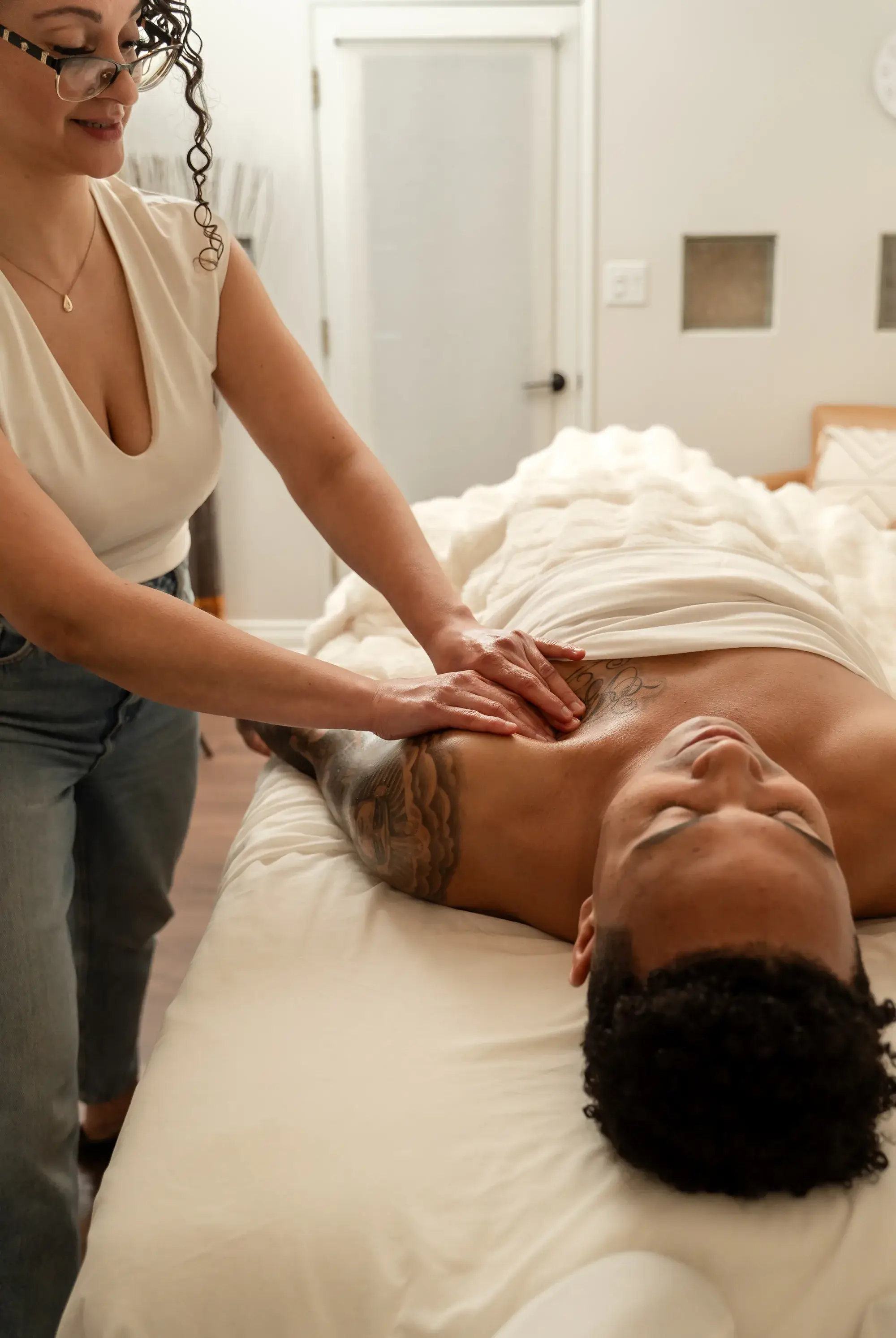
Massage cannot repair a torn meniscus, but it can support the treatment that does the heavy lifting: a supervised exercise program. Gentle work on the quadriceps, hamstrings and calf can ease tension around a sore, swollen knee and make it easier to keep moving between exercise sessions. If your knee is truly locked, cannot straighten or will not take your weight, see a doctor before you book anything.
Massage for a meniscus tear plays a supporting role. The tear itself sits inside the joint, out of reach of any hands, and the treatment with the strongest evidence for most tears in adults is a progressive exercise program. What massage can do is look after the muscles that move and protect the knee, take the edge off the ache, and help you keep showing up for the work that changes things.
That is the honest role we take at our clinic: we support your exercise therapy and your doctor’s plan. If the knee is truly locked, we send you to a doctor first.
Two kinds of tear, two different stories
The answer to “do I need surgery?” depends a lot on how the tear happened.
| Traumatic tear | Degenerative tear | |
|---|---|---|
| Often seen in | Active people of any age | Middle-aged and older adults |
| How it starts | A clear moment: a twist on skis, a pivot in hockey or soccer | Often no single injury; the knee gradually aches or swells |
| What the knee may do | Pop at the time, swell, sometimes give way | Ache, stiffen, catch now and then |
| First stop | A doctor, especially if the knee locks or will not straighten | A doctor or physiotherapist for diagnosis and an exercise plan |
The research that has changed practice over the past decade is about the second column. If you are in your 40s, 50s or 60s and an MRI shows a meniscus tear without a clear injury behind it, the trials below were run on people just like you, and they suggest surgery is rarely the shortcut people expect.
What the trials found about surgery and exercise
Several large, well-run trials have tested arthroscopic partial meniscectomy, the keyhole operation that trims away the torn part, against other options for degenerative tears.
- The Finnish sham-surgery trial (FIDELITY). 146 adults aged 35 to 65 with a degenerative medial meniscus tear and no knee arthritis had either the real operation or a sham one, without knowing which. At 12 months, both groups had improved by about the same amount. At two years the real operation was still no better, and people with catching or failed earlier treatment did not do better with it either. At five years the operated group had a slightly greater risk of arthritis changes on X-ray, with no gain in symptoms or function.
- Catching and locking. A separate analysis of the same trial looked at the symptom many people assume demands surgery. Removing the torn piece gave no added benefit over the sham procedure for catching or occasional locking.
- The Norwegian exercise trial. 140 middle-aged adults with a degenerative tear did either 12 weeks of supervised exercise or surgery. At two years there was no clinically relevant difference in knee function, and the exercise group had stronger thigh muscles at three months. About one in five in the exercise group later chose surgery, without extra benefit.
- METEOR, for tears with arthritis. In 351 people aged 45 and over with a tear and mild to moderate arthritis, physical therapy and surgery gave similar function at six months. The caveat: 30 percent of the physical therapy group had crossed over to surgery by then.
None of this means surgery is never right. A young athlete with a displaced traumatic tear, or a knee that is mechanically stuck, is a different case, and that decision belongs to your surgeon. For the common degenerative tear, though, the evidence points firmly at exercise first.
Where massage fits beside exercise therapy
Massage is not in any of those trials, so we will not claim it changes the outcome. We see it as a comfort and maintenance tool that makes the proven part easier to stick with.
Here is what a session for a torn meniscus usually involves:
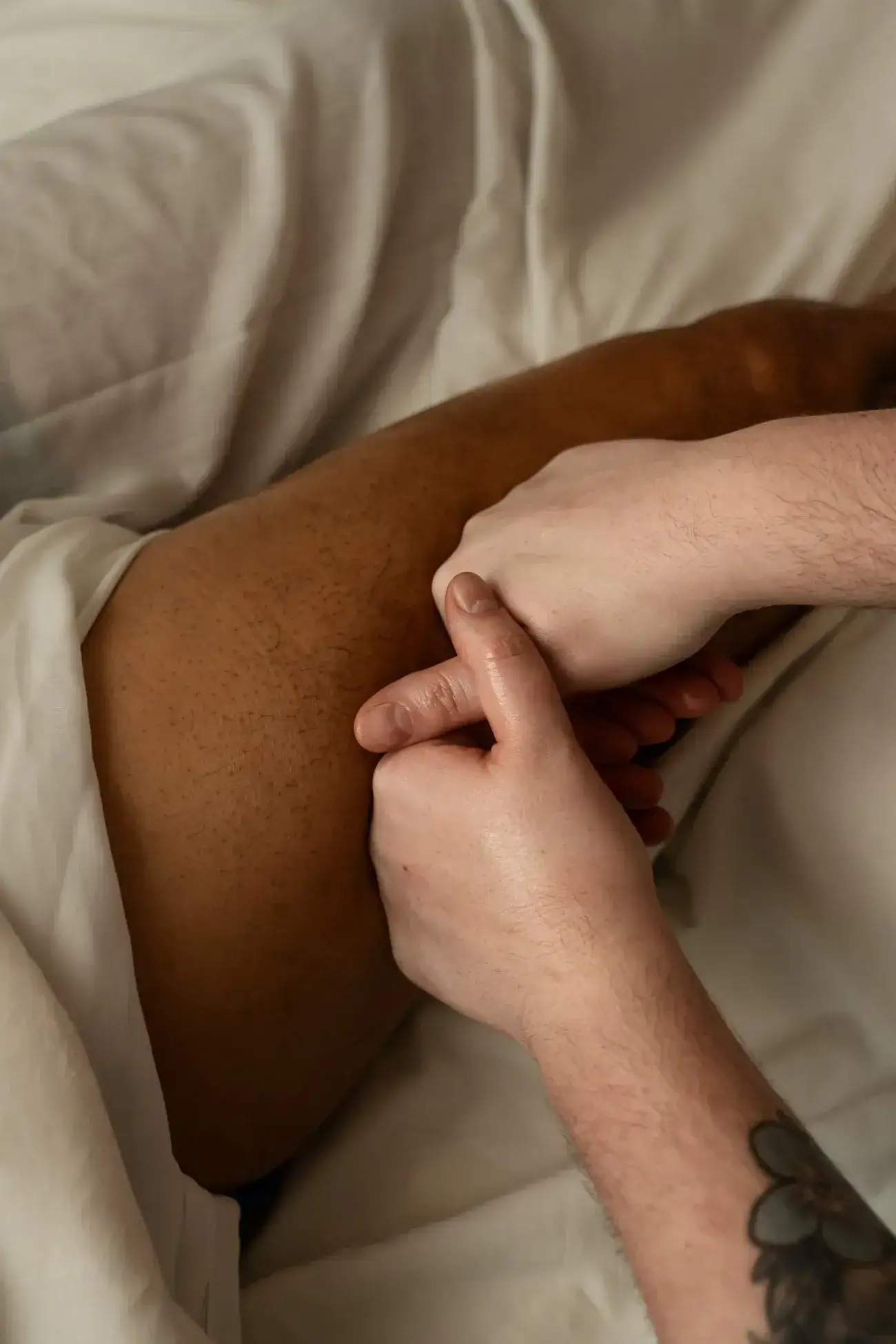
- Quadriceps work. The thigh muscles take a beating when the knee hurts, and building their strength was a key result of the exercise trial. Easing tension through the quads can make the next round of squats or step-ups feel less guarded.
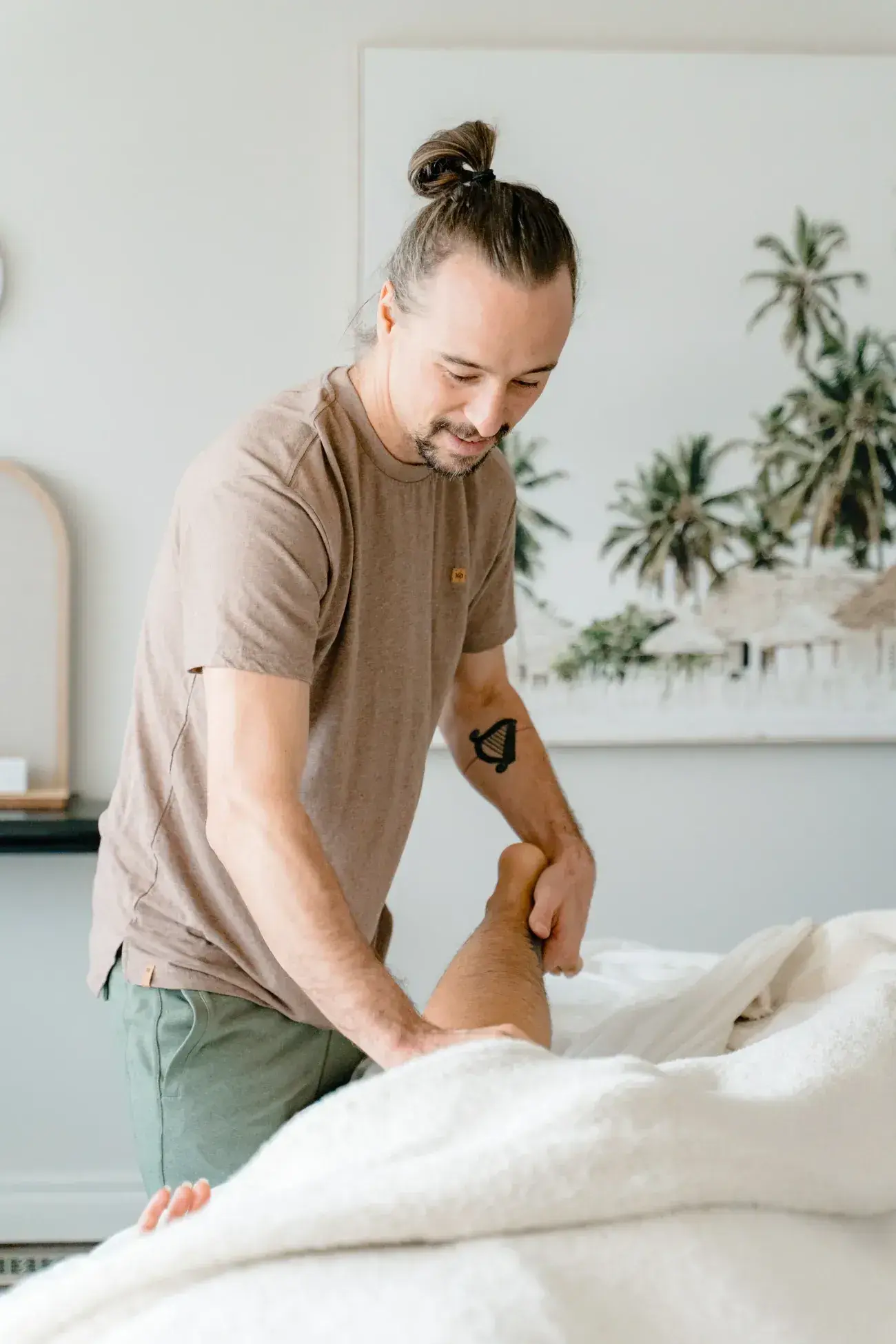
- Hamstrings and calf. These often tighten around a sore knee as you limp or avoid bending it. Broad, steady work through the back of the thigh and the calf is usually well tolerated.
- Swelling comfort. If the knee is puffy, very light strokes above the knee toward the groin can feel soothing. We do not press into a hot, swollen joint.
- Comfortable movement. We may gently bend and straighten the knee within the range that feels easy. We do not force the end of the range or twist the knee to make it click.
What we avoid matters just as much: deep pressure on the joint line, forced rotation, and anything that reproduces a sharp catching pain. If your physiotherapist has given you specific limits, bring them and we will follow them.
How this works at Renu
Book a regular massage therapy session with one of our Registered Massage Therapists through Jane. A 45-minute session ($100) gives time for the thigh, calf and hip on the injured side. A 60-minute session ($120) suits people who also want the other leg, hips and low back worked after weeks of limping. If your knee swells after activity, the 60-minute massage and lymphatic combination ($130) blends regular massage with gentle drainage strokes.
Wear or bring shorts so we can work above and below the knee easily. Tell us which knee, how the tear happened, what imaging showed and what exercises you are doing. Whether yours came from a twist on a ski run in the Rockies or a slip on an icy sidewalk, our pages on massage for skiers and snowboarders and knee osteoarthritis cover the neighbouring problems. If you do have keyhole surgery, our page on lymphatic drainage after knee arthroscopy explains how drainage can help with the swelling afterward.
When to see your doctor first
Some knee symptoms need a medical assessment before any massage. The NHS lists these as reasons to get urgent help:
- the knee is very painful;
- you cannot move the knee or put any weight on it;
- the knee is badly swollen or has changed shape;
- the knee locks, gives way or painfully clicks.
Redness or heat around the knee together with a very high temperature, or feeling hot, cold or shivery, can be a sign of infection and needs urgent advice the same day. And if ordinary knee pain has not improved within a few weeks of rest, ice and simple pain relief, the NHS advises seeing a doctor, who may arrange physiotherapy or a scan.
In Alberta, a family doctor or a physiotherapist is a sensible first stop for a new knee injury. Once you know what you are dealing with and you have an exercise plan, massage can sit comfortably alongside it.
Questions people ask
Can a torn meniscus heal on its own?
Many people with a degenerative tear improve without surgery. In the Norwegian trial of middle-aged adults, 12 weeks of supervised exercise gave the same knee function at two years as surgery. Whether a particular tear can heal depends on its type and location, which is a question for your doctor or surgeon.
Should I massage my own knee after a meniscus tear?
Light stroking of the thigh and calf is fine if it feels good, and it can be a pleasant way to warm up before your exercises. Avoid digging into the joint line or twisting the knee to chase a click. If self-massage makes the knee more swollen or painful the next day, stop and mention it to your physiotherapist.
My knee catches. Does that mean I need surgery?
Not necessarily. In the Finnish trial, removing part of the torn meniscus did no better than a sham operation at relieving catching or occasional locking. A knee that is stuck and cannot straighten is a different situation and needs a prompt medical assessment.
Can I get massage while I wait to see a specialist?
Yes, as long as nothing on the urgent list applies: a locked knee, a knee that will not bear weight, or one that is hot, red or badly swollen. Massage during the wait is about comfort and keeping the surrounding muscles working, not about changing the tear.
Sources
- Sihvonen et al., New England Journal of Medicine 2013: Arthroscopic partial meniscectomy versus sham surgery for a degenerative meniscal tear
- Sihvonen et al., British Journal of Sports Medicine 2020: Five-year follow-up of the FIDELITY trial
- Sihvonen et al., Annals of Internal Medicine 2016: Mechanical symptoms and arthroscopic partial meniscectomy in degenerative meniscus tear
- Katz et al., New England Journal of Medicine 2013: Surgery versus physical therapy for a meniscal tear and osteoarthritis (METEOR)
- Kise et al., BMJ 2016: Exercise therapy versus arthroscopic partial meniscectomy for degenerative meniscal tear in middle aged patients
- NHS: Knee pain
Page reviewed October 5, 2026. This page is education, not a diagnosis. For your own situation, talk to your doctor, surgeon or care team, or ask us.
Keep reading
Related pages