
Conditions
Massage for capsular contracture after breast implants
Massage for capsular contracture after breast implants: why it will not soften a tight capsule, when to see your surgeon first, and what an RMT can help with.
By The Renu lymphatic and massage team · 6 min read
Massage cannot soften or reverse capsular contracture. The firmness comes from scar tissue tightening around the implant, and a literature review found the available data do not support breast massage even to prevent it. If an implanted breast has become firm, high, misshapen or painful, see your plastic surgeon first; massage therapy can then help with chest, shoulder and upper-back tension and comfort while you decide what to do.
Can massage soften capsular contracture?
Massage does not soften a contracted capsule, so our honest role here is to refer you to your surgeon first and then support your comfort. Every implant is surrounded by a thin layer of scar tissue, the capsule, that the body forms naturally. The FDA describes capsular contracture as tightening of that capsule, which makes the breast firm or hard and, if severe, squeezes the implant. It can affect one or both implants and can be painful.
People often find our site after reading that “implant massage” or lymphatic drainage can loosen things up. The research does not back that. A 2017 review in Eplasty looked for every study of breast massage and implant displacement exercises after augmentation. It found four studies with 587 patients in total. Contracture rates averaged 31% in the massage groups and 40% without massage, but the ranges overlapped widely, and the authors concluded that the available data do not support breast massage to prevent capsular contracture. A 2021 review from McGill University’s plastic surgery division reached the same view: postoperative breast massage has not been proven to prevent it.
If massage has not been shown to prevent contracture, there is no basis for expecting it to undo one that has already formed.
The Baker grades in plain words
Surgeons grade contracture on the Baker scale, which describes how the breast feels and looks. Knowing your grade helps you understand what your surgeon is likely to suggest.
| Baker grade | How the breast feels | How it looks |
|---|---|---|
| I | Soft, like a breast without an implant | Natural |
| II | A little firm | Normal |
| III | Firm | Visibly abnormal, often higher or rounder |
| IV | Hard and painful to touch | Visibly abnormal |
The grades come from the FDA and the Eplasty review. The McGill review notes that people experience contracture differently: a severe case can be hard, distorted and painful, but any or none of those may be present, so your own description of what changed matters at the consultation.
Why firmness after implants is not swelling we can drain
Contracture is fibrosis around a device, not fluid in the tissue, which is why lymphatic drainage does not reach it. The McGill review describes it as an inflammatory process that ends in fibrosis where the implant meets the tissue. Lymphatic drainage moves interstitial fluid toward working lymph nodes. In the first weeks after surgery, when the chest is genuinely swollen, that can help, and our page on lymphatic drainage after breast surgery covers that stage. Months or years later, a breast that has become steadily firmer is a different problem.
Researchers still do not know exactly why one person develops contracture and another does not. The FDA says the cause is not known, though it may be more common after infection, a hematoma (a collection of blood) or a seroma (a collection of fluid). A 2018 systematic review of 40 studies found a presumed higher risk with:
- Placement of the implant above the chest muscle (subglandular)
- A hematoma after surgery
- A textured implant surface
- Reconstruction after breast cancer
- Longer time since surgery
None of these are things massage can change.
What your surgeon may offer
Treatment for contracture belongs to your plastic surgeon, and it is usually surgical. The McGill review describes complete capsulectomy with a change of implant pocket and implant exchange as the gold standard, with capsulotomy (releasing the capsule) or partial capsulectomy as alternatives. It also reports that leukotriene antagonists such as montelukast have been studied for prevention and treatment, with liver monitoring needed. The American Society of Plastic Surgeons advises anyone with an implant complication to consult a board-certified plastic surgeon promptly.
If your surgery was out of province or overseas, your family doctor is a sensible first stop. Bring your implant card or operative notes if you have them, since implant type and placement shape the conversation.
Changes that need a surgeon, not a massage
Some changes around an implant should be checked by a doctor before any hands-on treatment, and a few need prompt attention.
- New swelling, a lump or pain around the implant years after surgery. The FDA lists persistent swelling, a mass or pain in the area of the implant, often years after placement, as the main symptoms of breast implant-associated anaplastic large cell lymphoma (BIA-ALCL). A fluid collection around the implant is often found and should be tested. The FDA notes the risk is higher with textured implants.
- A breast that is suddenly larger, hot and red, or a fever. These can point to infection or a fluid collection (seroma), both on the ASPS list of implant risks.
- A change in shape, rippling or a new asymmetry. The ASPS lists leakage or rupture, wrinkling and implant malposition among the known risks, and recommends regular imaging for silicone implants.
- Hard, painful, distorted breasts (Baker grade IV). This is a surgical consultation, not something to wait out.
We will ask about these before any session that involves your chest, and if something sounds new or unexplained we will suggest you see your doctor first.
Where massage therapy does fit
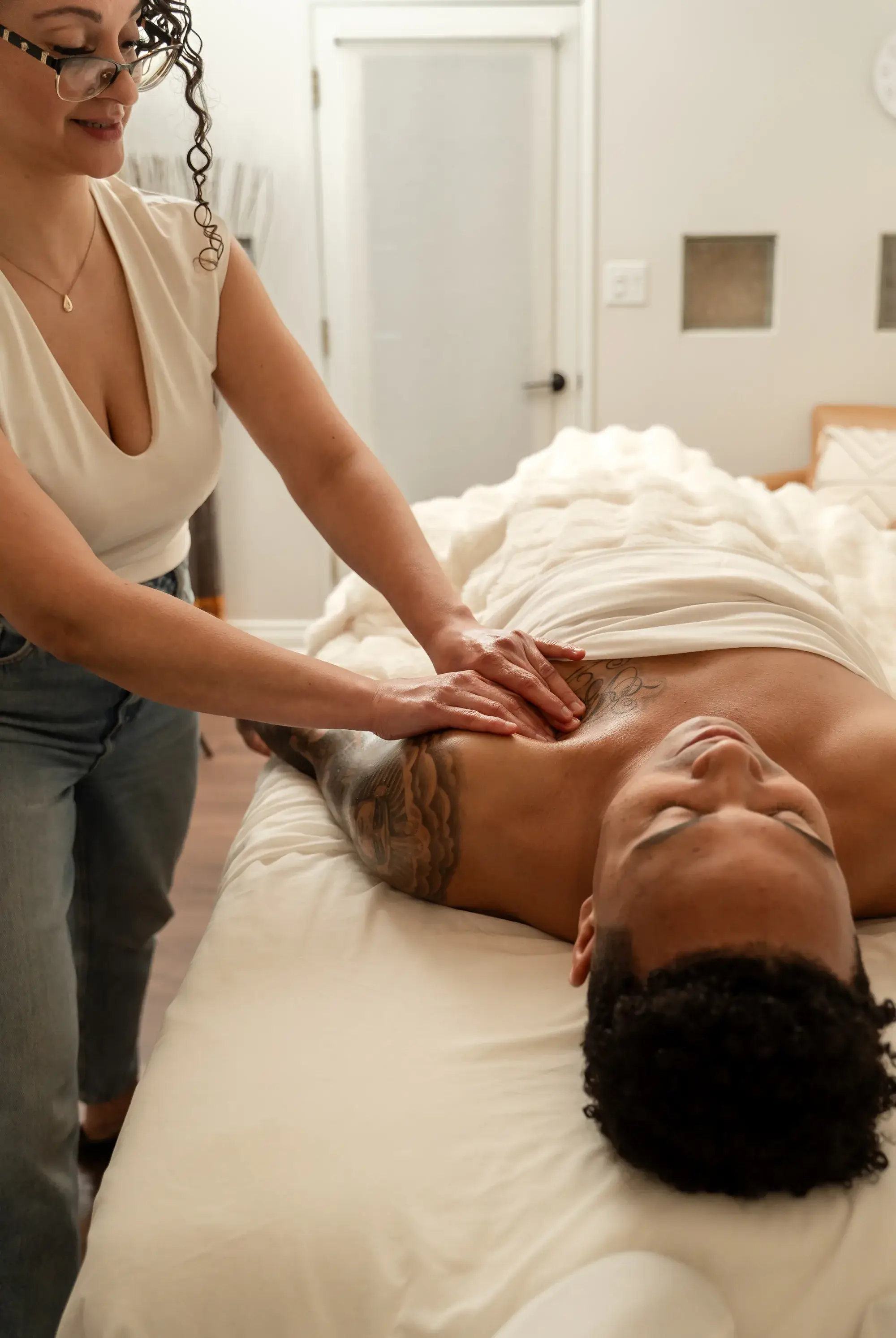
Once your surgeon has assessed the breast, massage therapy can help with the parts of this that are muscular and with general comfort. People living with a tight, sore breast often brace their shoulders, round forward and sleep awkwardly. That tension in the chest wall, upper back and neck is something a Registered Massage Therapist works with every day.
What a session can include:
- Work on the upper back, neck and shoulders, and the muscles between the shoulder blades
- Gentle work along the chest wall and the outer border of the chest, away from the implant itself, if you are comfortable with it
- Scar mobility on fully healed incisions, if your surgeon agrees
- Positioning with pillows so lying face down is not needed
What it does not include: pressing, squeezing or displacing the implant, or any attempt to break up the capsule. Releasing a capsule is a surgeon’s decision, not ours.
Booking at Renu
Book a massage in Jane, either 45 minutes ($100) or 60 minutes ($120), and add a note that you have implants and a firm or painful breast. Our Registered Massage Therapists will check what your surgeon has said, agree with you which areas are in and out of bounds, and keep consent clear throughout. If you have since had the implant removed or a capsulectomy, our page on lymphatic drainage after breast implant removal explains how post-op care is different, and can you get lymphatic drainage with breast implants covers drainage with implants in place.
Questions people ask
Can I massage my own capsular contracture away?
No. Contracture is scar tissue that has tightened around the implant, and pressing or kneading the breast does not loosen it. Surgeons treat established contracture surgically, most often by removing the capsule and exchanging the implant.
My surgeon told me to do implant displacement exercises. Should I stop?
Follow your own surgeon's instructions. The review we cite found the evidence on displacement exercises conflicting rather than proven, but your surgeon chose them for your implant type and pocket, so raise any doubts with them directly rather than stopping on your own.
Is a hard breast years after surgery always contracture?
Not always. The FDA lists persistent swelling, a mass or pain around the implant, often years after placement, as the main symptoms of BIA-ALCL, a rare lymphoma linked to implants. Any late change needs a surgeon's assessment, not a massage booking.
Can I book lymphatic drainage for a hard breast?
Lymphatic drainage moves fluid, and a contracted capsule is not fluid. It is useful after a capsulectomy or implant removal, once your surgeon clears you, but not as a treatment for the contracture itself.
Sources
- Sood et al., Eplasty 2017: Breast massage, implant displacement and prevention of capsular contracture, a review
- US FDA: Risks and complications of breast implants
- US FDA: Questions and answers about BIA-ALCL
- Bachour et al., J Plast Reconstr Aesthet Surg 2018: Risk factors for capsular contracture, a systematic review
- Safran et al., Semin Plast Surg 2021: Current concepts in capsular contracture
- American Society of Plastic Surgeons: Breast augmentation risks and safety
Page reviewed October 5, 2026. This page is education, not a diagnosis. For your own situation, talk to your doctor, surgeon or care team, or ask us.
Keep reading
Related pages