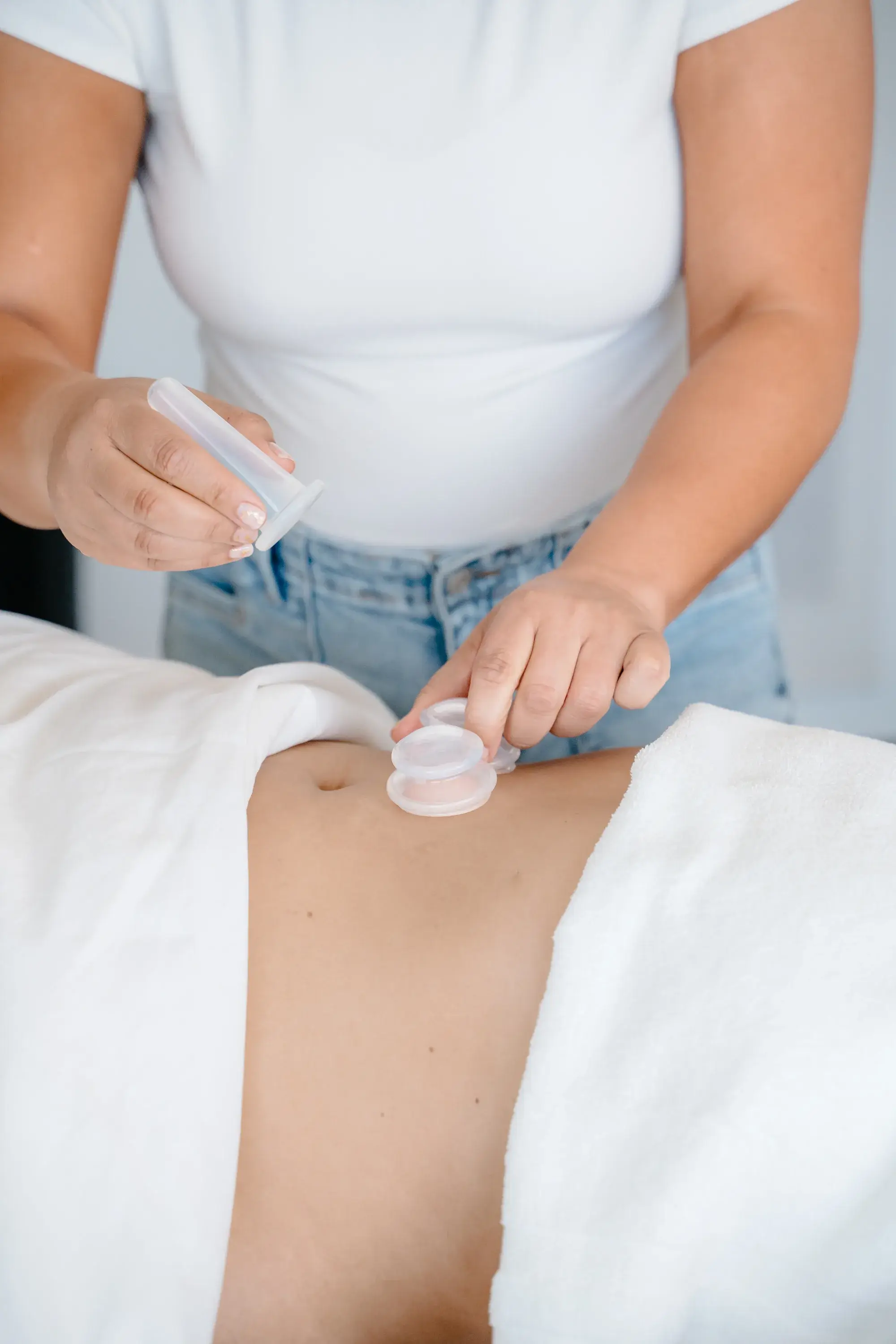


Lymphatic drainage after top surgery in Calgary
Lymphatic drainage after top surgery in Calgary: when it can start around drains, binders and nipple grafts, how sessions keep your arms down, and red flags.
By The Renu lymphatic and massage team · 5 min read
Lymphatic drainage after top surgery can ease chest and armpit swelling once your surgeon clears you, usually after the drains are out. Sessions are built around your recovery rules: your binder or garment goes back on quickly, your arms stay below shoulder height, and free nipple grafts and incisions are never touched. Seroma is the most common complication after gender-affirming mastectomy and bleeding the most common reason for a return to surgery, so either one goes to your surgeon, not the massage table.
What top surgery recovery asks of your body
Top surgery removes breast tissue and reshapes the skin, nipples and areolas to create a flatter chest. UW Medicine’s patient guide describes it this way, and notes that some people have a free nipple graft: the nipple is removed and sutured back on in a new position. Others have a keyhole or periareolar approach that keeps the nipple attached.
The American Society of Plastic Surgeons (ASPS) says that after chest masculinization surgery, an elastic bandage or support garment minimizes swelling. A thin tube may be placed under the skin to drain blood or fluid, and healing continues for several weeks as the swelling goes down and the chest shape improves.
That swelling is what lymphatic drainage can help with, and most of a session happens at the neck and armpits rather than on the healing chest itself.
The rules that shape every session
Your surgeon’s recovery rules come first, and they decide how we position you and what we touch. UW Medicine’s guide gives a clear example of a common protocol:
| UW Medicine recovery rule | What it means on our table |
|---|---|
| Wear the surgical garment or wrap 24 hours a day for 4 weeks, off only to wash it or for hygiene | The garment is off for as short a time as possible, or left on if your surgeon prefers |
| For 4 weeks, do not raise your arms above shoulder height | Arms rest at your sides on pillows; no overhead stretches or arm lifts |
| Do not lift, push or pull more than 8 pounds for 4 weeks | We help you on and off the table so you do not push up with your arms |
| A bolster dressing is sutured over a nipple graft for the first week | The bolster, and later the graft, is never touched |
| No baths, hot tubs or swimming until incisions are healed, which may take 4 to 6 weeks | Incisions are kept dry and clear of strokes |
Your surgeon may have different timings. Bring their instructions, and we will match them.
When to start: drains and seroma
Most people book their first session after the drains are out and their surgeon has seen them. In a 2026 study of 100 gender-affirming mastectomies, all patients had drains, kept in for a mean of six days (range three to 13).
Seroma, a pocket of fluid under the skin, was the most common complication in that study, affecting 9 percent of patients, and it appeared after the drains were removed. All of those seromas resolved with aspiration, sometimes needing weekly visits over a few weeks. That timing matters: the second week, when many people start lymphatic work, is also when a seroma is most likely to show up. If we feel a new, soft, fluid-filled swelling, we stop working on that side and ask you to call your surgeon. Our page on seroma explains how they are usually managed, and our page on lymphatic drainage with surgical drains in covers the earlier stage.
The same study recorded complications in 23 percent of patients overall, including partial loss of nipple and areola tissue in 5 percent, wound separation in 5 percent and bleeding in 4 percent; 2 percent needed urgent surgery. A 2025 review of 2,534 patients found that hematoma, a collection of blood, is the most common early complication after gender-affirming mastectomy and the most common reason for a return to the operating room. Lymphatic drainage does not treat any of these, which is why we watch for them.
How a session runs at Renu
A post-op chest session is quiet, slow and done mostly away from the incisions. Cleveland Clinic describes lymphatic drainage as beginning with light work over the areas that house lymph nodes, such as the neck and armpits, and that is where we start.
- Settling in. You lie on your back, propped if that is more comfortable, with your arms supported at your sides below shoulder height.
- Neck and collarbones. Light strokes above the collarbones and along the sides of the neck.
- Armpits. Gentle work in each armpit without lifting the arm.
- Sides of the chest. Strokes move fluid from the outer chest toward the armpits, well clear of the incision lines.
- Garment back on. Before you sit up, with our help so you do not push with your arms.
If you are unsure whether your garment needs to come off, our page on whether you take your compression off for a lymphatic session explains the usual approach.
Chest recovery sessions are booked as post-op lymphatic drainage, at $105 for 30 minutes, $115 for 45 minutes or $140 for 60 minutes. For chest surgery alone, 30 or 45 minutes is usually enough; 60 minutes leaves room for the neck and shoulders as well. You can book online through Jane, and if you would like us to use a particular name or pronouns, add them to your booking notes. Meeghan Mackenzie, our Certified Lymphedema Therapist, can help if your recovery is not following the usual pattern.
If your surgery was for gynecomastia rather than gender affirmation, the gynecomastia page covers that procedure, and if you are planning facial surgery too, see lymphatic drainage after facial feminization surgery.
When to call your surgeon first
UW Medicine’s guide lists the signs to report after top surgery. Contact your surgical team, and skip your session, if you have:
- a fever higher than 38 C;
- bleeding or drainage that soaks your dressing;
- redness, increased swelling, bad-smelling drainage, or pus or cloudy drainage at an incision;
- a new rash;
- pain that is getting worse and not helped by your pain medicine;
- nausea or vomiting.
Sudden swelling, tightness or bruising on one side of the chest also needs a call to your surgeon, since a collection of blood (hematoma) is the most common early complication in the 2025 review.
Call 911 for new chest pain or shortness of breath. The same guide says redness, swelling, pain or cramping, or warmth in one limb may be signs of a blood clot, and to go to the emergency department.
Questions people ask
Do I have to take my binder off for lymphatic drainage?
Only for the time the chest is being treated, and only if your surgeon allows it to come off briefly. Some guides say the surgical garment comes off only to wash it or for daily hygiene, so ask your surgeon whether a short session counts. If they prefer it stays on, we work at the neck, armpits and sides of the chest around it.
Will you touch my nipple grafts?
No. Free nipple grafts are left alone completely, during the bolster week and after it, until your surgeon says the grafts have fully taken. The same goes for incisions.
Can I lie on my stomach during the session?
Not in the early weeks. Most post-op chest work is done lying on your back or slightly propped up, with your arms resting at your sides. If your surgeon has given you sleeping or position rules, tell us and we will follow them.
Do I still need breast screening after top surgery?
UW Medicine's top surgery guide says regular screening mammograms are still recommended despite the removal of breast tissue. Ask your family doctor what screening suits you.
Sources
- UW Medicine Patient Education: Gender affirming top surgery, with or without a free nipple graft (2024)
- Libondi et al., Plastic and Reconstructive Surgery Global Open 2026: Early and late surgical complications after gender-affirming mastectomy in predominantly young adults
- Pollack et al., Plastic and Reconstructive Surgery Global Open 2025: Bleeding, drains, and reoperation in transmasculine chest surgery, 2,534 patients
- American Society of Plastic Surgeons: Transmasculine top surgery recovery
- Cleveland Clinic: Lymphatic drainage massage
Page reviewed October 5, 2026. This page is education, not a diagnosis. For your own situation, talk to your doctor, surgeon or care team, or ask us.
Keep reading
Related pages