
Lymphatic drainage after breast fat transfer in Calgary
Lymphatic drainage after breast fat transfer in Calgary treats the liposuction donor sites and leaves grafted breasts alone. When to start and what to report.
By The Renu lymphatic and massage team · 5 min read
After a breast fat transfer, lymphatic drainage is for the places the fat came from, not the breasts it went to. The liposuction donor sites, usually the abdomen, flanks or thighs, swell and bruise like any liposuction and respond to gentle drainage once your surgeon agrees. The grafted breasts are left untouched for as long as your surgeon asks, and any new lump in them is something to show your surgeon, not something to massage.
Two kinds of tissue, two different rules
A breast fat transfer is two procedures in one. The American Society of Plastic Surgeons (ASPS) describes fat transfer breast augmentation as using fat from another part of your own body to create breast volume, so liposuction comes first and injection into the breasts comes second. Each half of that surgery recovers differently, and lymphatic care treats them differently.
| Area | What happened there | What lymphatic care does |
|---|---|---|
| Donor sites (often abdomen, flanks or thighs) | Liposuction | Gentle drainage once your surgeon clears you |
| Breasts | Fat was injected in many small amounts | Left alone; no strokes, no pressure, no repositioning of tape or dressings |
| Neck, armpits, groin | Untouched | Opened first so donor-site fluid has somewhere to go |
This is the opposite of most breast surgery recovery, where light work may approach the chest. After fat transfer, the chest is a no-go zone for as long as your surgeon says.
Why the breasts are left alone
Surgeons protect newly grafted breasts carefully, and the published protocols show how seriously. In a 2026 series of 87 women who had large-volume fat transfer to the breasts under local tumescent anesthesia, the breasts were immobilized with perforated surgical tape for three weeks after surgery. Some patients went back into rigid domes or negative pressure dressings for a further seven days. Strenuous exercise was off the table for six weeks.
Not all transferred fat survives. In that series the median graft survival was 82 percent, which means some of what was injected was lost even in a careful protocol. Since drainage is not aimed at the grafts and pressure could disturb them, the only sensible plan is to keep our hands off the breasts until your surgeon tells you otherwise.
In practice that means:
- your tape, dressings or bra stay exactly as your surgeon left them;
- you should be positioned so nothing presses on the chest, which rules out lying face down;
- any work near the upper body stays at the neck and armpits, away from the breast tissue itself.
How donor-site drainage works
The donor sites are where lymphatic drainage earns its place. Harvesting fat is liposuction. The Marxen review in the Aesthetic Surgery Journal Open Forum notes that swelling after liposuction can take three to six months to resolve, and that lymphatic drainage combined with compression has been reported to reduce swelling, firmness and pain after liposuction.
The Salmon series shows what garments looked like in one fat transfer protocol: compression over the donor sites full-time for the first week, then during waking hours in the second week. Your surgeon’s instructions may be longer or shorter, and the session fits around whatever you have been told.
A donor-site session usually runs like this:
- Node regions first. Light work at the neck, then the armpits, and the groin if the thighs or lower abdomen were harvested.
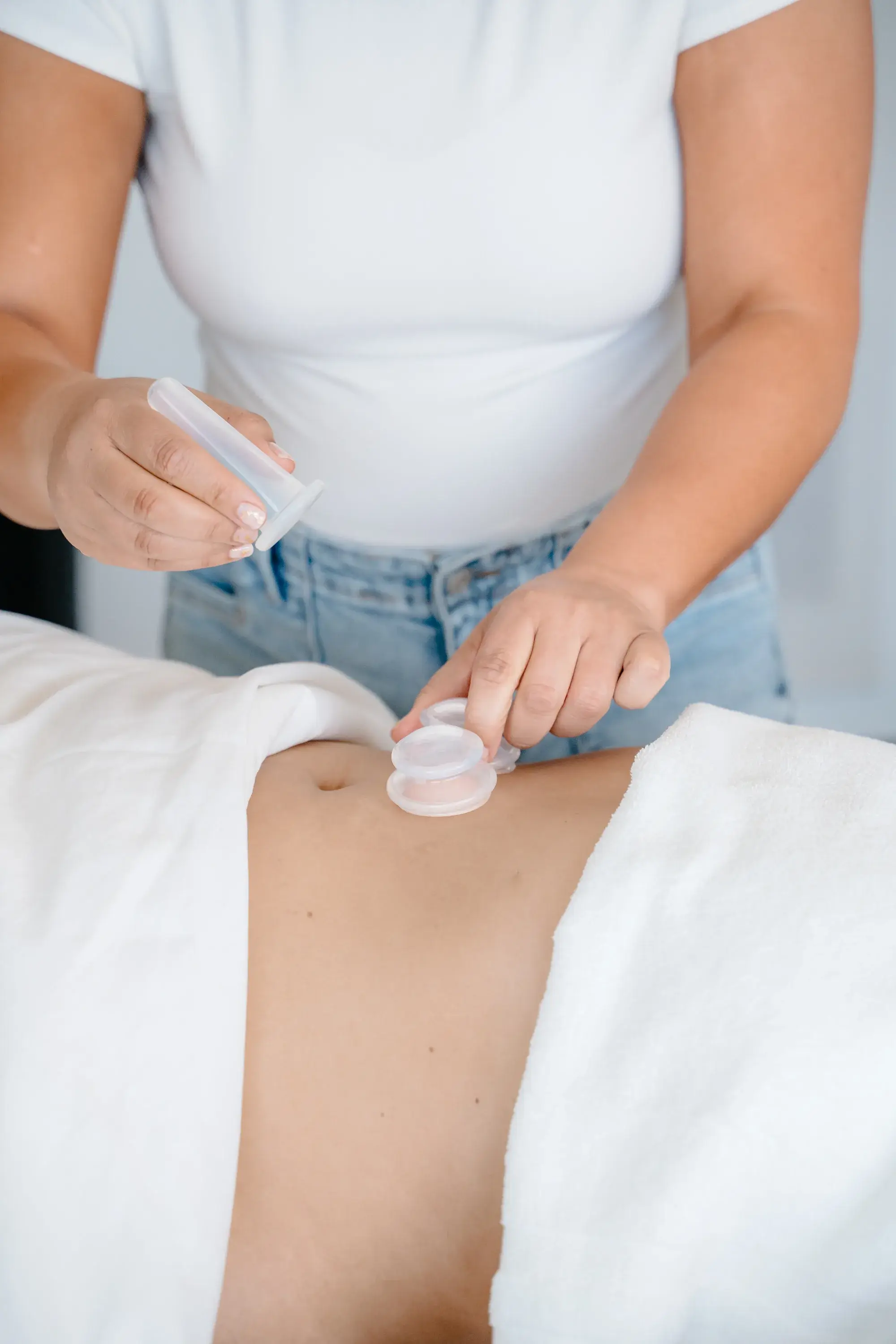
- The donor areas. With the garment opened or removed for that area only, slow strokes move fluid toward those open regions, staying off the small liposuction incisions.
- Firm patches. Areas that feel lumpy or tight get the same light touch, not deeper pressure. Our page on whether the firmness after lipo is swelling or fibrosis explains the difference.
- Garment back on before you sit up.
Not every surgeon recommends lymphatic massage after liposuction. One 2026 study used two months of continuous compression and two weeks of lymphatic taping with no recommendation for lymphatic drainage massage. If your surgeon has not mentioned it, ask before you book; our page on whether all surgeons recommend lymphatic massage after lipo goes into why opinions differ.
Lumps in the breast: report them, do not rub them
Some lumps after fat transfer are expected complications of the graft itself, and they belong with your surgeon. A 2026 systematic review and meta-analysis of randomized trials lists bruising, fat necrosis (grafted fat that dies and firms up), oil cysts and calcifications among the complications of fat transfer, and rarely fat embolism. The same review found fat transfer had fewer surgical complications than implant-based reconstruction and that most side effects settled on their own.
In the 87-patient series, five women (6.25 percent) developed benign nodules that imaging identified as fat granulomas, all on one side only.
Two reasons we never try to massage these out:
- They need a diagnosis. The review notes that fat necrosis, calcifications and nodules may complicate cancer surveillance and physical examination. A new lump should be looked at by your surgeon, and imaging may be the right next step.
- Imaging matters. The Salmon team recommends breast imaging before and after surgery for women over 40 or with a family history of breast cancer, read by breast-trained radiologists.
If you notice a lump in a grafted breast, mention it to your surgeon at your next visit, or sooner if it is painful, red or growing.
Booking donor-site drainage at Renu
Our post-op lymphatic drainage sessions come in 30 minutes ($105), 45 minutes ($115) and 60 minutes ($140). If only one area was harvested, such as the lower abdomen, 30 or 45 minutes is often enough. If fat came from the abdomen, flanks and thighs together, 60 minutes gives time to clear the node regions properly. Meeghan Mackenzie, our Certified Lymphedema Therapist, can help you choose.
When you book through Jane, add a note saying the surgery was a fat transfer to the breasts, so your therapist plans a donor-site session from the start. If you had implants instead, or alongside the fat, the breast augmentation and reduction guide is the better fit, and the 360 lipo guide covers larger torso harvests in more depth.
When to call your surgeon first
Call your surgical team before your next session if you notice:
- a breast that becomes red, hot, swollen or painful, or a fever;
- a new, hard or growing lump in a grafted breast;
- a donor site that keeps swelling, leaks cloudy or foul-smelling fluid, or has a soft fluid bump that is growing;
- skin over a donor site or breast turning dark or blistered.
The NHS lists throbbing pain and swelling in one leg, usually the calf or thigh, as signs of a deep vein thrombosis, and notes that surgery raises the risk; get urgent medical advice. Breathlessness or chest pain alongside those leg signs means calling 911 right away.
Questions people ask
Can lymphatic drainage make my fat transfer results last longer?
Drainage is not aimed at the grafted fat. How much of it survives depends on the surgery and on how the breasts are protected afterward, which is why we leave them alone. What drainage can help with is comfort and swelling in the areas the fat was taken from.
I had fat grafting after a mastectomy. Is that different?
The same split applies: drain the donor sites, leave the grafted chest to your surgeon. Because you may also have had lymph nodes removed, tell us exactly what was done in each surgery, since that changes which node regions we use. Your oncology and surgical teams should agree before we start.
Why is my thigh or belly sorer than my breasts?
That is common. Harvesting fat is liposuction, and the donor sites carry the bruising, firmness and tenderness that come with it, while the breasts were only injected. Gentle drainage of those areas, once your surgeon clears you, is where most of our session time goes.
Will fat grafting affect my mammograms?
It can. A 2026 review notes that fat necrosis, calcifications and nodules after fat transfer may complicate cancer surveillance and breast examination. Tell your imaging clinic about the surgery each time, and follow your surgeon's advice on screening.
Sources
- American Society of Plastic Surgeons: Fat transfer breast augmentation
- Salmon and Seine, Dermatologic Surgery 2026: Large-volume breast autologous fat transfer entirely under tumescent anesthesia, 87 patients over 6 years
- Meijer et al., Plastic and Reconstructive Surgery Global Open 2026: Outcomes and complications of autologous fat transfer for total breast reconstruction and augmentation, systematic review and meta-analysis
- Huber et al., Plastic and Reconstructive Surgery Global Open 2026: Liposuction followed by helium plasma radiofrequency versus liposuction control
- Marxen et al., Aesthetic Surgery Journal Open Forum 2023: The utility of lymphatic massage in cosmetic procedures
- NHS: DVT (deep vein thrombosis)
Page reviewed October 5, 2026. This page is education, not a diagnosis. For your own situation, talk to your doctor, surgeon or care team, or ask us.
Keep reading
Related pages