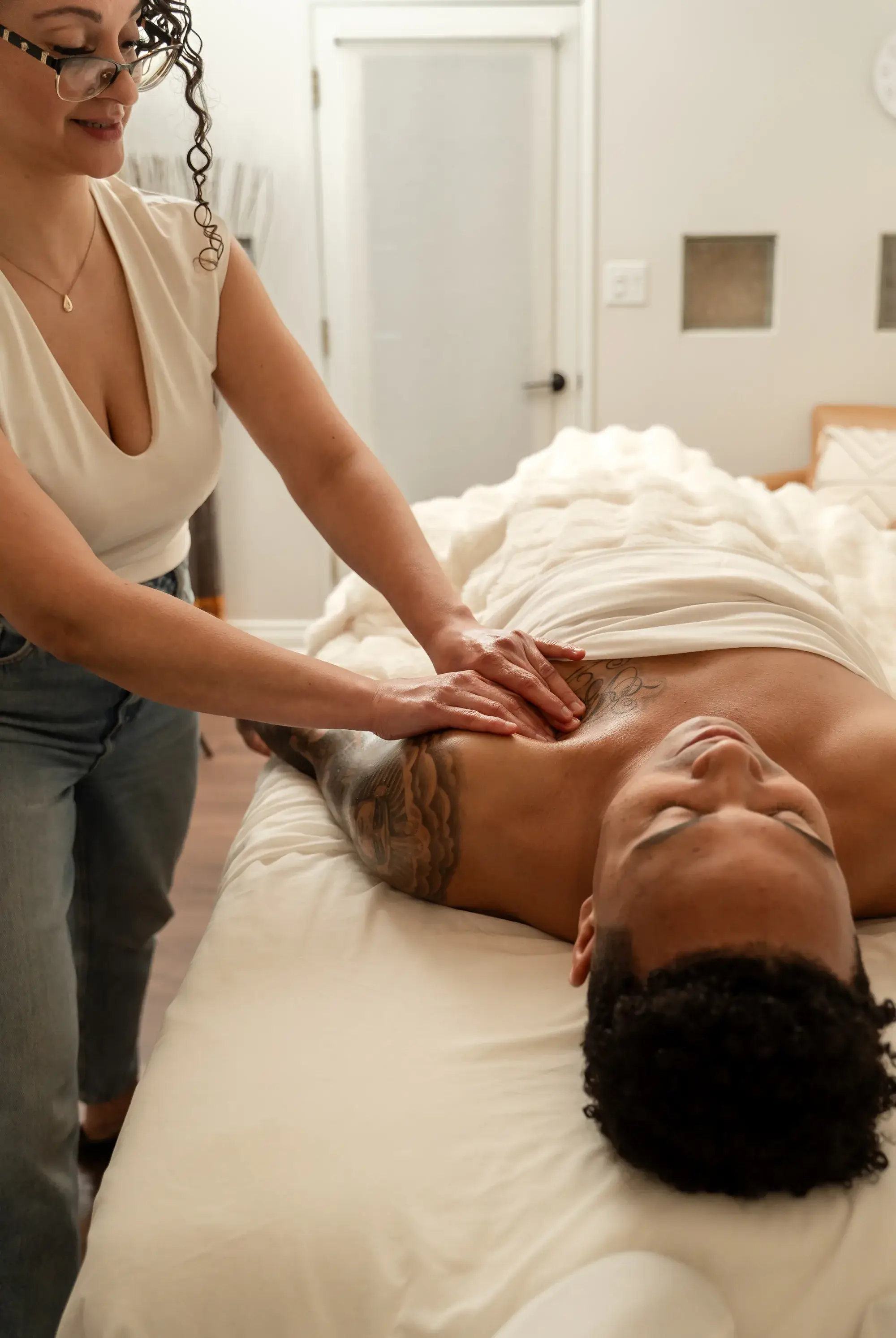


Myofascial release vs deep tissue massage
Myofascial release vs deep tissue massage: MFR is a slow, low-load sustained stretch of connective tissue; deep tissue is firmer, targeted pressure on muscle.
By The Renu lymphatic and massage team · 5 min read
Myofascial release (MFR) applies a low-load, long-duration stretch to the muscle and its surrounding connective tissue, so it feels slow, sustained and often gentle. Deep tissue massage uses firmer, more intense pressure aimed into specific muscles and tendons. Most Registered Massage Therapists blend both, so the real choice is about your pain and your pressure tolerance: slow MFR-style work for sensitive, flare-prone pain, deep tissue for a localised tight band, and exercise alongside either.
Myofascial release and deep tissue massage are often listed as if they were separate menu items, but in a treatment room they overlap. The difference is in the load and the pace. MFR uses a light-to-moderate load held for a long time, waiting for connective tissue to give. Deep tissue massage uses more intense pressure aimed at a particular muscle or tendon. Knowing that difference helps you ask for what you actually want.
Two techniques, one session
Cleveland Clinic describes myofascial release as a form of deep stretching that is often used together with other therapeutic massage techniques, and especially useful for tension in the neck, shoulders and back. It describes deep tissue massage as getting into muscles and tendons to release tightness, suited to injuries and chronic muscle pain. It also makes the point that matters most here: massage types are not exclusive, and a therapist usually combines techniques to get rid of tight muscles and address your concerns.
In practice, a single session might begin with slow, sustained MFR across the back to warm and soften the area, then move into firmer deep tissue work on one stubborn band beside the shoulder blade.
How each one feels
| Myofascial release | Deep tissue massage | |
|---|---|---|
| Load | Low | Firm to intense |
| Pace | Slow, held, waiting for the tissue to change | Slow strokes and focused pressure |
| Target | The muscle and its surrounding fascia as one complex | Specific muscles and tendons |
| Typical sensation | Spreading stretch, warmth | Pressure, tenderness on sore spots |
| Safety note | Low load, low intensity | NCCIH links rare serious events mostly to vigorous work like this |
The researchers who reviewed MFR trials define it as applying a low-load, long-duration stretch to the myofascial complex, intended to restore length, decrease pain and improve function. That definition is why MFR can work for people who tense up under heavy pressure.
What the research shows for each
The evidence for MFR is mixed, and recent reviews are less encouraging than older ones.
- Ajimsha and colleagues, 2015: reviewed randomised trials and found the literature mixed in both quality and results, though the authors called the newer studies encouraging.
- McKenney and colleagues, 2013: ten studies of MFR for orthopaedic problems, six of them case studies. Outcomes were positive, but quality was too low to draw firm conclusions.
- Laimi and colleagues, 2018: eight randomised trials covering tennis elbow, fibromyalgia, low back pain and heel pain, with sessions of 30 to 90 minutes given 4 to 24 times over 2 to 20 weeks. For low back pain and fibromyalgia, effects did not reach the minimal clinically important difference. The authors concluded the evidence was not sufficient to warrant MFR for chronic musculoskeletal pain.
For massage generally, NCCIH reports weak and mixed evidence for low back pain and short-term benefit for neck and shoulder pain. On safety, it describes the risk as low but notes rare serious events, such as a blood clot, nerve injury or bone fracture, mostly with vigorous techniques such as deep tissue massage and particularly in older adults.
Put simply, neither approach has strong evidence on its own. Both seem most useful as part of a plan that includes movement and exercise.
How to choose
- Your pain flares easily, you bruise, or heavy pressure makes you brace: ask for slow, MFR-style work. A low load is the defining feature.
- One tight band builds up from repetitive work, such as mouse-arm forearm tension or a desk-bound upper back: deep tissue lets the therapist work directly into that spot.
- You have widespread pain, such as fibromyalgia: start gentle. The trials suggest any benefit is modest, so stop if sessions leave you worse for days.
- You are recovering from an injury: check with your doctor or physiotherapist first, and tell your therapist what you were told.
- You are not sure: say so. Most therapists will blend both and adjust as they go.
If an area is getting worse after treatment, our answer on whether deep tissue massage can make pain worse explains what is normal and what is not.
When to see a doctor first
Cleveland Clinic’s advice is simple: if you have a medical condition, check with your doctor and talk it through with your massage therapist before treatment. NCCIH says the same for anyone unsure whether massage is appropriate. That matters most for deep tissue work, because the rare serious problems NCCIH describes, a blood clot, nerve injury or fracture, have mostly followed vigorous techniques.
Check with your doctor first if you have a known or suspected blood clot, take blood thinners, have osteoporosis, or have had recent surgery, and tell your therapist about any of these so they can keep the load low. Pain that follows a fall or an accident should be assessed before anyone works on it.
Asking for myofascial release at Renu
We book both approaches as massage therapy with a Registered Massage Therapist: 60 minutes for $120, 75 minutes for $141 or 90 minutes for $157. MFR takes time, because the tissue is given time to change, so a 75 or 90 minute session suits it if you want slow work across several areas. When you book through Jane, add a note saying you would like myofascial release, deep tissue, or a mix, and how firm you like the pressure.
For the technique itself, our page on the sustained myofascial stretch goes into detail, fascia explains the tissue involved, and myofascial pain syndrome covers a common reason people look for this work. We are in West Hillhurst and open seven days a week.
Questions people ask
Does myofascial release hurt less than deep tissue massage?
Usually, yes. MFR is defined by a low load held for a long time, so it tends to feel like a slow, spreading stretch rather than a deep press. Deep tissue uses more intense pressure and can be tender, especially over a sore spot.
How do I book myofascial release at Renu?
Book a massage therapy session online through Jane and add a note that you would like myofascial release. Your Registered Massage Therapist will build the session around that approach.
Can myofascial release be combined with lymphatic drainage?
They are different techniques with different aims, but they can share an appointment. Our massage and lymphatic combination is $130 for 60 minutes or $165 for 90 minutes, and you can ask for slow myofascial work within the massage portion.
How many sessions of myofascial release do I need?
There is no set number. The trials in one review used 4 to 24 sessions over 2 to 20 weeks, and still found the benefit for low back pain and fibromyalgia too small to matter clinically. Judge it by whether you move and feel better after two or three visits.
Sources
- Ajimsha MS, Al-Mudahka NR, Al-Madzhar JA. Effectiveness of myofascial release: systematic review of randomized controlled trials. J Bodyw Mov Ther, 2015 (Europe PMC)
- Laimi K et al. Effectiveness of myofascial release in treatment of chronic musculoskeletal pain: a systematic review. Clin Rehabil, 2018 (Europe PMC)
- McKenney K et al. Myofascial release as a treatment for orthopaedic conditions: a systematic review. J Athl Train, 2013 (Europe PMC)
- Cleveland Clinic: Benefits of massage
- NCCIH: Massage therapy, what you need to know
Page reviewed October 5, 2026. This page is education, not a diagnosis. For your own situation, talk to your doctor, surgeon or care team, or ask us.
Keep reading
Related pages