
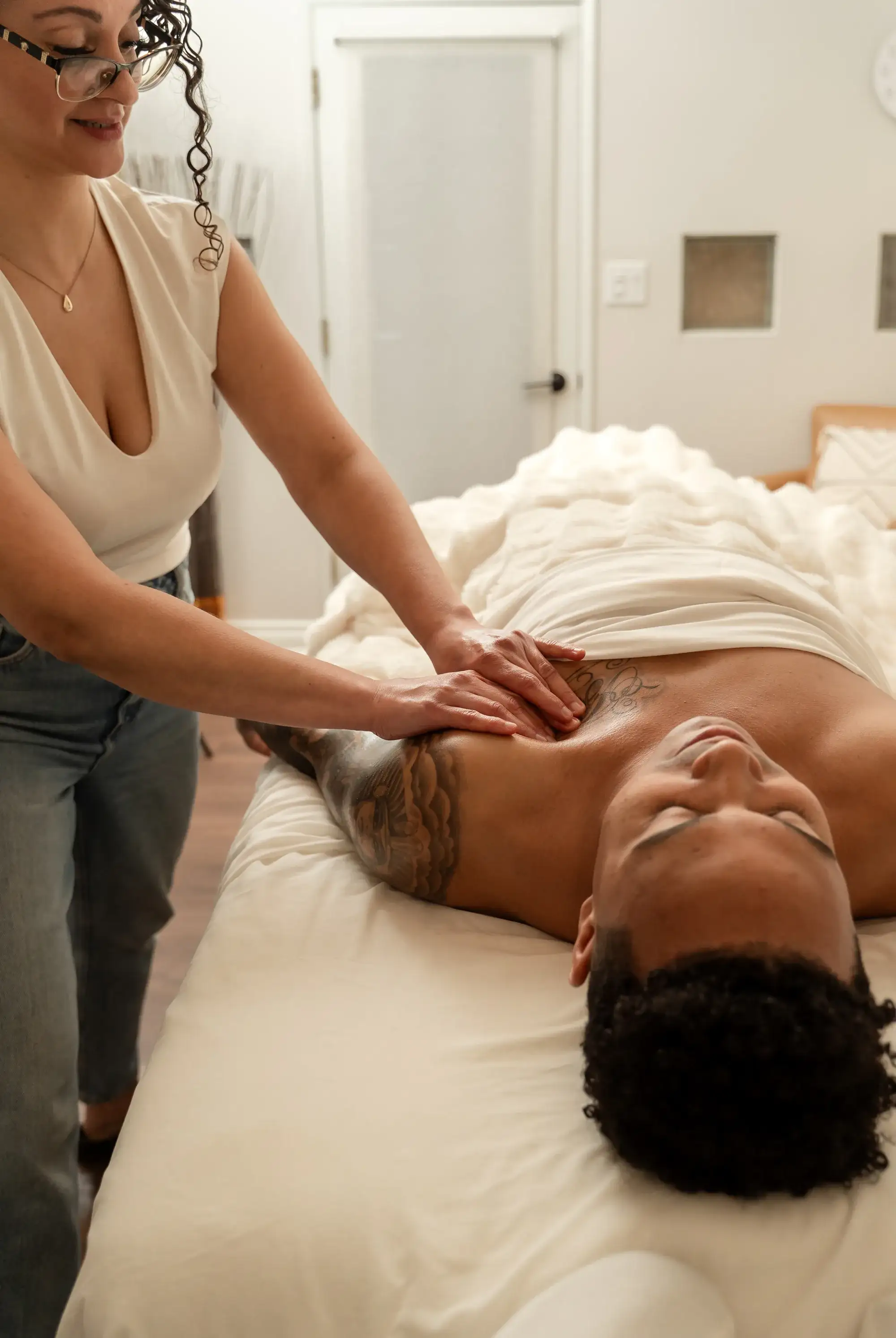
Ashiatsu vs deep tissue massage
Ashiatsu vs deep tissue massage: barefoot strokes give broad, heavy pressure; hands give targeted, adjustable work. How to choose, and who should avoid each.
By The Renu lymphatic and massage team · 5 min read
Ashiatsu is barefoot massage: the therapist stands over you, holding overhead bars, and uses the heel, arch or whole sole to deliver broad, heavy pressure along large muscles. Deep tissue massage uses hands, forearms and elbows for firm work that can be aimed at one specific muscle or tendon. Ashiatsu suits people who want wide, deep pressure across the back and legs and have none of its many contraindications; hands-on deep tissue suits a particular sore spot, a recent injury, or anyone for whom heavy body-weight compression is not safe.
Ashiatsu and deep tissue massage both aim for firm pressure, but they get there differently. In ashiatsu the therapist’s feet do the work and body weight supplies the force. In deep tissue massage the therapist’s hands, forearms and elbows do the work, which makes the pressure easier to aim and to change from moment to moment. The choice comes down to what you want pressed, how broad you want it, and whether anything in your health history rules heavy compression out.
How ashiatsu is delivered
The name is Japanese: ashi means foot and atsu means pressure. The therapist uses the heel, the ball of the foot, the arch or the whole sole. In the traditional set-up they stand on or over the massage table and hold parallel bars mounted overhead for balance and to control how much weight goes down. A floor version, often called Ashiatsu Floor Therapy, uses hip-height bars while you lie on a pad on the floor.
Because the foot is broad, it can apply large compression, tension and shear with less concentrated pressure than an elbow. That is why ashiatsu is usually described for big muscle groups such as the thighs, the long muscles of the back and the upper trapezius. Schools describe long, flowing strokes down the length of the back and legs.
Schools that teach ashiatsu make larger claims, such as pressure up to three times deeper than hands, spinal elongation and detoxification. We could not find research testing any of these, so treat them as marketing rather than findings.
How deep tissue massage differs
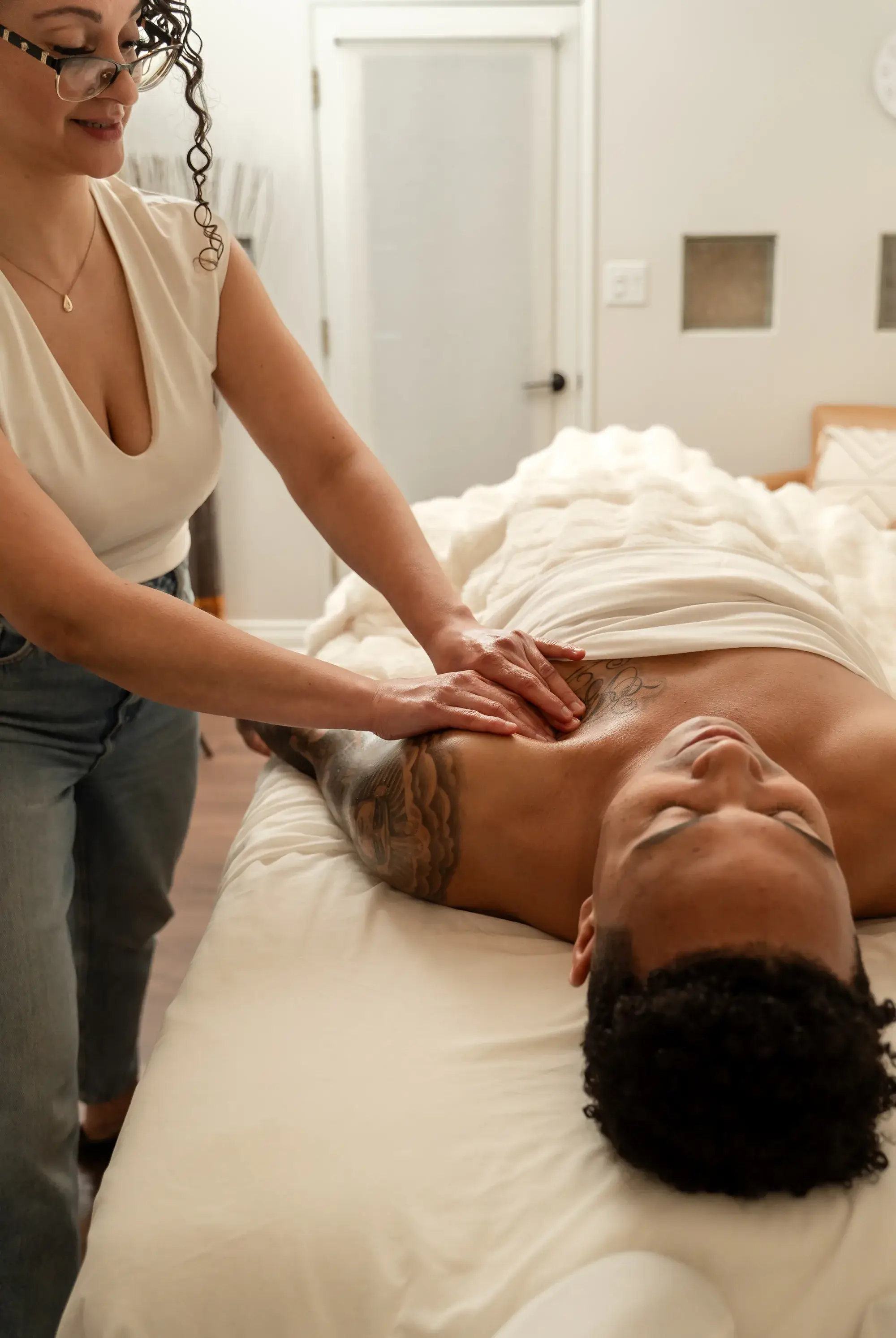
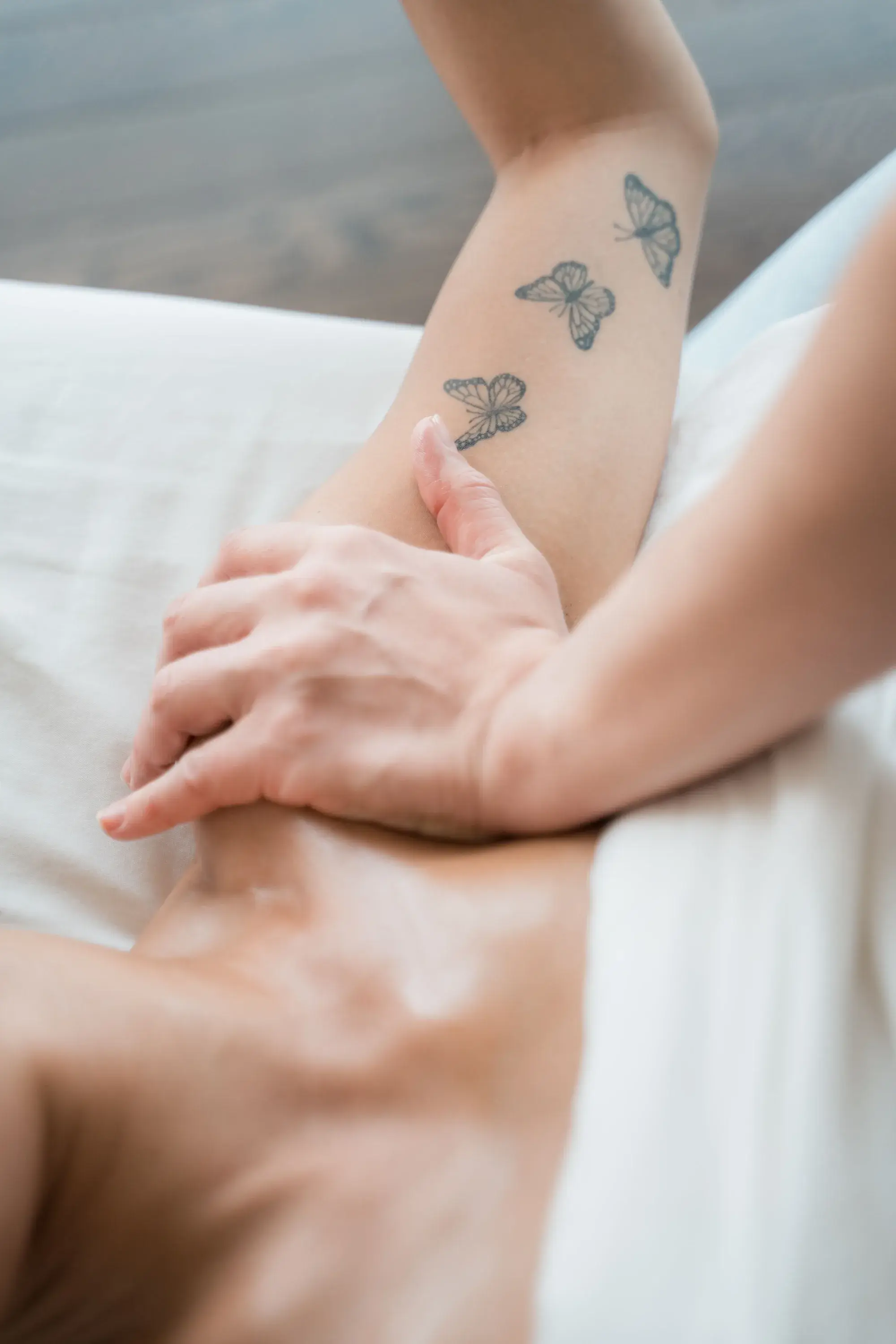
Cleveland Clinic describes deep tissue massage as getting into muscles and tendons to release tightness, and suggests it for people with injuries and chronic muscle pain. The therapist can sink slowly into one band of muscle beside the shoulder blade, hold it, and ease off the moment you tense up. That precision is the main thing feet cannot match.
| Ashiatsu | Deep tissue massage | |
|---|---|---|
| Contact | Heel, arch, whole sole | Fingers, thumbs, forearms, elbows |
| Set-up | Therapist above you, holding overhead or hip-height bars | Therapist beside the table |
| Pressure | Broad and heavy, from body weight | Firm and targeted, adjusted continuously |
| Best for | Large areas: back, thighs, calves | A specific muscle, tendon or knot |
| Adjusting mid-stroke | Limited by balance and body weight | Easy: lighten, shift angle or move on |
Who should avoid ashiatsu
Ashiatsu carries a longer list of cautions than most massage, because the force is heavy and spread across the trunk. East West College lists these reasons not to have it:
- pregnancy or trying to conceive
- recent surgery or injury
- contagious skin conditions
- a compromised immune system
- certain medications
- advanced diabetes
- acute autoimmune, kidney or liver disorders
- recent surgical implants
- high blood pressure
MASSAGE Magazine’s list for deep compression with the feet adds breast implants within nine months, varicose veins, open wounds or rashes, thrombosis or a history of blood clots, aneurysm, uncontrolled hypertension, pacemakers, advanced osteoporosis, conditions that reduce sensation, and recent joint or muscle injections.
Many of these apply to deep tissue massage too, but with hands a therapist can simply work around an area, lighten up, or change your position. With body weight through the feet there is less room to adjust.
What the evidence says about safety and benefit
Massage is low risk, not no risk. NCCIH describes the risk of harm as low, with rare reports of serious effects such as a blood clot, nerve injury or bone fracture, and notes that vigorous techniques such as deep tissue massage carry more of that risk, particularly in older people. A systematic review of reports from 2003 to 2013 found 138 adverse events linked to massage across 40 reports, concluding that massage is not devoid of risk but serious events are uncommon.
On benefit, NCCIH reports weak and mixed evidence for low back pain and short-term benefit for neck and shoulder pain. None of the research we found looked at ashiatsu specifically.
How to choose
- You want broad, heavy pressure along the back and legs and nothing on the lists above applies: ashiatsu with a trained practitioner may suit you.
- One spot hurts, such as a shoulder blade or the side of the hip: hands reach it more precisely. Choose deep tissue.
- You have had a recent injury, surgery or injection, take blood thinners, or have osteoporosis or varicose veins: choose hands-on massage and tell your therapist, or check with your doctor first.
- You are pregnant or trying to conceive: skip ashiatsu. See our prenatal massage page instead.
Either way, pressure should feel strong but tolerable. Our answer on whether deep tissue massage has to hurt explains why bracing against pain defeats the purpose.
Firm pressure at Renu
We do not offer ashiatsu. Our Registered Massage Therapists work by hand on a table, and deep tissue work is booked as massage therapy: 60 minutes is $120, 75 minutes $141 and 90 minutes $157. A 75 or 90 minute session leaves time to cover the whole back and legs and still spend real time on the one area that bothers you most.
When you book through Jane, mention that you like firm pressure. Tell your therapist about medications, recent procedures and any of the conditions listed above before you start, and say so the moment the pressure is more than you want. Our pages on who should avoid deep tissue massage and massage on blood thinners cover the screening in more detail, and Swedish vs deep tissue massage helps if you are unsure how firm to go.
Questions people ask
Is ashiatsu deeper than a regular deep tissue massage?
It can deliver more total force, because the therapist uses body weight through the foot. Practitioners describe it as large compression with less sharp pressure than an elbow. Deeper is not the same as better, though; the right pressure is the one your tissue can accept without bracing.
Is there research showing ashiatsu works better than hands-on massage?
We could not find trials comparing ashiatsu with hand-based massage. Claims about it being several times deeper or detoxifying come from schools that teach it, not from studies. Massage research in general shows modest, mostly short-term benefits for pain.
Does Renu offer ashiatsu in Calgary?
No. Our Registered Massage Therapists work with their hands, forearms and elbows on a table. If you want broad, firm pressure, ask for deep tissue work when you book and tell your therapist how much pressure you like.
Can I have ashiatsu if I have breast implants?
MASSAGE Magazine's list of deep compression cautions includes breast implants placed within the last nine months. Check with your surgeon and tell the therapist before booking, because the compression is heavy across the trunk.
Sources
- Wikipedia: Ashiatsu
- East West College: Massage modalities, Ashiatsu barefoot massage
- MASSAGE Magazine: Thai massage and ashi-thai, similarities and contraindications
- Cleveland Clinic: Benefits of massage
- NCCIH: Massage therapy, what you need to know
- Yin P et al. Adverse events of massage therapy in pain-related conditions: a systematic review. Evid Based Complement Alternat Med, 2014 (Europe PMC)
Page reviewed October 5, 2026. This page is education, not a diagnosis. For your own situation, talk to your doctor, surgeon or care team, or ask us.
Keep reading
Related pages