
Massage for truck drivers in Calgary
Massage for truck drivers in Calgary: what it can do for the low back, hips and legs after long hauls, how to book it into a reset, and when to see a doctor.
By The Renu lymphatic and massage team · 6 min read
Massage can ease the low back, hip and neck tension that long hours behind the wheel build up, and for many drivers it is a practical way to use a reset at home in Calgary. The evidence that massage relieves low back pain is short term, so it works best as regular maintenance alongside moving more on the road. If one leg is painful or swollen after a long run, see a doctor before anyone massages it.
What massage can do for a driver’s body
Massage is most useful to drivers for the muscles that carry the load of the cab: the low back, the hips and glutes, the neck and shoulders from holding the wheel, and the calves that barely move for hours. A session eases that tension and gives the body a break from the fixed driving posture. It does not undo years of driving, and it is not a substitute for a doctor when something is wrong.
What the research says about massage for low back pain in general is worth knowing. A Cochrane review of 25 trials found that massage improved low back pain in the short term only, and the authors had very little confidence in how large that effect is. Side effects were minor. For a driver, that points to massage as maintenance: something you book regularly during resets, alongside getting out of the cab more, rather than a single fix.
Why the cab is hard on the low back
Driving for a living is hard on the back for reasons that go beyond sitting. A review of 25 studies in occupations that sit for more than half the working day found that sitting alone was not linked with low back pain. When whole-body vibration and awkward postures were added, the risk increased fourfold. Vibration while sitting was also linked with sciatica, and how long you were exposed mattered more than how strong the vibration was.
Other numbers from drivers line up:
| Finding | Source |
|---|---|
| 81% of 192 professional truck drivers had musculoskeletal pain in the past year; 60% had low back pain | Robb and Mansfield, 2007 |
| Manual handling and seat discomfort were associated with drivers’ musculoskeletal problems | Robb and Mansfield, 2007 |
| Driving time was a significant risk factor for low back pain (odds ratio 2.03) | Meta-analysis, 2021 |
| 57.9% of long-haul drivers reported sleep disturbances and 42.3% musculoskeletal disorders | Healthy Trucker Survey, 2013 |
CCOHS adds that studies of bus and truck drivers found whole-body vibration could have contributed to circulatory, bowel, respiratory, muscular and back disorders, with posture, postural fatigue and diet also in the mix. That is why the advice for drivers is never just “get a massage”. Loading and unloading, seat set-up, breaks and sleep all matter too.
Booking around your hours of service
The federal hours-of-service rules shape when a driver can realistically get to an appointment. South of 60°N, a driver may not drive after 13 hours of driving or 14 hours on duty in a day, and must take at least 10 hours off duty each day. A cycle resets after at least 36 consecutive hours off duty on cycle 1, or 72 on cycle 2.
That reset is the natural window for a massage. A few ways drivers use it:
- Day one of a reset: a moderate 60-minute massage focused on the low back, hips and neck, once you have slept and moved around.
- A longer home stretch: a 90-minute massage when you want the back, hips, legs and shoulders covered without rushing.
- Heavy legs after a long run: the 90-minute massage and lymphatic combination, which pairs regular massage with gentle lymphatic work. This is only for legs that have been checked and are not showing clot signs (see below).
We are open seven days a week, until 8:30 pm on weekdays and 10:00 am to 5:00 pm on weekends, so a reset that lands midweek or over a weekend can usually be matched. If you are unsure which length to choose, is a 60 or 90 minute massage better walks through it.
Before anyone touches your legs: clot warning signs
Long journeys raise the chance of a deep vein thrombosis (DVT). The NHS lists a long journey of more than 4 hours by plane, car or train among the situations that increase the risk, alongside dehydration and being immobile. A driver’s whole working day fits that description.
DVT signs in the leg, according to the NHS, are:
- a throbbing ache in a single calf or thigh
- one leg noticeably more swollen than the other
- skin around the sore spot that looks red, blue or darker
- veins that stand out more than usual
If you notice these, see a doctor as soon as possible and do not book a massage for that leg. Leg symptoms together with breathlessness or chest pain are an emergency, so call 911: the NHS warns that a clot can move to the lungs and become life-threatening. When you arrive at Renu, tell your therapist if either leg has been sore or swollen since the trip. Our page on deep vein thrombosis explains more.
Other reasons to see your doctor before massage, rather than after:
- back pain with leg weakness, numbness that is spreading, or changes in bladder or bowel control
- back pain after a fall from the cab or trailer
- pain that is getting steadily worse over weeks, or that wakes you at night regardless of position
What a session looks like at Renu
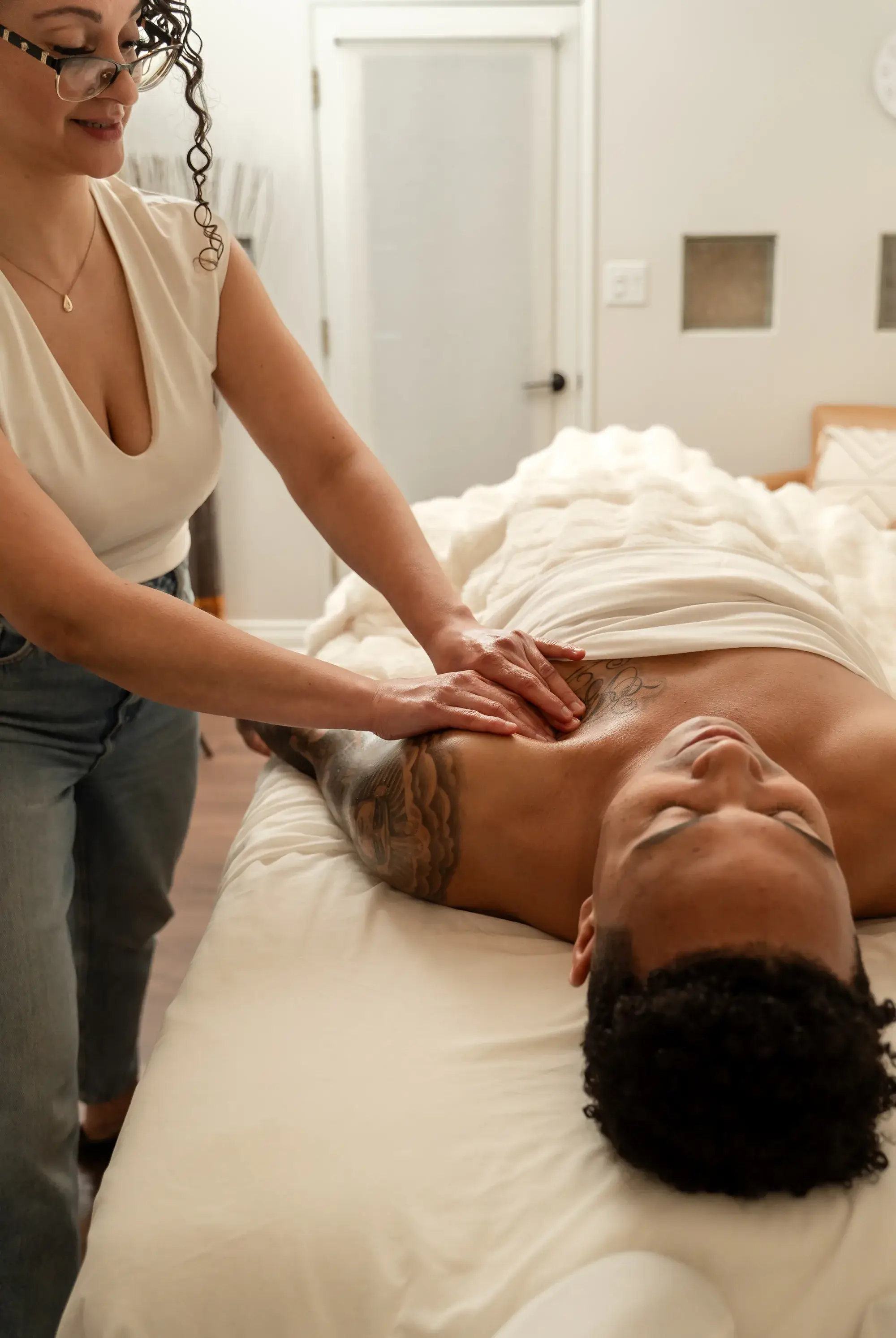
Your Registered Massage Therapist (RMT) will ask where it hurts, how many hours you have been driving, and how you are sleeping. Most driver sessions spend their time on:
- the low back and the muscles on either side of the spine
- the glutes and hips, which stay flexed for hours on the seat
- the neck and shoulders, especially if you hold the wheel high or check mirrors constantly
- the calves and feet, once clot signs are ruled out
Pressure is your call. If you are back on the road soon, moderate pressure usually leaves you loose without next-day soreness. If sciatica-type pain is part of the picture, mention it: can massage make sciatica worse covers what your therapist will watch for, and sciatica explains the condition.
Keeping the benefit on the next run
What you do between sessions decides how long the relief lasts. The NHS advice for long journeys is to wear loose clothing, drink plenty of water, avoid alcohol and get up and move around every hour or so where you can. On a truck, that might mean a walk around the rig at each fuel stop or check, a few calf raises at the door, and standing to stretch the hips before you climb back in.
A few minutes of low back and hip stretching at the end of a shift helps too; lower-back stretches after a day of sitting has a short routine that works in a parking lot. Book your reset massage through Jane, and see all lengths and prices on our massage therapy page.
Questions people ask
Can a massage fix sciatica from driving?
Massage can ease the muscle tension around the low back and buttock that often comes with sciatica, but it does not change a disc or a nerve. If you have leg weakness, numbness that is spreading, or trouble with bladder or bowel control, that needs a doctor first, not a massage.
Is it worth getting a massage if I am back on the road in two days?
Yes, as long as you set the pressure so you are not sore when you climb back in the cab. Many drivers prefer moderate pressure on a short reset and save deeper work for a longer break at home.
Why do my legs feel heavy after a long haul?
Hours of sitting with little calf movement let fluid settle in the lower legs, so heaviness on both sides that eases with walking is common. Pain or swelling in one leg only is different and should be checked by a doctor before any massage.
Do I need to shower before coming straight off a run?
It helps you relax, but it is not required. Come as you are if that is what makes the appointment possible, and let us know if you need a minute to change.
Sources
- Robb and Mansfield, Ergonomics 2007: Self-reported musculoskeletal problems amongst professional truck drivers
- Lis et al., Eur Spine J 2007: Association between sitting and occupational low back pain
- Baradaran Mahdavi et al., Int J Prev Med 2021: Sedentary behaviour and low back pain, systematic review and meta-analysis
- Apostolopoulos et al., 2013: Health survey of U.S. long-haul truck drivers
- Justice Laws Website: Commercial Vehicle Drivers Hours of Service Regulations, sections 12 and 13
- Justice Laws Website: Commercial Vehicle Drivers Hours of Service Regulations, daily off-duty time and cycle reset
- CCOHS: Vibration, health effects
- NHS: DVT (deep vein thrombosis)
Page reviewed October 5, 2026. This page is education, not a diagnosis. For your own situation, talk to your doctor, surgeon or care team, or ask us.
Keep reading
Related pages