

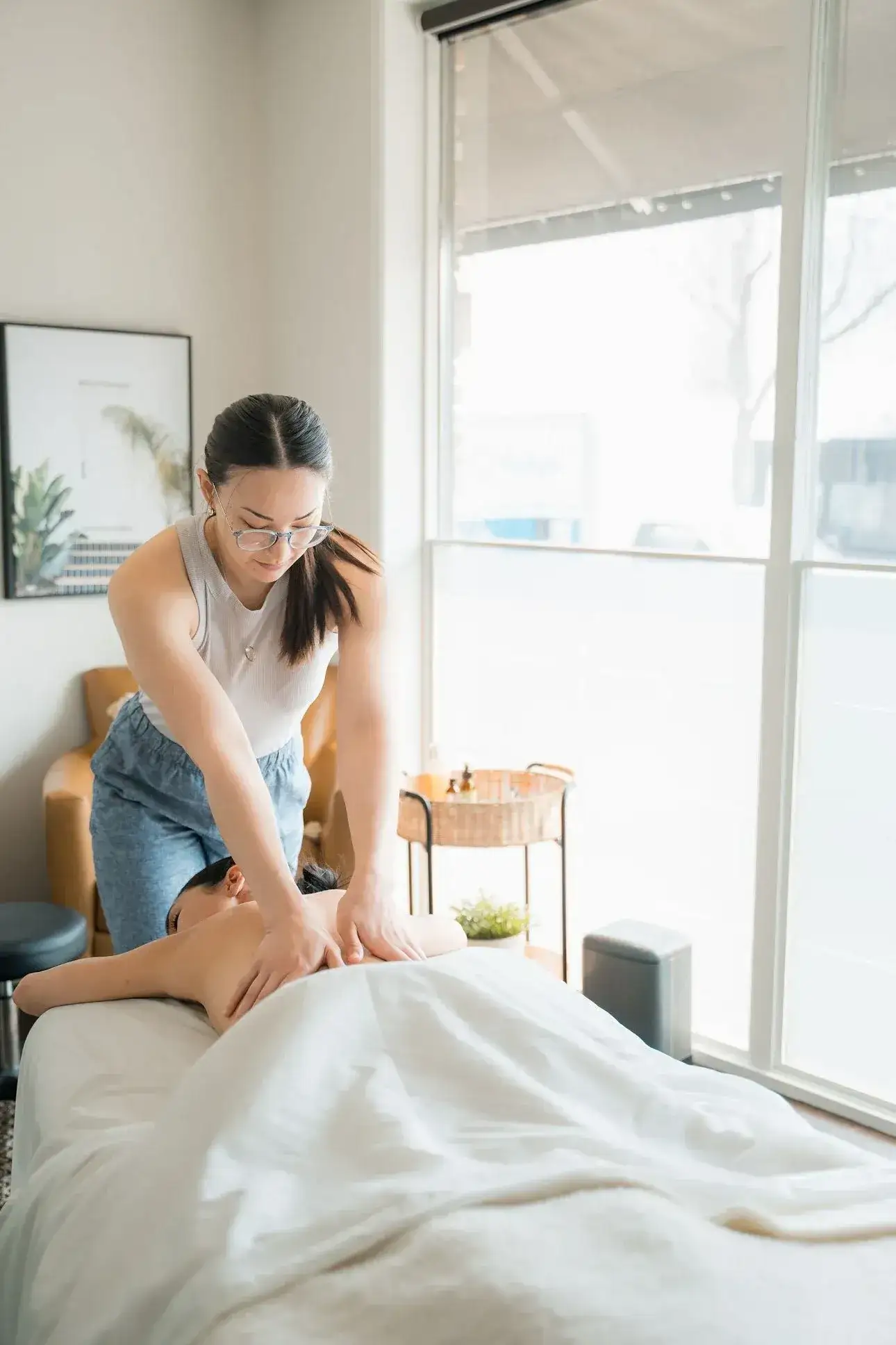
Massage for hikers and backpackers in Calgary
Massage for hikers and backpackers in Calgary: why the descent makes your legs sore for days, how massage eases it, and pack and pole tips for your next trip.
By The Renu lymphatic and massage team · 5 min read
Massage is a sensible way to ease the deep thigh and calf soreness that follows a big mountain day, and research on strenuous exercise shows lower soreness at 24 and 48 hours with massage. Most of that soreness comes from the walk down, not the climb up, so trekking poles and a well-fitted pack matter for your recovery too. A swollen joint, a calf that is swollen and painful on one side, or a leg that will not take weight needs a doctor first.
Living in Calgary means the mountains are close enough for a day trip, and plenty of our clients spend summer weekends on the trails and long weekends with a pack on. The Monday after often looks the same: thighs that protest on every stair, tight calves, and shoulders still shaped by the hip belt and straps. Here is why that happens, what massage can do about it, and how to make the next trip easier on your body.
Why the walk down hurts more than the climb
Most of the soreness after a mountain day comes from the descent. Walking downhill makes the thigh and calf muscles brake every step, and that braking work causes temporary muscle damage. A study on Mount Snowdon in Wales described exactly this: downhill walking caused muscle damage that affected muscle function and could expose the muscle to further injury.
In that study, 37 active adults climbed and descended the mountain carrying a day pack of about 5.6 kg. Those who used trekking poles kept more of their leg strength immediately after and at 24 and 48 hours. They also had less soreness at 24 and 48 hours and a lower level of creatine kinase, a marker of muscle damage, at 24 hours.
A separate lab study measured knee loads on a 25-degree downhill ramp. With hiking poles, ground reaction force, knee joint moment and the compressive and shear forces inside the knee all dropped by 12 to 25 percent. The researchers credited the force going into the poles and a slightly more forward-leaning posture. If your knees are the weak link on the way down, see our page on knee osteoarthritis as well.
What massage does after a big hike
Massage eases the soreness that follows hard, unfamiliar exercise; it does not speed the trip itself or make your legs stronger for the next one. A 2017 meta-analysis of 11 randomized trials (504 people) found soreness ratings were lower with massage than without at 24 and 48 hours after strenuous exercise, and creatine kinase was lower too. Our page on whether massage helps sore muscles after exercise covers that research in more depth.
After a hiking day, a session usually spends time on:
- quadriceps, the main brakes on the descent
- calves and shins, which work on every step of a steep or rocky trail
- hips and glutes, from climbing and stepping up
- upper back, shoulders and neck, from carrying a pack
Light, steady pressure on the freshly sore thighs usually feels better than deep work. If your legs feel heavy and puffy after a long day, a massage and lymphatic combination session mixes the two approaches.
Packs, straps and sore shoulders
If your shoulders ache after every backpacking trip, look at how the pack sits. Researchers loaded a manikin with a 20 kg backpack and measured pressure where the straps meet the shoulder. Pressure fell as strap width rose from 5 cm to 8 cm, and the lowest pressure came with 8 cm straps and the load packed high. Massage can ease the neck and upper back once you are home, but a better-fitting pack spreads the load before it becomes sore.
Planning trips and recovery from Calgary
The drive is part of the recovery picture. Banff National Park is about 90 minutes and 130 kilometres from Calgary International Airport, and that is a long time to sit with stiff legs after a hard descent. Stop to stretch your legs on the way home.
For Kananaskis Country and the Bow Valley corridor, the Government of Alberta requires a Kananaskis Conservation Pass for vehicles parked at provincial park and public land sites. A day pass is $15 and a yearly pass is $90, covering up to three vehicles. If you hike there most weekends, the yearly pass usually makes sense.
As for timing, the day after a big hike or the day after you get home from a multi-day trip tends to work well, when soreness is building. Easy walking in the meantime keeps blood moving; our page on the calf muscle pump explains why moving helps.
When to see a doctor before booking
Ordinary hiking soreness is spread across both legs, builds over a day or two and eases within a few days. See a doctor before massage if:
- one calf is swollen, warm, red or painful, especially after a long drive or flight home; this can be a sign of deep vein thrombosis, and the leg should not be massaged until it is checked
- a knee or ankle is swollen, or you cannot put weight on it after a slip or twist
- you have numbness, tingling or weakness in an arm or leg
- soreness is getting worse after several days rather than better
Massage for hikers at Renu
At Renu, your massage is with a Registered Massage Therapist who will ask about the trip, your pack weight and any falls or twists before starting. Most hikers choose:
- 60 minutes ($120) for legs, hips and shoulders after a day hike
- 90 minutes ($157) after a multi-day trip, with time for everything from calves to neck
- Massage and lymphatic combination, 60 minutes ($130) when your legs feel heavy as well as sore
We are open seven days, with weekend hours from 10:00 am to 5:00 pm and weekday evenings until 8:30 pm. Free street parking on 19 Street makes it easy to come straight from the car. Book through Jane online or read our massage therapy page.
Questions people ask
Why are my legs more sore two days after a hike than the day after?
That pattern is typical of delayed onset muscle soreness, which builds over a day or two after unfamiliar work, especially downhill walking where the thighs work as brakes. In the trekking pole study, soreness was measured at 24, 48 and 72 hours for that reason. It should ease within a few days.
Should I get a massage before a big backpacking trip?
A lighter session a few days before is fine if it helps you feel loose. Avoid a first-ever deep session right before you leave, since you do not know how your body will respond. Afterward is where massage has more to offer.
Do I need trekking poles for Calgary day hikes?
Not for every trail, but they are worth considering for steep descents. In a study on a 25-degree slope, poles cut forces on the knee by 12 to 25 percent, and in a mountain trek study they lowered soreness in the days after. If your knees complain on the way down, poles are a reasonable experiment.
Can massage help sore shoulders from my pack?
Yes, massage of the neck, upper back and shoulders is a common request after a multi-day trip. If your shoulders are sore every time, look at the pack too: wider straps and a higher load placement lowered shoulder pressure in testing.
Sources
- Medicine and Science in Sports and Exercise: Trekking poles reduce exercise-induced muscle injury during mountain walking (2011)
- Journal of Sports Sciences: Knee joint forces during downhill walking with hiking poles (1999)
- Work: Effect of shoulder strap width and load placement on shoulder-backpack interface pressure (2017)
- Frontiers in Physiology: Massage alleviates delayed onset muscle soreness after strenuous exercise (2017)
- Government of Alberta: Kananaskis Conservation Pass
- Banff and Lake Louise Tourism: Getting here
Page reviewed October 5, 2026. This page is education, not a diagnosis. For your own situation, talk to your doctor, surgeon or care team, or ask us.

