
Conditions
Lymphatic drainage for idiopathic edema
Lymphatic drainage for idiopathic edema: how this daytime fluid retention is diagnosed, why water pills can make it worse, and where a drainage session fits.
By The Renu lymphatic and massage team · 5 min read
Lymphatic drainage may ease the heavy, puffy feeling of idiopathic edema for a while, but no trials have tested it for this condition and it is not a treatment for the cause. Idiopathic edema is daytime fluid retention in women of menstruating age, diagnosed by a doctor once heart, kidney, liver and vein causes are ruled out. Its usual care is medical and practical, and diuretics can themselves keep the swelling going, so see your doctor first.
Does lymphatic drainage help idiopathic edema?
Lymphatic drainage may make a puffy, heavy body feel lighter for a while, but it does not treat idiopathic edema, and we could find no trials testing it for this condition. Our role is to refer first, so your doctor confirms the diagnosis and manages any medication, and then to support comfort if you want hands-on care.
Idiopathic edema means fluid retention without an identified cause. It used to be called cyclic edema, and you may also see it described as fluid-retention edema or orthostatic edema. A 2006 review in the Journal of the American Board of Family Medicine says it is the most likely cause of leg swelling in women under 50, and describes it this way:
- It occurs only in women who are menstruating, most often in their 20s and 30s.
- Fluid is retained when upright, so swelling builds through the day.
- Typical weight gain over a day is more than 1.4 kg, though it can be as little as 0.7 kg.
- The face and hands often puff up as well as the legs.
- It persists through the whole cycle.
That last point separates it from premenstrual swelling, which the same review says comes a few days before a period and resolves as it starts. If your swelling follows your cycle, our page on fluid retention before your period is the better fit.
The water pill trap
Diuretics are a common reason this kind of swelling keeps going, and this is the single most useful thing to know. The 2006 review notes that many women with idiopathic edema are already taking diuretics when first seen and may have diuretic-induced edema. Long-term use leaves the body slightly short of fluid, which switches on the renin-angiotensin-aldosterone system, the hormones that hold on to salt and water. When the pills stop, swelling rebounds, which convinces people they need them.
A 1979 study in The Lancet showed this directly. Ten women with “idiopathic” edema retained salt and water and gained weight quickly when their usual diuretics were stopped. In seven, the weight gain and swelling settled within 20 days. A year later, two of the three most affected women were free of swelling without diuretics. The authors concluded that this kind of intermittent swelling in otherwise healthy women seemed to result from diuretic use rather than being truly unexplained.
The recommended approach, per the 2006 review, is a supervised withdrawal over 3 to 4 weeks, with a warning that swelling will probably worsen first and reassurance that the medicine can be restarted. That is a conversation for your doctor, never something to try alone. Our page do water pills help lymphedema covers why diuretics are a poor fit for lymphatic swelling too.
What usually helps day to day
The everyday measures for idiopathic edema are simple, and they matter more than any single appointment. The 2006 review lists:
| Measure | The reasoning |
|---|---|
| Lying down for periods during the day | Fluid builds while upright |
| Avoiding environmental heat | Hot surroundings tend to make daytime swelling worse |
| A lower-salt diet | Less salt to hold water |
| Not over-drinking fluids | Very high intake gives the body more to hold on to |
| Weight loss if carrying excess weight | Reduces the load |
When medication is needed, doctors usually start with spironolactone, given in the early evening because swelling peaks late in the day. Compression stockings, so useful for vein problems, are usually not helpful and not well tolerated in idiopathic edema.
Calgary summers bring their own test of the heat rule: long days on your feet at Stampede, a patio afternoon or a hot car can all push swelling up by evening, so build in time with your legs raised. Our page on how to elevate an arm or leg shows how to do it well.
Swelling that needs a doctor, not a massage
Idiopathic edema is a diagnosis reached by ruling other things out, so new or changing swelling always goes to your doctor first. The 2013 American Family Physician review says swelling of a limb that develops over less than 72 hours is more characteristic of:
- Deep vein thrombosis (a clot in a deep vein)
- Cellulitis (a skin infection)
- A ruptured cyst behind the knee
- Compartment syndrome after an injury
- Recently starting a calcium channel blocker for blood pressure
Swelling in both legs that is more generalized points toward heart, kidney or liver disease, covered on our page about heart, kidney or liver swelling. Medications are another common cause; see can medications cause swollen ankles.
Get urgent help if one calf or thigh is swollen, throbbing and discoloured, or if swelling comes with chest pain or shortness of breath, which the NHS lists as signs of a clot that may have reached the lungs. Red, hot, painful skin with flu-like symptoms suggests cellulitis. Sudden puffiness with breathlessness also needs a same-day assessment. If doubt remains about lymph flow, the 2000 Radiographics review notes that lymphoscintigraphy can confirm or rule out a lymphatic problem.
How this works at Renu
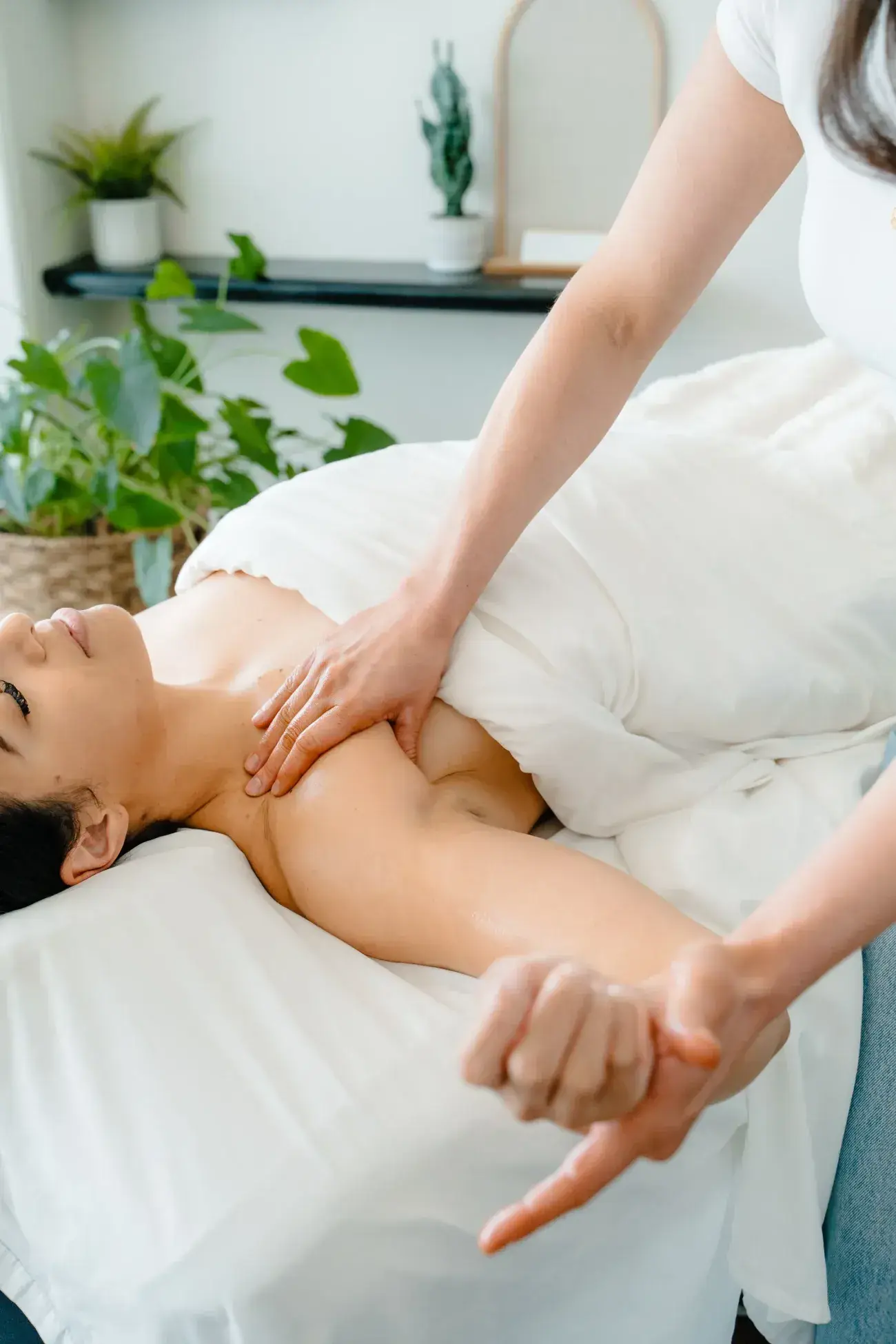
If your doctor has confirmed idiopathic edema and you would like hands-on care, a classic lymphatic drainage session is a gentle, quiet hour that many people find settling. We will ask about your diagnosis, medications, any diuretic changes underway and how the swelling behaves across the day, and we will not suggest you change any medicine.
- Classic lymphatic drainage, 45 minutes, $105: legs, or face and hands, with time to show you simple self-drainage.
- Classic lymphatic drainage, 60 minutes, $130: legs, abdomen, arms and face in one session.
Late-afternoon bookings, when swelling is at its fullest, can be a good time to come in; we are open until 8:30 pm on weekdays. Book through Jane, and treat it as a comfort measure that sits beside your doctor’s plan rather than a replacement for it.
Questions people ask
Is idiopathic edema the same as PMS bloating?
No. Premenstrual swelling comes a few days before a period and settles once it starts. Idiopathic edema persists right through the cycle, and doctors are advised to tell the two apart.
Why did my swelling get worse when I stopped my water pills?
Long-term diuretic use switches on the body's salt-saving hormones, so stopping causes a rebound. Doctors manage this with a planned 3 to 4 week withdrawal, warning that swelling usually worsens at first. Do not stop prescribed medication without your doctor.
Do compression stockings help idiopathic edema?
Usually not. A family medicine review notes compression stockings are usually not helpful and not tolerated in idiopathic edema, unlike in vein-related swelling, where they are a standard treatment.
How do I know my swelling is idiopathic?
Only a doctor can say. It is diagnosed clinically after a history and examination rule out heart, kidney, liver, thyroid, medication and vein causes, sometimes with blood and urine tests, and occasionally lymphatic imaging when lymph flow is in doubt.
Sources
- Ely et al., J Am Board Fam Med 2006: Approach to leg edema of unclear etiology
- MacGregor et al., Lancet 1979: Is idiopathic edema idiopathic?
- Trayes et al., American Family Physician 2013: Edema, diagnosis and management
- Witte et al., Radiographics 2000: Advances in imaging of lymph flow disorders
- NHS: DVT (deep vein thrombosis)
- NHS: Cellulitis
Page reviewed October 5, 2026. This page is education, not a diagnosis. For your own situation, talk to your doctor, surgeon or care team, or ask us.
Keep reading
Related pages