
Infrared sauna pod vs infrared sauna cabin
Infrared sauna pod vs cabin: the same radiant heat in a different format. Lying in a private pod or sitting in a cabin, session length and who suits each.
By The Renu lymphatic and massage team · 5 min read
An infrared pod and an infrared cabin use the same kind of heat: emitters that warm your body directly while the air stays far cooler than a traditional sauna. The difference is format. In a pod you lie down alone in a cushioned chamber, usually for a shorter session; in a cabin you sit upright in a wooden room, often for longer and sometimes with others. Choose by how you like to rest, how enclosed you are comfortable being and how long you want to be in the heat.
A pod and a cabin are two shapes of the same idea. Both use infrared emitters that warm your skin and the tissue beneath it directly, so the air can stay around 40 to 60 °C instead of the 70 to 90 °C of a traditional sauna. What changes is how you spend the time: lying down alone in a cushioned chamber, or sitting upright in a wooden room. For most people the right choice comes down to comfort, privacy and how long they want to be in the heat.
Same heat, different shell
The heat source is the same type in both; the format is what you are really choosing. Infrared saunas come as cabins that look like small traditional saunas, as cheaper portable tents with an infrared element inside, and as enclosed pods you lie in. Far infrared is felt directly by the body as radiant heat, which is why sessions can feel gentle even as you start to sweat.
| Infrared pod | Infrared cabin | |
|---|---|---|
| Posture | Lying down on a cushioned base | Sitting upright on a bench |
| Who is inside | One person | One person or several |
| Typical session | Shorter sessions; 20 minutes at Renu | Longer; research protocols often 45 minutes |
| Feel | Enclosed and cocooning | Open room you can move around in |
| Best for | Resting, privacy, adding heat after a treatment | Longer sessions, sharing, sitting up |
Lying down vs sitting up
Lying down suits people who want the session to feel like rest. In a pod, your whole body is supported and you stay still, which many people find easier after a massage or a long day. A cabin keeps you upright, which some people prefer because they can shift position, stretch or step out more easily.
Where your head is matters too. Some portable designs leave the head outside the heated space. Researchers using a head-out portable infrared sauna in a 2025 study noted that letting people breathe room-temperature air instead of heated air could play a role in comfort and tolerability. Their protocol alternated up to 20 minutes in the heat at about 66 °C with five-minute rests. In a cabin you breathe the warm air of the room; pods vary in design, so ask what a particular one does if breathing warm air bothers you.
How long people stay in each
Cabin research tends to use long sessions, while pod sessions are usually shorter. In a 2025 laboratory comparison by Atencio and colleagues, the far infrared sauna protocol was 45 minutes at 45 to 65 °C, compared with three 10-minute rounds at 80 °C in a traditional sauna. The infrared cabin raised core temperature the least of the three heat methods tested, and hot water immersion raised it the most.
A related study from the same group put probes in the thigh muscle of ten people sitting in an infrared cabin for 45 minutes. Muscle temperature rose by about 1 to 3 °C depending on depth, core temperature did not change, and people lost about 0.5 percent of body weight in sweat, roughly 0.46 litres an hour.
Cleveland Clinic’s guidance is shorter than those protocols: start with five to ten minutes at the lower end of the range, keep sessions under 30 minutes, and use infrared three or four times a week at most. A 20-minute pod session sits comfortably inside that advice; a 45-minute cabin session does not.
Longer, structured heat can be therapeutic. In Japan, Waon therapy has people sit in a far infrared sauna pre-warmed to 60 °C for 15 minutes, then rest lying down wrapped in a blanket for 30 minutes. In a 2021 study of 31 people with hypertension, a single session lowered blood pressure. That is a supervised medical protocol, though, not a reason to stay longer in any sauna on your own.
Privacy, hygiene and claustrophobia
A pod is a one-person space, which some people value for privacy and others find too enclosed. In a cabin you may share benches and air with others, depending on the facility. In a pod you are on your own for the whole session.
The enclosure is the main reason people hesitate about pods. If lying in an enclosed chamber makes you anxious, our page on whether the cocoon pod is claustrophobic walks through what it feels like. A cabin, with its door and room to sit up, may simply suit you better, and that is a fine answer.
Who should skip either format
The cautions are the same for both, because the heat is the same. Cleveland Clinic advises avoiding infrared saunas if you are pregnant, trying to conceive, unwell, or have multiple sclerosis, and checking with a doctor first if you have a pre-existing condition. In either format, drink water, skip alcohol, and get out straight away if you feel dizzy or nauseated.
The cocoon pod at Renu
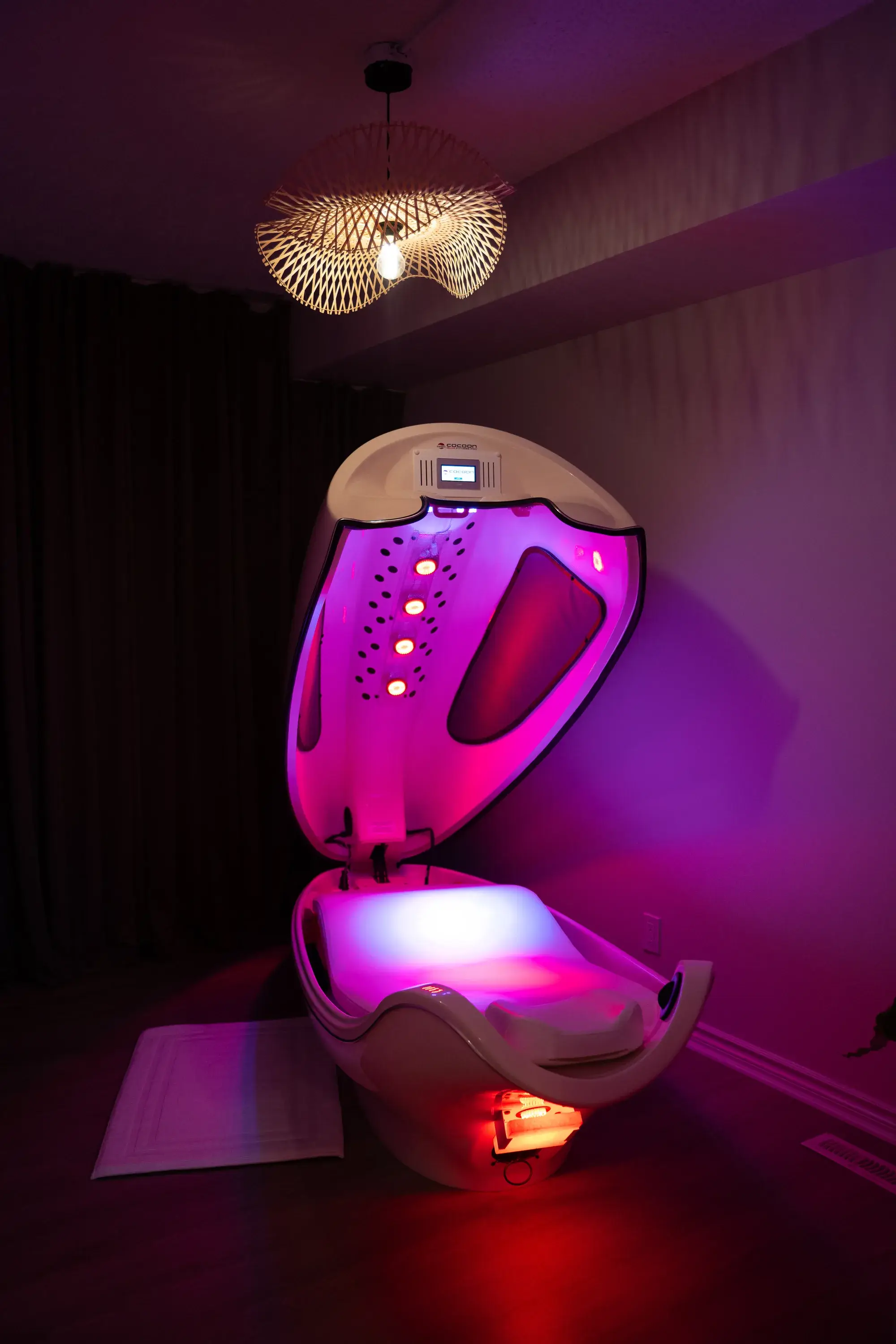
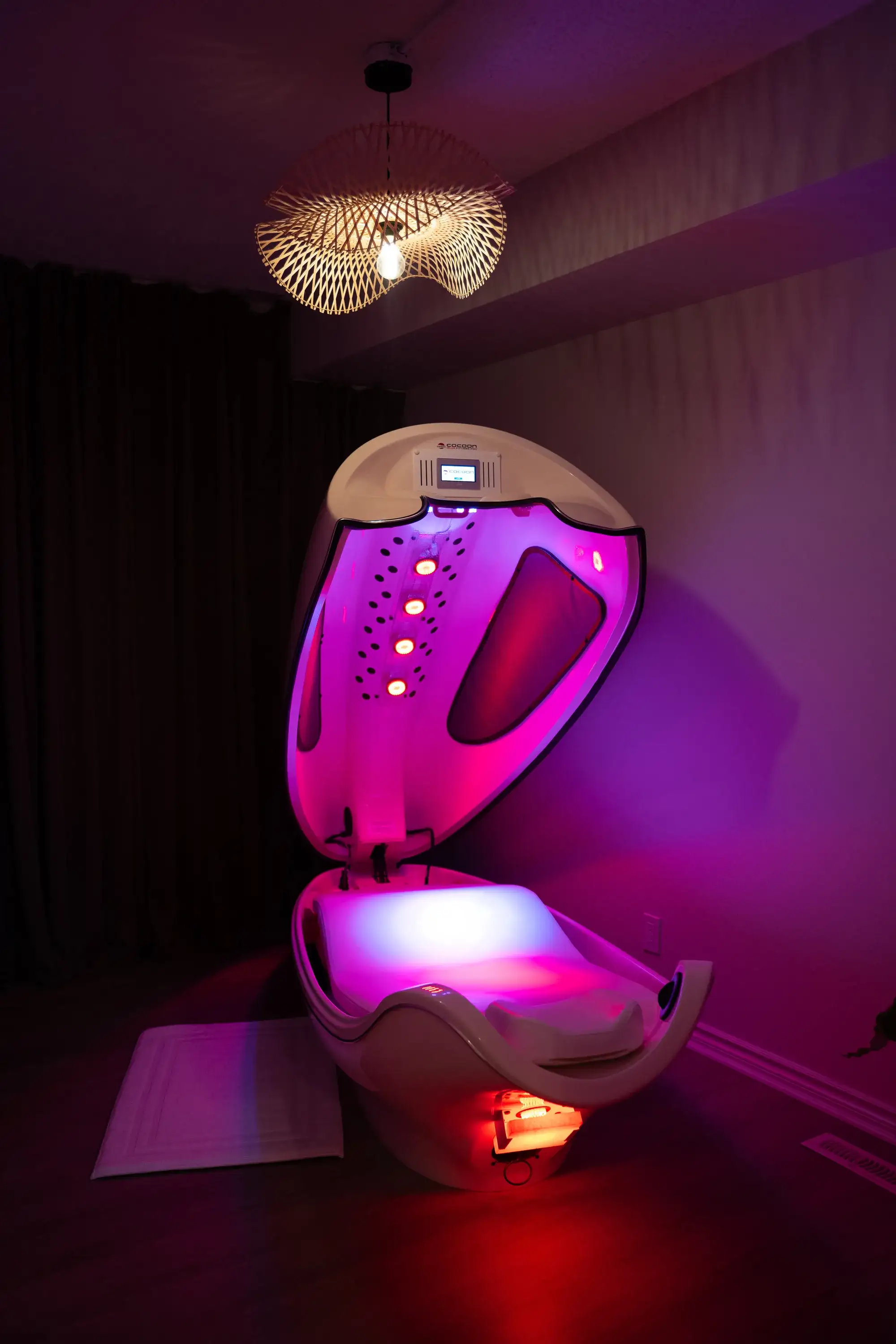
Ours is a pod, not a cabin. The infrared cocoon in the BodyTox studio is a cushioned, full-body private chamber with full-spectrum infrared, and you lie still for the session. You can book it in several ways:
- a 20-minute session on its own, or added to a facial, massage or lymphatic treatment;
- included with the new client massage special and with every Full BodyTox;
- a monthly membership for regular use, which adds 40-minute member sessions.
If you are new to infrared, start with 20 minutes. Our page on what happens in a cocoon pod session describes the visit step by step, and how often you can use the pod helps if you are weighing the membership.
How to choose
Choose the format that lets you relax in the heat. A pod suits you if you like to lie still, want a short private session, or want heat straight after a treatment without changing rooms. A cabin suits you if you prefer to sit up, want longer sessions, or would rather share the experience. If you are unsure how you handle enclosed spaces or heat, try a single 20-minute pod session before committing to anything regular.
Questions people ask
Is a sauna pod as effective as a full infrared sauna?
No study we know of compares a lie-down pod with a sit-up cabin directly. The heat source is the same type, so the main differences are session length, posture and how enclosed you are, rather than a different kind of effect.
Do I sweat as much in a pod?
Sweat depends mostly on how hot the space is and how long you stay in. In a 45-minute cabin study, people lost about half a percent of their body weight. A 20-minute pod session is shorter, so expect less, but still drink water before and after.
Can two people use an infrared pod together?
Pods are usually built for one person lying down, which is part of their appeal for privacy. Cabins range from one-person units to rooms that seat several people, so a cabin suits you better if you want to share the session.
Why is the 40-minute pod session only for members?
At Renu the 40-minute session is part of the monthly membership, for people who use the pod regularly. Longer heat is something to build toward once you know how your body handles it, which a regular routine allows.
Sources
- Wikipedia: Infrared sauna
- Lebron et al., Journal of the International Society of Sports Nutrition 2025: Reliability of achieving target dehydration levels using a portable infrared sauna protocol
- Atencio et al., Am J Physiol Regul Integr Comp Physiol 2025: Comparison of thermoregulatory, cardiovascular and immune responses to different passive heat therapy modalities
- Reed et al., Journal of Applied Physiology 2025: Muscle temperature increases during a single far infrared sauna session
- Cleveland Clinic Health Essentials: Infrared saunas, what they do and health benefits
- Kominami et al., Medicine 2021: Blood pressure-lowering effect of repeated Waon therapy in non-smokers with hypertension
Page reviewed October 5, 2026. This page is education, not a diagnosis. For your own situation, talk to your doctor, surgeon or care team, or ask us.
Keep reading
Related pages