
Your first RAPID NeuroFascial Reset session in Calgary: what to expect
Your first RAPID NeuroFascial Reset session in Calgary: show what hurts, move while your therapist holds pressure, re-test, and choose 30 or 45 minutes.
By The Renu lymphatic and massage team · 6 min read
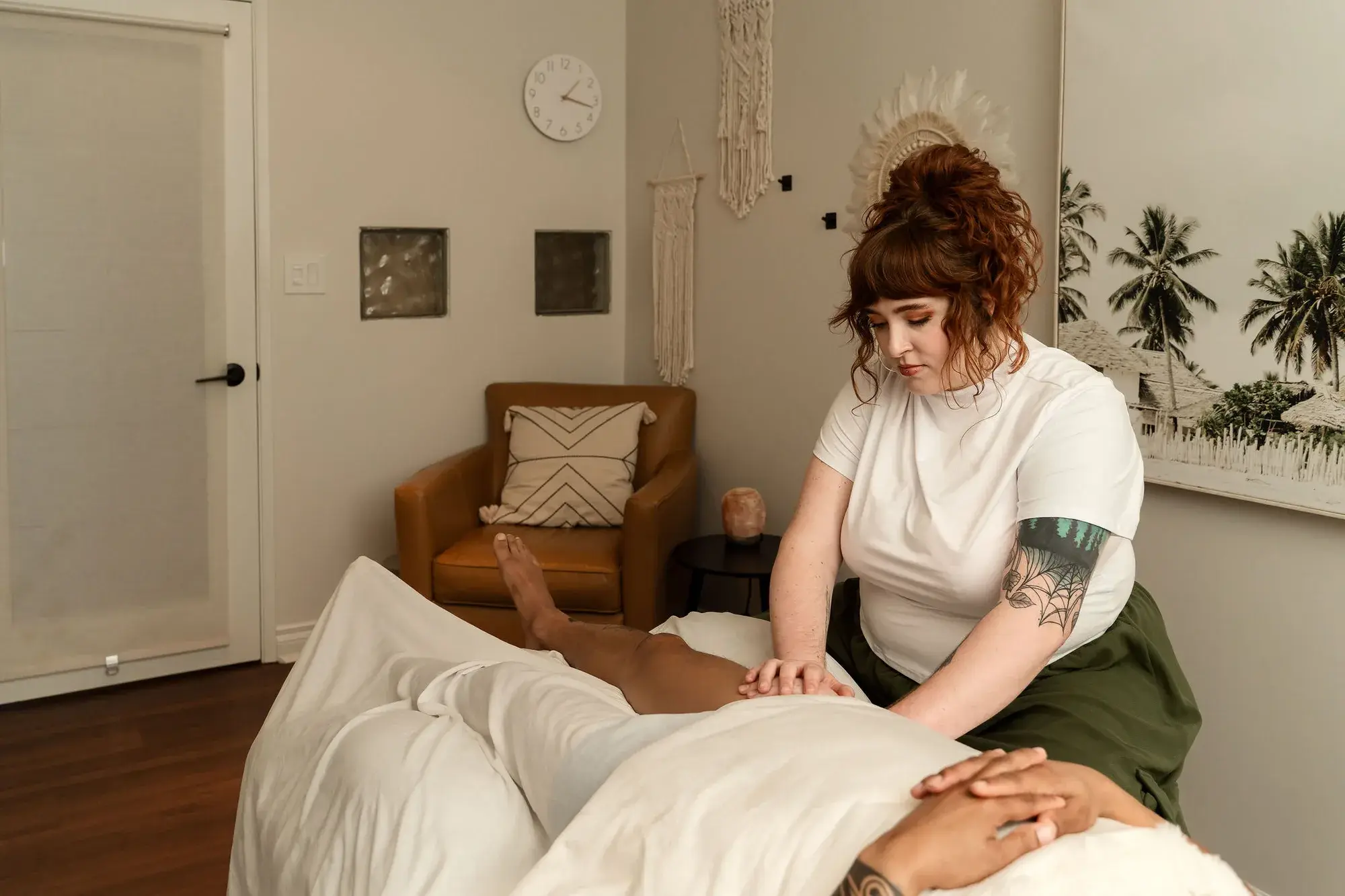
Your first RAPID NeuroFascial Reset session starts with you showing your therapist which movements hurt or feel restricted. She then finds the sensitive tissue by touch and holds precise pressure on it while you move the joint in a specific way, which can be briefly intense, and re-tests the movement as she goes. At Renu, RAPID is booked with Monica Von Gaza as a 30-minute ($85) or 45-minute ($110) session.
A first RAPID session in four stages
A first RAPID session has four parts that repeat in short loops: you show what hurts, your therapist searches the tissue by touch, she holds a contact while you move, and you test the movement again. It is active, quick and conversational, closer to a coaching session than to lying still under a sheet.
| Stage | What you do | What your therapist does |
|---|---|---|
| Show | Move the way that hurts or catches | Watches, asks where and when it hurts |
| Search | Relax while the area is felt | Feels the texture, tightness and movement of the tissue |
| Treat | Perform a specific, guided movement | Holds directed pressure and tension on one spot |
| Re-test | Repeat the original movement | Notes what changed and picks the next spot |
Show the movement that hurts
The session begins with your problem movement, not with a massage. Be ready to demonstrate: reaching overhead, gripping a kettle, turning your head to shoulder-check, opening your mouth wide, or lifting a bag onto a shelf. The more precisely you can reproduce the pain, the more useful the session is, because that movement becomes the yardstick for the rest of the session.
Expect questions about how the problem started, what makes it worse and what you have already tried. Mention anything that sounds medical rather than mechanical (see the last section).
The search: hands-on palpation
Next, your therapist examines the area by touch. RAPID’s developers describe a combination of hands-on palpation, examination and treatment, with the therapist feeling the texture, tightness and movement of muscles, fascia, tendons, ligaments and nerves. In practice this is a slow, attentive press-and-pause around the joint, looking for the spots that feel thickened or are sharply tender. You will usually recognise the right spot at once: it tends to feel like the pain you came in with.
The reset: pressure while you move
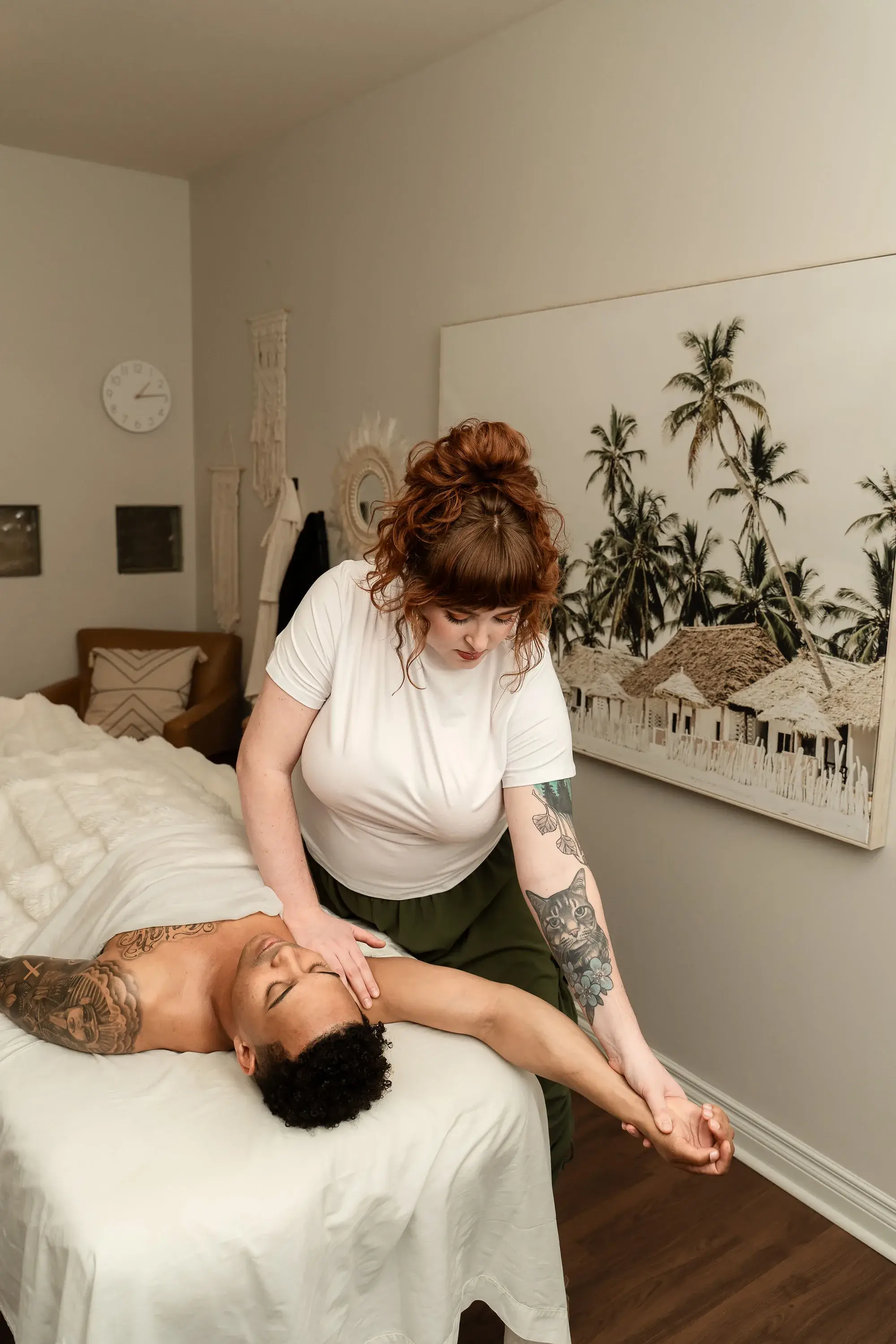
This is the part that surprises first-timers. RAPID combines precisely directed depth and tension with very specific patient movements, according to the method’s own description. Your therapist anchors a firm contact on the sensitive point and asks you to move the joint slowly through a set path, for example straightening the elbow, rotating the shoulder outward or flexing the wrist, while she keeps the contact in place.
A few things that help:
- Move slowly. A smooth, deliberate movement works better than a fast one.
- Breathe. People tend to hold their breath at the intense moment; keep breathing through it.
- Follow the cue, not your instinct. Your body may want to pull away. The guided path is the treatment.
Why you move at all is explained in more depth on our page about why you move during RAPID.
Intense, brief, and always on your terms
RAPID can feel strong, and that is by design. The method’s own site says sessions may be uncomfortable because the nervous system is being stimulated. The intensity usually lasts only for the length of one movement, and the contact lifts as soon as the movement ends.
Strong is not the same as unbearable. CRMTA standards require therapists to work within your pain threshold and to stop if you withdraw consent. Before the first movement, agree a simple scale with Monica: a word for “that is my limit” and a word for “stop”. If a pass makes you clench your jaw, hold your breath or flinch, say so, and she will lighten the contact or choose a different angle.
The re-test, and what you might notice
After each pass, you repeat the movement you showed at the start. Some people notice a change in range or comfort within the session, some notice it over the following days, and some notice little. RAPID’s developers say clients value a rapid response, and our page about the research behind RAPID goes into more detail. Use the re-test honestly. If the movement is unchanged, tell your therapist rather than being polite about it.
What to wear, and choosing 30 or 45 minutes
Wear or bring clothing that lets the area be reached and moved freely. A tank top or sports bra suits shoulder, neck and upper-back work; a short-sleeved shirt suits elbows and wrists; shorts suit hips, knees and feet. You stay dressed except where the contact is needed.
At Renu, RAPID is booked as:
| Session | Price | Suits |
|---|---|---|
| RAPID NFR Treatment 30 | $85 | One clear problem area, such as a tennis elbow or one stiff shoulder |
| RAPID NFR Treatment 45 | $110 | A first visit with more history to cover, or two related areas such as neck and shoulder |
On our massage and TMJ menus the same sessions are listed as RAPID NeuroFascial Reset (upper body), so shoulders, elbows, wrists, the neck and the jaw are the most common reasons people book. If your problem is in a hip, knee or foot, ask when you book. Why a short session can still do the job is covered in why RAPID sessions are shorter than a massage.
Who does RAPID at Renu, and after the session
Monica Von Gaza, a Registered Massage Therapist, provides RAPID NeuroFascial Reset at Renu; she also offers lymphatic massage and myofascial cupping. You can read about her on our team page and book her through Jane. We are on 19 Street NW in West Hillhurst, a short drive from downtown via Memorial Drive, open seven days with weekday evening appointments.
Afterward, go about your normal day and pay attention to the problem movement. Re-test it the next morning and over the next few days, in the real setting where it bothers you: your desk, the golf swing, carrying groceries in from the car. Note what changed and bring that to your follow-up; the timing of the next visit depends on how the movement responds.
When to see a doctor before booking
RAPID is for mechanical pain and restriction, not for pain that needs a diagnosis. NCCIH advises against using massage therapy to postpone seeing a health care provider about a medical problem and suggests discussing concerns with your provider if you are unsure massage is appropriate. See your doctor first if the pain followed a fall, a car accident or a sports injury and has not been assessed; if you have numbness or weakness that is spreading or getting worse; or if the pain is getting steadily worse rather than staying the same. Your therapist may also suggest a doctor visit if anything in your history suggests the problem is not mechanical.
Questions people ask
Can I book a RAPID session online?
Yes. RAPID is booked through Jane like our other treatments, under Monica Von Gaza. If you have imaging results or a diagnosis from your doctor or physiotherapist, bring a summary, because it helps Monica decide where to start and what to leave alone.
Can RAPID be used for jaw pain?
RAPID's developers list TMJ problems among the conditions the method is used for, and at Renu the RAPID sessions also appear on the TMJ massage menu. If your jaw locks, or you cannot eat comfortably, see your dentist or doctor first.
Can I combine RAPID with a regular massage?
They are booked separately at Renu. Some people book a regular massage on another day for general tension and keep RAPID for the one movement that will not settle; ask Monica which order she would suggest for you.
What if nothing changes after my first session?
Tell Monica honestly at the re-test. If a movement does not change, a different approach or a medical assessment may suit you better.
Sources
Page reviewed October 5, 2026. This page is education, not a diagnosis. For your own situation, talk to your doctor, surgeon or care team, or ask us.
Keep reading
Related pages