
Deep tissue massage in Calgary
Deep tissue massage in Calgary with a Registered Massage Therapist: no extra fee over a regular massage, 60 min $120, 75 min $141, 90 min $157. Open 7 days.
By The Renu lymphatic and massage team · 7 min read
At Renu, deep tissue massage is booked as a regular massage with a Registered Massage Therapist, so firm work carries no separate fee: $120 for 60 minutes, $141 for 75 and $157 for 90. Pick the length by how many areas need focused work, tell your therapist where the stubborn tension lives, and pressure is built gradually and adjusted with you throughout. Expect some soreness for up to about a day and a half; skip deep work and talk to your doctor first if you have a clotting history, osteoporosis or a recent injury.
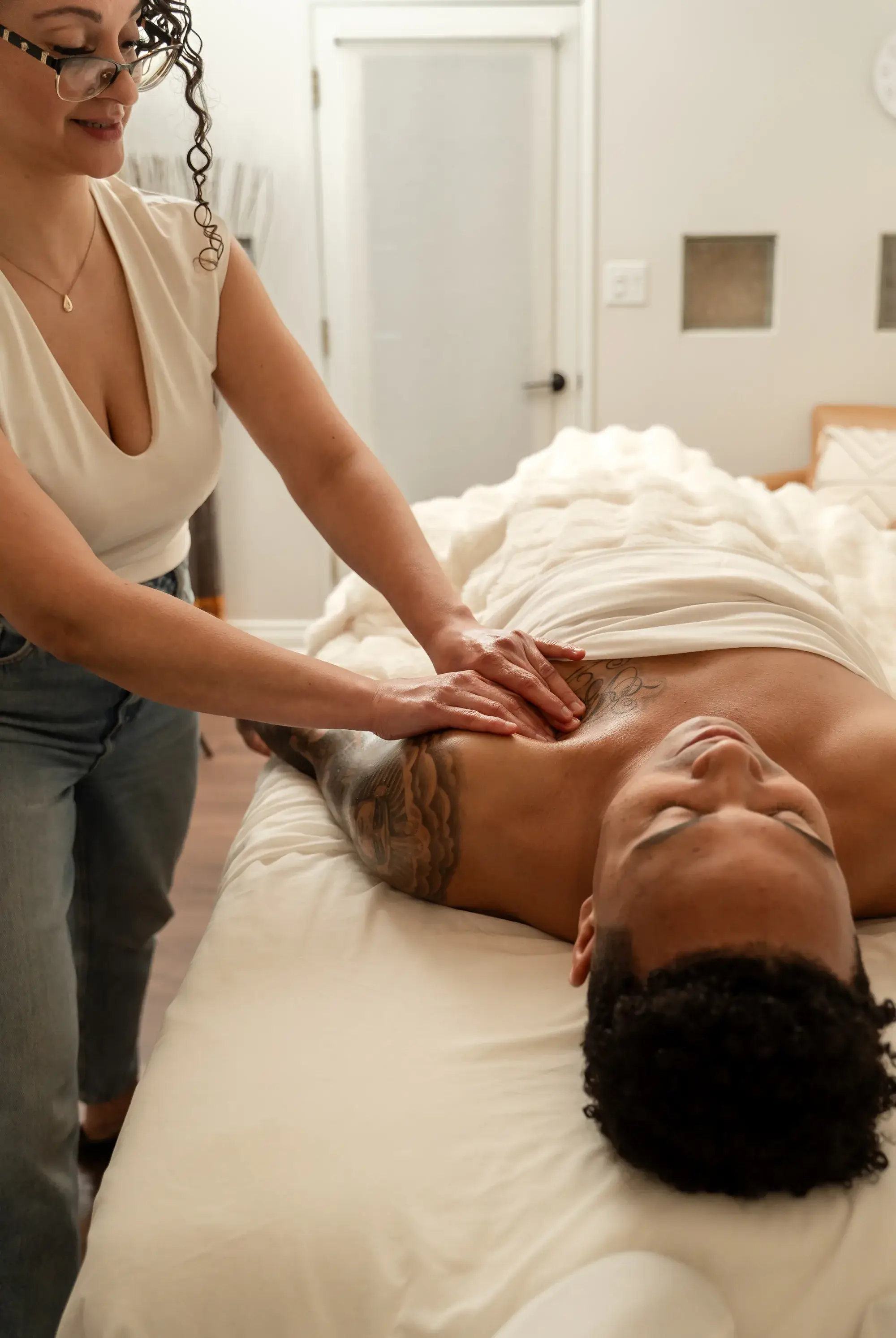
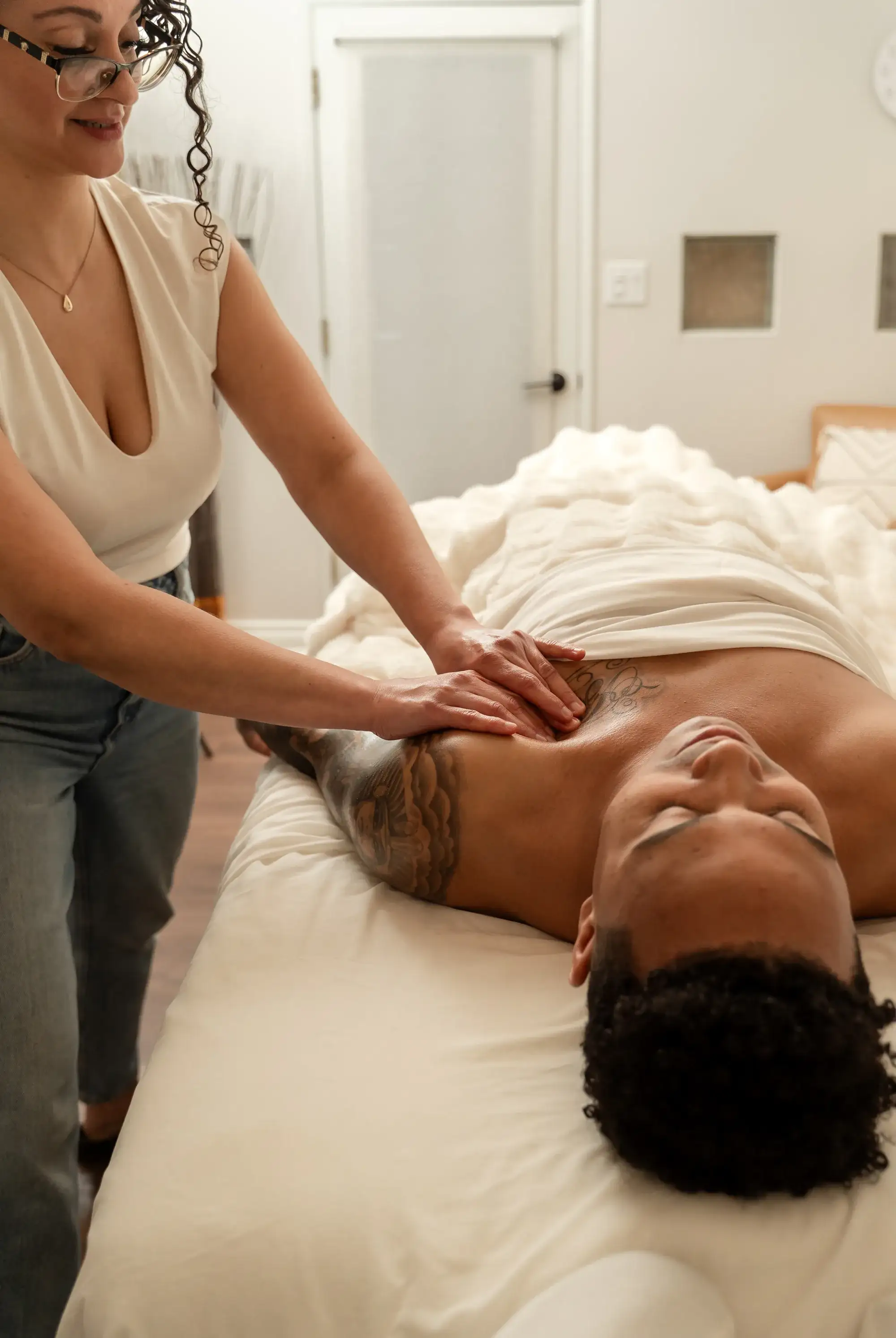
Deep tissue massage in Calgary does not need to be a special order at Renu. You book a massage for the length you want with one of our Registered Massage Therapists, tell us you want firm, focused work, and the session is built around the places that keep tightening up. This page covers what that costs, how to choose a length, how we settle on pressure together, what the next day usually feels like, and when deep work is the wrong choice.
What deep tissue costs at Renu
Deep tissue is priced the same as every other massage style on our list. Our massage rate covers Swedish, deep tissue, sports or relaxation, or a mix you settle on with your therapist, so the only decision with a price attached is time.
| Length | Price | A realistic scope for deep work |
|---|---|---|
| 60 min | $120 | One or two regions, such as neck and upper back |
| 75 min | $141 | Two or three regions, with time to return to the worst spot |
| 90 min | $157 | Several regions, or full body with focused work where you need it |
We also offer 30- and 45-minute massages ($80 and $100). They suit a single area you already know well, but deep work takes time to build into, so most people asking for deep tissue are better served by an hour or more. If this is your first visit, the 60-minute new client massage ($120 plus GST) can be deep tissue too, and it comes with a complimentary 20-minute infrared cocoon session.
Our receipts come from Registered Massage Therapists who belong to professional associations. Benefit plans decide which associations and training hours they accept, often 2,200 hours, so check your own plan before you claim.
Choosing 60, 75 or 90 minutes for firm work
Match the length to the number of areas, not to how sore you feel. Firm pressure is applied slowly. A therapist warms the tissue with broader strokes first, then works more specifically, then eases off again, and that arc takes time in each region.
A few practical rules we share with clients:
- One stubborn spot, such as a shoulder blade that never lets go: 60 minutes leaves room to work it properly and still address the neck that usually comes with it.
- Neck, upper back and low back together: 75 minutes avoids rushing the last area.
- Desk posture plus training soreness in the legs: 90 minutes, or two shorter visits a week or so apart.
If you are unsure, book 60 minutes. We would rather you finish wanting a little more than leave with every area half done. Our article on whether a 60- or 90-minute massage is better goes further into the trade-offs.
How pressure is settled on the table
Pressure is a conversation that continues all session, not a setting chosen once at the start. Before we begin, we ask where the tension sits, how long it has been there and what makes it worse. Then we work in stages:
- Warm-up strokes to let you get used to our hands and to let us read how the tissue responds.
- Gradual depth. We lean in slowly and check in. You can answer in words, in a number out of ten, or simply by saying “more” or “less”.
- Specific work on the spots that need it: slow strokes, sustained direct pressure, and friction across the grain of the muscle.
- Easing out so the area is not left feeling raw.
Firm work can be intense, but it should not make you hold your breath, clench your jaw or pull away. Cleveland Clinic’s advice is simple: if a technique does not feel therapeutic to you but simply feels like pain, speak up. You can ask us to change pressure, skip an area or stop at any point, and none of that is an inconvenience. Our page on whether deep tissue massage has to hurt to work explains why more pain does not mean more benefit.
What the evidence says about deep work
The research supports deep tissue massage for some kinds of muscle pain. In a randomized trial of 80 adults with myofascial pain syndrome in the neck, half received 12 sessions of deep tissue massage alongside standard physiotherapy (heat, ultrasound and TENS). They improved more in neck pain, disability, quality of life and most neck movements than people who had the physiotherapy alone.
A 2019 systematic review of treatments for myofascial pain and trigger points found moderate evidence for manual therapy.
The broader picture from the US National Center for Complementary and Integrative Health (NCCIH) is that massage may help neck or shoulder pain, but the benefit may only last for a short time. That is why we talk with clients about spacing visits and about what they can do between them, rather than promising that one firm session will reset months of tension. If you are wondering about rhythm, see how often to get a deep tissue massage.
The day after: soreness you can expect
Some soreness after deep work is common and usually short-lived. Cleveland Clinic notes that discomfort after a massage usually lasts a few hours to about a day and a half, and that deep tissue work can leave you sorer because deeper pressure is applied to specific muscle groups.
What tends to help:
- staying hydrated and moving gently, such as a walk;
- a warm bath or shower, or heat or cold on the area;
- a decent night’s sleep before you load the area hard again.
If you have a hard workout or a long drive planned, book your session a day or two before rather than the evening before. Intense soreness that lasts longer than a couple of days is worth checking with a health care provider. Bruising is covered separately in our article on bruising after a deep tissue massage.
When to check with your doctor before deep tissue
Deep work is not right for everyone, and some situations need a medical opinion first. NCCIH describes the overall risk of harm from massage as low, but reports rare serious side effects such as a blood clot, nerve injury or bone fracture. These have sometimes been linked to vigorous techniques like deep tissue massage or to people who are more vulnerable, such as older adults.
Talk to your doctor before booking firm work, and tell us at the start of the session, if you:
- have had a blood clot, or have throbbing pain and swelling in one leg, usually the calf (do not book a massage for that; get it assessed the same day);
- have osteoporosis or a history of fragility fractures;
- take blood thinners or bruise very easily;
- have a recent injury, surgery or new numbness or tingling in the area;
- have lymphedema or have had lymph nodes removed.
In those cases we can still often help with lighter, adapted work. Our full guide to who should avoid deep tissue massage lists more situations, and deep tissue with lymphedema has its own page.
Booking deep tissue at Renu
You can book online through Jane: choose “Massage” and the length you want, and add a note that you would like deep tissue focus. Deep tissue is part of the massage work all of our RMTs offer; if you want the same therapist each time, book them by name so they can follow how your tension changes from visit to visit. We are on 19 Street NW in West Hillhurst, open seven days, with evening appointments Monday to Friday. If this will be your first deep tissue session anywhere, our page on your first deep tissue massage walks through the visit step by step.
Questions people ask
Is deep tissue massage more expensive than a regular massage at Renu?
No. Deep tissue, Swedish, sports and relaxation work all sit under one massage price list, so you pay for the length of the appointment, not the style. A 60-minute session is $120 whether your therapist spends it on firm work or blends in lighter strokes.
Can I ask for deep tissue on my neck and lighter work everywhere else?
Yes, and many people do. Tell your therapist at the start which areas you want worked firmly and which you would rather keep gentle; a single session can change pressure from one region to the next.
Do I need a doctor's referral for deep tissue massage in Alberta?
Not to book with us. Whether your benefit plan wants a note before it reimburses massage is set by the plan itself, so check its wording if you intend to claim the receipt.
Can I use the new client special for a deep tissue session?
Yes. The 60-minute new client massage at $120 plus GST can be Swedish, deep tissue, relaxation or a combination, and it includes a complimentary 20-minute session in the infrared cocoon pod. Pod spots are limited, so phone ahead to hold one.
Sources
- Somatosensory & Motor Research (2024): Deep tissue massage in myofascial pain syndrome, randomized trial
- Cleveland Clinic: Why does my body feel worse after a massage?
- NCCIH: Massage therapy, what you need to know
- Journal of Bodywork and Movement Therapies (2019): Manual therapy, dry cupping and dry needling for myofascial pain
- NHS: Deep vein thrombosis (DVT) symptoms
Page reviewed October 5, 2026. This page is education, not a diagnosis. For your own situation, talk to your doctor, surgeon or care team, or ask us.
Keep reading
Related pages