
Consent for sensitive areas in massage therapy
Consent for sensitive areas in massage therapy: why the chest, abdomen, glutes, inner thighs or mouth may be treated, how it is explained, and how to say no.
By The Renu lymphatic and massage team · 6 min read
Consent for sensitive areas means your massage therapist explains why an area such as the breast tissue, chest wall, abdomen, buttocks, upper inner thighs or the inside of your mouth needs treatment, how it will be done, and asks before touching it. Only that area is uncovered, the genitals are never touched, and you can say no, stay clothed or stop at any moment. Draping is a professional standard, not an optional extra, so a professional massage is never undraped.
What counts as a sensitive area
Sensitive areas are the parts of the body where touch needs its own explanation and its own yes. Ontario’s massage therapy standards name the upper inner thighs, the chest wall muscles, the breasts and the buttocks. Inside the mouth is not on that list, but intra-oral work is just as personal, so we treat it the same way. The genitals and anus are a different category altogether: Ontario’s standard says therapists must never touch them, and must protect the genital area and the gluteal cleft from exposure.
Renu’s therapists are Registered Massage Therapists through their professional associations, and one of those associations, the CRMTA, publishes the standards quoted on this page. We also refer to Ontario’s published standards, because their rules on sensitive areas spell out each step in detail. Our page on checking a massage therapist’s registration explains more.
Why each area might be part of your treatment
Sensitive-area work is never routine; it happens because your reason for booking calls for it. Here is when each area usually comes up.
| Area | Why it may be treated | Typical treatment |
|---|---|---|
| Breast tissue and chest wall | Swelling after breast surgery, or swelling in the breast and chest wall after cancer treatment | Post-op lymphatic drainage, lymphedema care |
| Abdomen | Swelling after a tummy tuck or liposuction, bloating, digestive comfort | Post-op lymphatic drainage, TummyTox, Full BodyTox |
| Groin lymph nodes and upper inner thighs | Lymph from the legs drains toward the groin, so leg drainage often starts nearby | Lymphatic drainage for leg swelling, lymphedema care |
| Buttocks | Hip, low back and sciatic-type pain often involves the gluteal muscles | Massage therapy, RAPID |
| Inside the mouth | Two of the jaw muscles are reached most directly from inside the cheek | TMJ massage |
Some examples from the sources: the Cleveland Clinic describes lymphatic drainage beginning at the armpits, neck and, with your consent, the groin. Ontario’s standard allows breast treatment only when you request it for a clinically indicated reason, giving surgery and perinatal care as examples. Healthline quotes an RMT noting that intra-oral work is within a registered massage therapist’s scope. For the specific conditions, see breast and chest wall lymphedema, abdominal manual lymphatic drainage and intra-oral TMJ release.
What a proper consent conversation includes
A real consent conversation tells you enough to make a decision, before any touch. Ontario’s consent standard lists what it should cover:
- The nature of the treatment: which area, and how it will be worked.
- The benefits you can expect.
- Risks and side effects.
- Alternatives, including leaving the area out.
- What is likely if you do not have the treatment.
- Your right to ask questions, and that treatment will be stopped or changed at any time if you ask.
CRMTA standards say much the same in fewer words: the therapist must make sure you are fully informed about assessment and treatment and that you consent, and must stop if you withdraw consent. In Ontario, consent for the breasts, chest wall and upper inner thighs must be given in writing or electronically before every assessment or treatment of those areas. For the buttocks, Ontario requires written consent at the first visit and verbal consent before each later treatment in the same plan. Expect to be asked each time, even if it feels like a formality.
Draping: only the area being treated
Draping is how your privacy is kept while one area is worked, and it is a standard, not a courtesy. CRMTA standards require therapists to explain disrobing and draping options in advance and reach agreement with you. They must respect your right to keep any or all clothing on, use non-transparent draping, and arrange it so that only the part of your body being treated is exposed. Ontario’s standard adds that therapists must not reach under draping or clothing in a way that risks touching an area you have not agreed to.
In practice, it usually looks like this:
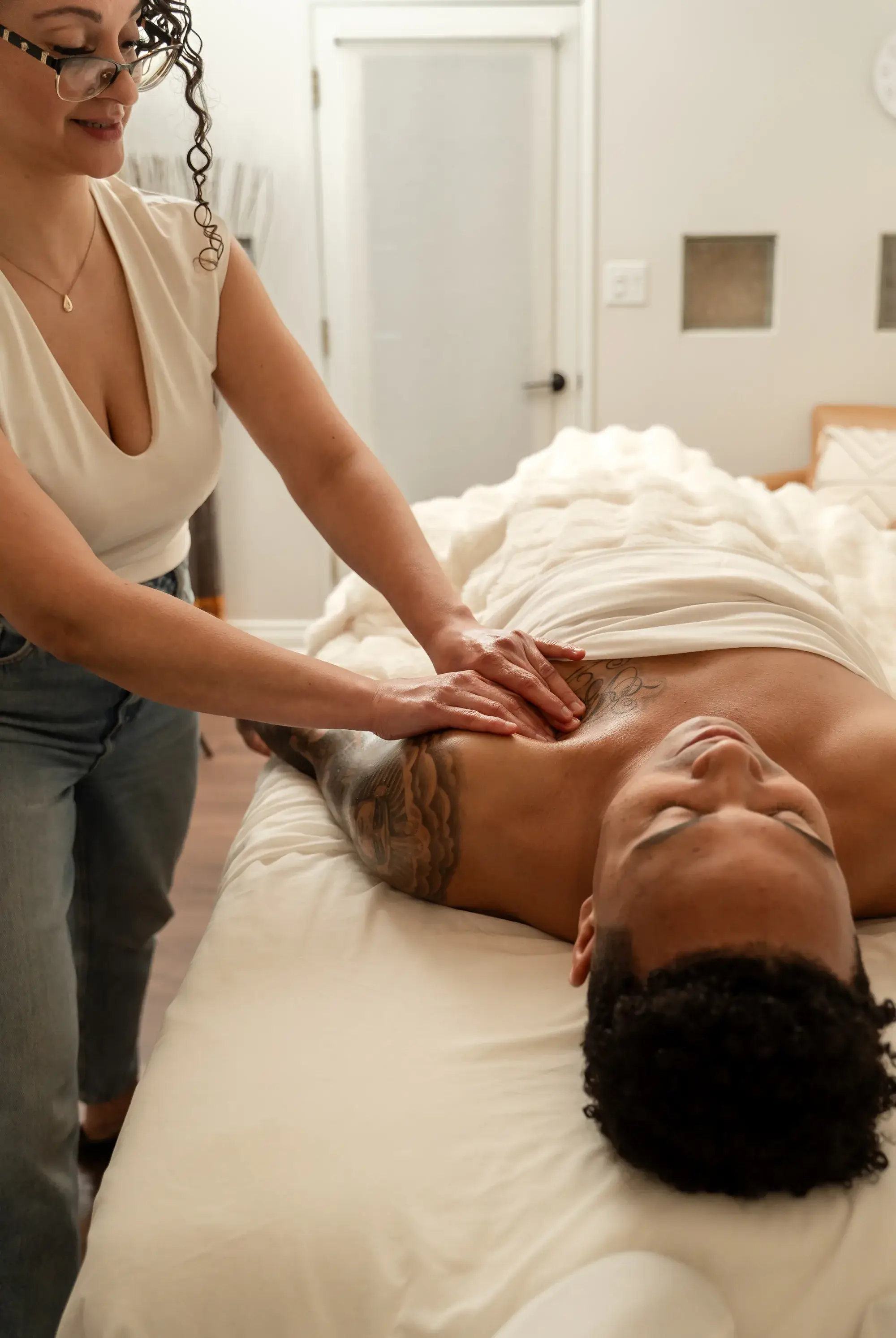
- Breast or chest wall work. Only the side being treated is uncovered, and only for as long as it is being worked.
- Abdominal work. A sheet or towel covers the chest above and the pelvis below.
- Gluteal work. The sheet is folded so the muscle is reached at the hip, with the gluteal cleft covered; many people prefer it worked through the sheet or their underwear.
- Groin nodes. Worked at the crease of the hip, with underwear on and the sheet tucked.
The “undraped massage” sometimes advertised is not something a registered massage therapist offers. If you want more cover, not less, ask for it; more is always possible. The basics of what to take off are in do I have to undress for a massage.
Staying clothed is a real option
You can have much of your treatment through clothing. Ontario’s standard recognises that patients may arrive in suitable clothing and prefer to remain clothed, and CRMTA standards protect your right to decline removing any clothing at all. A fitted tank top for shoulder work, shorts for hip work, or a soft bra for chest-wall drainage can all work, though some techniques, such as lymphatic drainage, need skin contact for the area being treated. Your therapist will tell you honestly where clothing changes what is possible, and adapt the plan rather than pressure you.
How to say no, or stop partway through
You can say no before an area is touched, or stop at any moment once it is, without giving a reason. CRMTA standards require therapists to stop treatment if you withdraw consent, and to stop if you withdraw consent to the agreed draping at any time and in any manner. Ontario’s standard asks therapists to monitor you throughout and recheck consent when appropriate.
Simple words work well:
- “Please skip my glutes today.”
- “Can you leave the chest out and do my arm only?”
- “Stop, please.” (For intra-oral work, agree a hand signal first.)
A good therapist thanks you and carries on with the rest of the plan. If something felt wrong during or after a session, asking your massage therapist to stop or change the treatment covers what to do next.
Sensitive-area work at Renu
At Renu, sensitive areas come up most often in post-op lymphatic drainage, lymphedema care with Meeghan Mackenzie, our Certified Lymphedema Therapist, BodyTox abdominal work, and TMJ massage with Sasha Bernard. A standard massage at Renu is $120 for 60 minutes, booked through Jane, and if you would like to talk through what a treatment involves before booking, call the clinic. We would rather you arrive knowing exactly what to expect.
When to raise a concern
If a therapist anywhere touched an area you had not agreed to, reached under draping without asking, or did not stop when you asked, that is a breach of professional standards, not a misunderstanding. You can raise it with the clinic and with the therapist’s professional association. Our page on the glossary term informed consent gives the definition in brief.
Questions people ask
Do you offer undraped massage?
No. Draping is part of professional massage therapy, not an add-on, and professional standards require that only the area being treated is uncovered. You can always choose to be more covered than standard, including staying fully clothed.
Can I ask for a therapist of a particular gender for sensitive-area work?
You can ask when you book. Our team page lists each practitioner and the treatments they offer, so you can see who provides what before you choose. Your comfort is a fair reason to choose.
Will I be asked to sign something before breast or chest wall work?
You should expect your consent to be recorded. CRMTA standards require therapists to keep a clinical record of assessment, treatment and communications, and Ontario's standard requires written or electronic consent before breast or chest wall treatment.
If I said yes last visit, do I have to say yes again?
No. Consent applies to the treatment in front of you, not to a past visit. You can agree to abdominal work one week and decline it the next without explaining why.
Sources
Page reviewed October 5, 2026. This page is education, not a diagnosis. For your own situation, talk to your doctor, surgeon or care team, or ask us.
Keep reading
Related pages