
Self-lymphatic drainage after liposuction: what you can do between sessions
Between post-op sessions after liposuction, ten gentle minutes of self-drainage a day: breathe, open the exits, then guide fluid toward them, feather-light.
By The Renu lymphatic and massage team · Reviewed by Meeghan Mackenzie, RMT, CLT · 7 min read
Between your post-op sessions, ten gentle minutes of self-lymphatic drainage, once or twice a day, can help keep fluid moving after liposuction. The routine below is simple: breathe, open the exits, then guide fluid toward them with a feather-light touch. Check with your surgeon before you start, and ask your therapist to tailor it to your procedure.
Why it helps, even though you’re walking
Walking is wonderful after surgery, and your surgeon will want you doing it. But walking mainly drives the deeper lymphatic system, the vessels among your muscles. Most lymph travels in the superficial system just under the skin, and that’s the layer liposuction disrupts most. Those vessels respond to light, slow skin-stretching, which is exactly what self-drainage gives them.
Breath is part of it, too. Physical therapist and CLT Kelly Sturm describes the diaphragm as acting almost like a pump for lymph, and notes small studies showing improvements in swelling from breathing work alone. Massage therapist Kathleen Helen Lisson builds her lymphedema self-care around breathwork for the same reason: a calmer body moves lymph more easily.
From the treatment room
As post-op therapists we can usually feel which clients have been doing their self-drainage. Their tissue is softer and more responsive when they come back in, and in our experience they move through recovery more quickly. Small tip: do it before you get out of bed, or after you brush your teeth and before you shower, when your compression is off for the day. Ten minutes a day really does add up.
The golden rules
Everything here sits underneath your surgeon’s plan. The American Society of Plastic Surgeons (ASPS) describes liposuction recovery in stages. Activity is significantly limited in week one, exercise is limited in weeks two and three, bruising should be gone by weeks four and five, and from about week six you may gradually increase activity and do gentle exercise. Your incisions must not be subjected to excessive force, abrasion or motion while they heal, and all questions go to your surgeon. So the first step is a question at your follow-up: “Is it all right for me to do light lymphatic self-care over the treated area between my sessions?” Until the answer is yes, do the breathing only. Our post-op recovery guide lays out the timeline week by week.
- Light, light, light. Lymph needs only about five grams of pressure. Picture rolling an uncooked egg across a table: that’s the touch. If you can feel muscle, you’re pressing too hard.
- Slow and rhythmic. Each movement should take a second or two. Lymph moves slowly.
- Clear the exits first. Always start at the neck, also known as the terminus, then the nearest lymph nodes, before working on the treated area. Opening those node groups first creates a gentle vacuum effect that draws fluid toward them.
- Never over incisions or drains. Work around them.
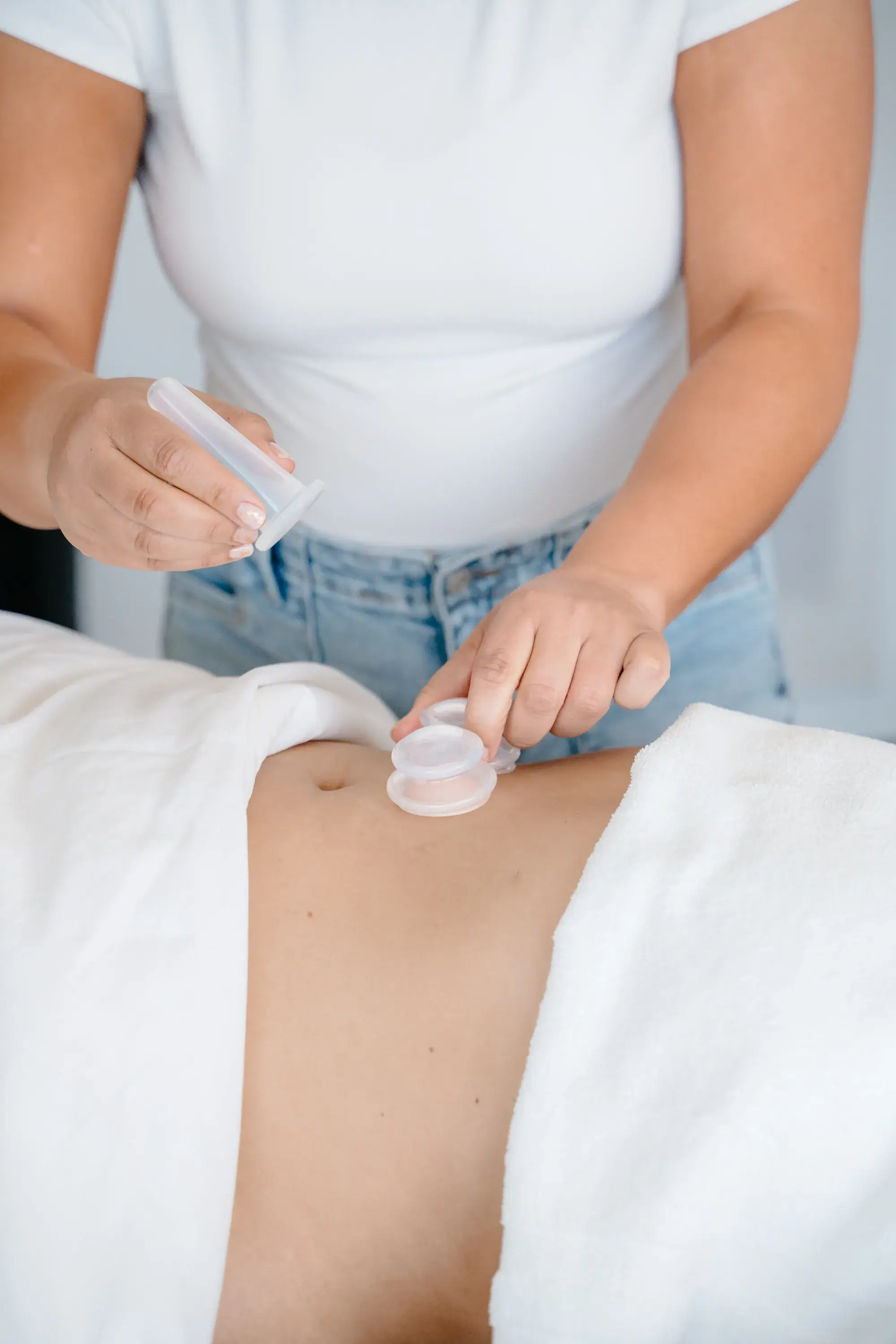
- No oils or creams on healing incisions, and no rollers, cups or wooden tools in the early weeks unless your therapist has shown you how and when.
The lymphoedema charities teach the same rules. Cancer Research UK explains that a therapist first clears the area they want the fluid to drain into, and that self lymphatic drainage is done only in the areas you were taught, with light pressure. Macmillan says you usually do not massage the swollen area at all; you move the skin where there is no swelling, in the direction away from it. After liposuction that principle protects you: the treated zone is bruised, tender and full of healing tissue, and a gentle skin stroke does the job better than kneading, rolling or pressing on firm patches. The lumps you may feel are covered on our fibrosis after liposuction page, and they are treated in clinic, not at home.
A simple 10-minute routine
- Breathe (1 minute). Lie down with your knees bent and a hand on your belly. Breathe slowly into your hand, letting your belly rise, then breathe out fully. Deep belly breathing helps draw lymph up through the large vessels in your trunk. Five to ten slow breaths.
- Neck and collarbones (2 minutes). Rest your fingers flat in the hollows just above your collarbones. Gently stretch the skin inward and down toward the centre, then release. Repeat ten times. This is where lymph empties back into your bloodstream.
- Armpits (1 minute). With a flat hand, gently pump upward into each armpit ten times. These nodes drain your upper abdomen above the belly button, flanks and back.
- Groin (1 minute). With flat hands at the crease where your thighs meet your body, gently stretch the skin up and in, ten times. These nodes drain your lower abdomen below the belly button, hips and thighs.
- The treated area (4 minutes). Work from the area closest to the nodes outward, always stretching the skin back toward those nodes. As a guide, above your belly button, guide fluid up and out toward your armpits; below it, guide fluid down and in toward your groin. Keep to the edges of firm or very tender spots.
- Finish with breathing (1 minute). A few more slow belly breaths.
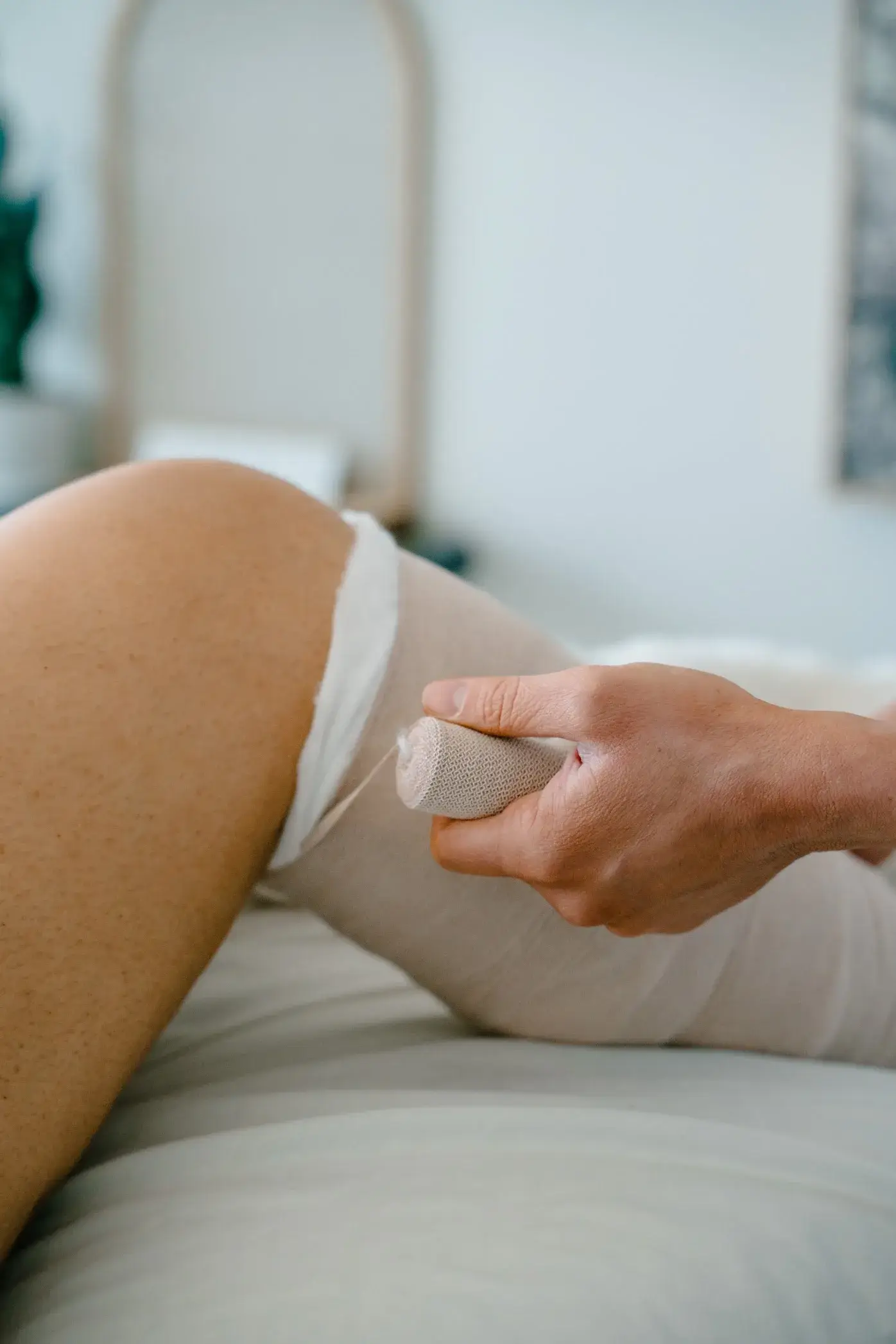
Do this once or twice a day. Only take your garment off for it if your surgeon allows, and put it straight back on afterwards. If the garment must stay on, do the breathing only; it needs no touching of the treated zone.
What you should feel, and what you should not
The West Suffolk NHS leaflet’s rule for every stroke is that it must not cause pain or redness to the skin. Macmillan’s test is the one to remember: if the skin is red when you have finished, the movement was too much. After liposuction, add bruising to that list; if a stroke leaves a mark, it was not a lymphatic stroke.
Light-headedness during the breathing means slow down. Soreness that builds over a day or two after you start the routine means stop and tell your therapist. A sense of the swelling shifting lower, for example toward the pubic area or the inner knee, is common after abdominal and thigh procedures and is worth mentioning at your next session so the route can be adjusted.
When to stop and call your surgeon
Self-drainage isn’t right on days when you have:
- A fever, or an area that’s hot, red or increasingly painful
- Pain, swelling or warmth in one calf, or sudden shortness of breath (call 911)
- An incision that’s opening or weeping
- A soft swelling that is growing, or fluid leaking from an incision
- Numbness that is new or spreading
ASPS lists fluid accumulation, infection, deep vein thrombosis and changes in skin sensation among liposuction’s risks, and the NHS leaflets say not to perform the massage if you feel unwell or have an infection. A collection of fluid needs your surgeon to look, not a massage. For anything more gradual, the post-op recovery guide lists what is normal in each week.
And if you’ve had lymph nodes removed or have lymphedema, the routes are different. Please let your therapist design your routine.
Better together
Self-drainage keeps things moving between visits; it doesn’t replace them. In session, a trained therapist can feel where fluid is pooling, reroute around swollen areas and soften firm tissue in ways that are hard to do on yourself. Ask us at your next post-op appointment and we’ll walk you through your routine, hands-on, so you feel confident doing it at home.
At Renu, post-op lymphatic drainage is 30, 45 or 60 minutes ($105, $115 or $140), with a 90-minute option at $210 for people recovering from more than one procedure. Our lymphatic work is grounded in the Chikly Method, the same light, rhythmic touch the routine above asks of you. The question of timing is answered on our page about when drainage can start after surgery, and how many sessions you need after lipo covers the usual rhythm. People recovering from a 360 lipo will find the specific plan on our 360 lipo page. If you are struggling to get comfortable at night in the garment, the sleeping after a tummy tuck or liposuction page covers set-up and getting out of bed.
Want someone to show you? Call us at 403-270-2111 or book post-op lymphatic drainage with the button below, and mention you’d like to learn self-drainage.
Questions people ask
Can I massage the hard lumps after lipo myself?
No. Lumps and firm patches are the surgeon's and your therapist's to assess, and simple lymphatic drainage never works directly on the swollen tissue; Macmillan says you usually do not massage the swollen area at all. Pressing a lump can bruise tissue that is still healing. Our fibrosis page explains what the firmness is and how it is treated in clinic.
When after liposuction can I start the home routine?
When your surgeon clears hands-on work over the area, and not before. The ASPS timeline has you significantly limiting activity in week one and limiting exercise in weeks two and three, with gentle exercise from about week six. Most people start the breathing straight away and add the node and skin strokes once incisions are closed and the surgeon agrees.
Do I take my compression garment off to do it?
Only for as long as your surgeon's schedule allows, and the garment goes straight back on. ASPS says you may be asked to wear an elastic bandage, support bra or compression garment to minimize swelling, and the surgeon decides how many hours a day. The breathing step can be done with the garment on.
Should the strokes glide with oil like a regular massage?
No. The NHS leaflets say the strokes are done on bare skin without creams or oils, because the hand is meant to carry the skin a short distance rather than slide over it. The pressure is light; Cancer Research UK describes the skin movements as very light, slow and rhythmic.
Is fluid leaking from an incision something I can drain at home?
No. Leaking fluid, a growing soft swelling, heat, redness or fever all belong to your surgeon's office, not a massage routine. ASPS lists fluid accumulation and infection among liposuction's risks and says to raise any complication with your plastic surgeon in a timely manner.
Sources
- American Society of Plastic Surgeons: Liposuction recovery
- American Society of Plastic Surgeons: Liposuction safety
- West Suffolk NHS Foundation Trust: Simple lymphatic drainage, legs (leaflet 6466)
- Cancer Research UK: Manual lymphatic drainage (MLD) for lymphoedema
- Macmillan Cancer Support: Lymphatic drainage for lymphoedema
- NHS: Swollen ankles, feet and legs (oedema)
- Kelly Sturm, PT, DPT, CLT-LANA: Cancer Rehab PT blog
- Kathleen Helen Lisson, CMT, CLT: Lymphedema self-care books and breathwork
Page reviewed October 13, 2026. This page is education, not a diagnosis. For your own situation, talk to your doctor, surgeon or care team, or ask us.
Keep reading
Related pages