
Massage for shoulder pain after a stroke
Massage for shoulder pain after a stroke can ease pain and anxiety alongside rehab, if the weak arm is supported and never pulled. What helps, what to watch.
By The Renu lymphatic and massage team · 6 min read
Massage can support, not replace, the rehabilitation team's plan for a painful shoulder on the weak side after a stroke. In a trial of 102 older stroke patients, a gentle 10-minute back massage on seven evenings eased shoulder pain and anxiety. The weak arm must be supported on pillows and never pulled or forced through its range, and any new weakness, facial droop or slurred speech means calling 911, not booking a massage.
A shoulder that aches on the weak side is one of the most common and most discouraging problems after a stroke. It can make sleep hard, make dressing painful and slow down the exercises that rehabilitation depends on. Massage has a modest, honest role here: it supports the work of your physiotherapist, occupational therapist and physiatrist, and it can ease pain and worry, but it does not repair the shoulder or replace their plan.
Why the shoulder hurts after a stroke
The pain usually has more than one cause, which is why no single treatment settles it for everyone.
When a stroke weakens one side, the muscles that normally hold the top of the arm bone snugly in its socket may stop doing their job. The weight of the arm can then drag the joint partly out of place (subluxation). Muscle tone may also change, becoming floppy early on and tight or spastic later, and sensation in the arm may be reduced. Reviews describe the causes as multifactorial and note that hemiplegic shoulder pain can affect up to 70% of stroke patients and can hold back rehabilitation.
A 2020 systematic review pooled the risk factors. The strongest predictors were:
- older age and female sex;
- increased muscle tone;
- sensory impairment in the arm;
- weakness on the left side of the body;
- a haemorrhagic (bleeding) stroke;
- hemispatial neglect, where one side of space is ignored;
- a more severe stroke on the NIH Stroke Scale.
Neglect and reduced sensation matter on a massage table too. If you cannot feel or attend to the arm well, you may not notice it slipping off a pillow or being positioned awkwardly, so the therapist has to watch it for you.
What the research says massage can do
The most direct trial is small and old, but it is encouraging. Researchers in Hong Kong gave 102 hospitalised older stroke patients either a 10-minute slow-stroke back massage on seven consecutive evenings or no massage. The massage group reported less shoulder pain and less anxiety, their blood pressure and heart rate fell, and the effects were still present three days after the last session.
Notice what that massage was: slow, gentle strokes over the back, not deep work on the painful shoulder itself. That is a useful template.
A 2022 meta-analysis of 12 trials with 723 stroke survivors found that adding a specific technique to conventional rehabilitation reduced shoulder pain more than rehabilitation alone. The techniques that stood out were medical or invasive ones:
| Added to conventional rehab | Result in the meta-analysis |
|---|---|
| Botulinum toxin injection | Less pain than rehab alone |
| Suprascapular nerve block | Less pain than rehab alone |
| Suprascapular nerve pulsed radiofrequency | Less pain than rehab alone |
| Trigger-point dry needling | Less pain than rehab alone |
Massage was not among them, so if your pain is severe or not settling, those are conversations to have with your physiatrist. A separate review of seven Chinese trials concluded that acupuncture combined with exercise was effective for shoulder pain after stroke, though the trials scored low to moderate on quality.
Handling a weak or subluxed shoulder safely
Protecting the shoulder from strain matters more than any massage technique. A review of shoulder pain management after stroke advises that rehab teams, patients and carers be taught how to avoid injuring the affected arm, and that overarm slings be avoided.
In practice, a safe session looks like this:
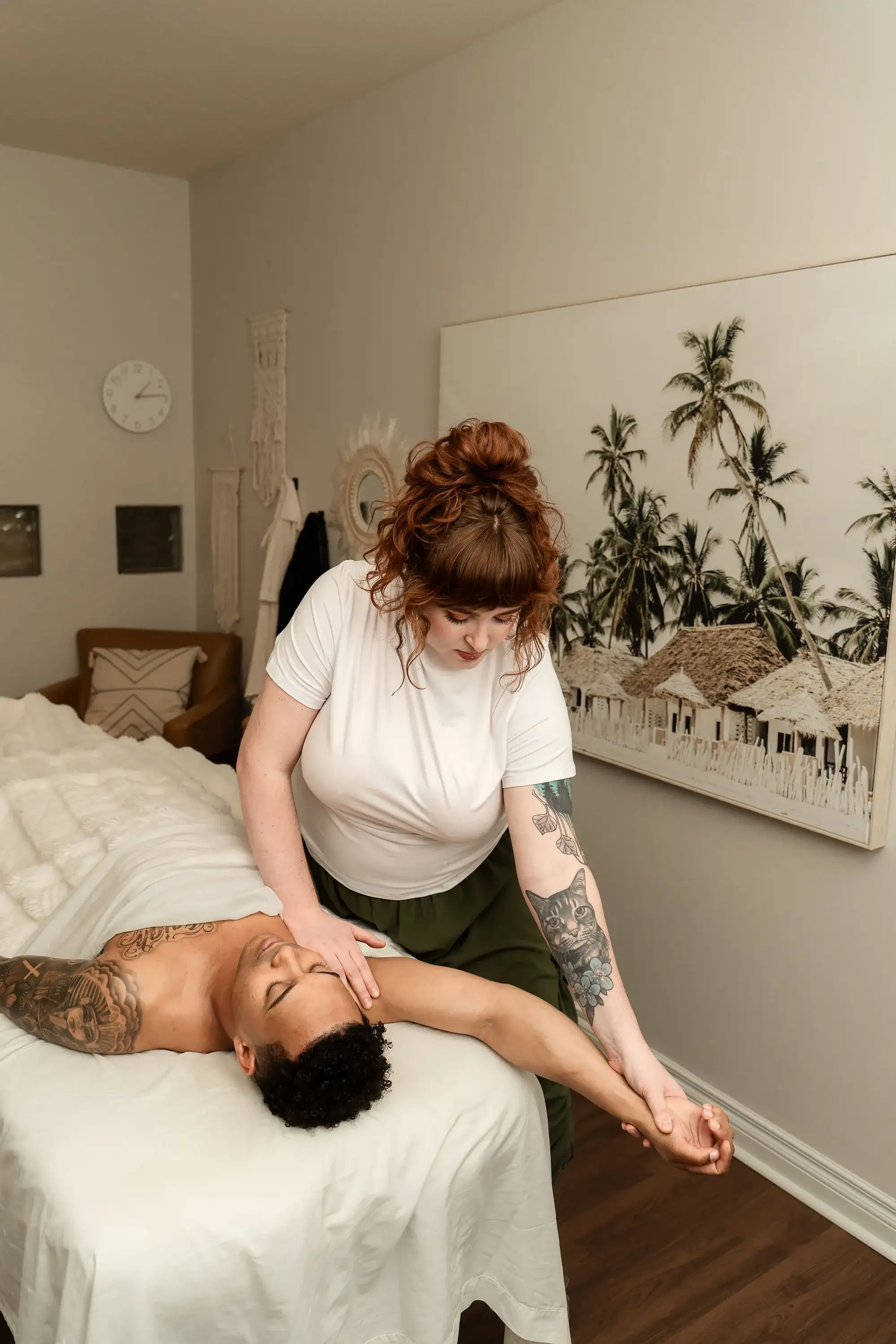
- the weak arm rests on pillows at all times, whether you are lying on your back, on your good side or sitting;
- nobody pulls on the arm to help you move, turn or sit up;
- no forceful stretching or end-range movement of the shoulder;
- light, slow pressure around the shoulder blade, neck and upper back, where guarding and overuse build up;
- frequent check-ins, because you may not feel discomfort in the arm the way you used to.
Getting on and off the table is part of the session. Plan the transfer the way your occupational therapist taught you, and bring a family member if that is how you usually move safely.
Hand swelling is not lymphedema
Many survivors also have a puffy hand on the weak side and ask whether lymphatic drainage will fix it. A systematic review concluded that post-stroke hand oedema is not lymphoedema, and that no specific treatment had yet proven better than other physical methods at reducing it. The same review found the shoulder is involved in only about half of cases of painful wrist and hand swelling.
So we would not sell you a lymphedema program for this. Light strokes toward the elbow, with the hand raised on a pillow, can feel soothing, but the plan for a swollen hand belongs to your rehab team. A hand that is hot, shiny, very tender or changing colour points toward a different problem, described on our complex regional pain syndrome page, and needs medical assessment.
When to call 911 or your doctor first
A stroke can recur, and its signs can look like ordinary tiredness. Call 911 straight away for:
- a face that droops on one side or a smile that looks uneven;
- an arm that cannot be lifted and held, or new weakness or numbness down one side;
- slurred, confused or lost speech;
- sudden blurred vision or loss of sight, sudden dizziness or falling, or a sudden severe headache.
The NHS stresses that these symptoms can stop after a short time and still need urgent help. The word FAST (face, arms, speech, time) is the easy way to remember them.
Check with your doctor or rehab team before booking if:
- you take blood thinners (see massage, cupping and acupuncture on blood thinners);
- your shoulder pain has suddenly worsened after a fall or a pull on the arm;
- your hand or arm is hot, red, very swollen or discoloured;
- your calf on either side is swollen, warm or painful.
How this works at Renu
Book massage therapy through Jane with any of our Registered Massage Therapists, and add a note that the session is for shoulder pain after a stroke so your therapist can plan the positioning before you arrive. A 30-minute session ($80) is a gentle first visit, close to the short back massages in the trial. A 45-minute session ($100) or 60-minute session ($120) leaves time for the neck, upper back and the overworked shoulder on your strong side, which often aches from doing double duty.
If you want to explore acupuncture as well, Dr. Will Tanner is both a Registered Massage Therapist and an acupuncturist, and the acupuncture and massage combination runs 90 minutes ($167). Our page on acupuncture for stroke recovery explains what that evidence shows and does not show. We are in West Hillhurst with free street parking, which helps if a family member is driving and helping with the transfer.
Questions people ask
Is it safe to massage a partly dislocated shoulder after a stroke?
Gentle massage of the muscles around it is generally reasonable if your rehab team agrees, provided the arm is fully supported and nobody pulls on it or moves it forcefully. The joint itself is not something massage can put back in place. Ask your physiotherapist or occupational therapist how they want the arm handled and bring that advice with you.
Why does my hand swell on the same side as my stroke?
Swelling in the hand on the weak side is common after a stroke, and a systematic review concluded it is not lymphoedema. No single treatment has been shown to beat other physical methods for reducing it. Mention it to your rehab team, especially if the hand becomes hot, very painful or shiny, because that pattern needs their assessment.
Can a family member do the slow-stroke back massage at home?
The trial authors suggested that nurses and family caregivers could use slow-stroke back massage. Keep it light, slow and over the back only, never pulling the weak arm, and stop if it causes pain. It is worth showing your physiotherapist what you plan to do.
How long after a stroke can I book a massage?
There is no single date that suits everyone. Check with your doctor or rehab team first, especially if you are on blood thinners, still in a formal rehab block or have had a recent procedure. Once they agree, a short session is a sensible first step.
Sources
- Bender and McKenna, Disability and Rehabilitation (2001): Hemiplegic shoulder pain, defining the problem and its management
- Anwer and Alghadir, IJERPH (2020): Incidence, prevalence and risk factors of hemiplegic shoulder pain, a systematic review
- Mok and Woo, Complementary Therapies in Nursing and Midwifery (2004): Slow-stroke back massage on anxiety and shoulder pain in elderly stroke patients
- de Sire et al., Annals of Physical and Rehabilitation Medicine (2022): Rehabilitative techniques for hemiplegic shoulder pain, systematic review and meta-analysis
- Walsh, Postgraduate Medical Journal (2001): Management of shoulder pain in patients with stroke
- Lee et al., Journal of Alternative and Complementary Medicine (2012): Acupuncture for shoulder pain after stroke, a systematic review
- Geurts et al., Scandinavian Journal of Rehabilitation Medicine (2000): Post-stroke hand oedema and shoulder-hand syndrome, a systematic review
- NHS: Symptoms of a stroke
Page reviewed October 5, 2026. This page is education, not a diagnosis. For your own situation, talk to your doctor, surgeon or care team, or ask us.
Keep reading
Related pages