
Massage for anterior pelvic tilt
Massage for anterior pelvic tilt eases tight hips and a sore low back, but it will not reposition your pelvis. Most healthy adults tilt forward a little.
By The Renu lymphatic and massage team · 5 min read
Massage for anterior pelvic tilt can ease the tight hip flexors, thighs and low back that make long sitting or standing uncomfortable, but it does not move your pelvis into a new position. A forward tilt is the usual finding in healthy young adults, not a diagnosis, and the research does not support the popular idea that a deeper low back curve causes back pain. Use massage for comfort and pair it with strength work if you want to change how your hips move.
A forward tilt is the common finding, not the exception
If someone has pointed out that your pelvis tips forward, you are in the majority. A study at the University of Salford measured the pelvic angle in 120 healthy young adults with no symptoms, using a palpation meter between the bony point at the front of the hip (the ASIS) and the one at the back (the PSIS).
| Pelvic position | Men (65) | Women (55) |
|---|---|---|
| Anterior (forward) tilt | 85% | 75% |
| Posterior (backward) tilt | 6% | 7% |
| Neutral | 9% | 18% |
So a “neutral” pelvis was the minority. On its own, a forward tilt tells you very little about whether anything is wrong.
There is a second problem with the measurement itself. In 30 pelves studied after death, the angle between those same front and back landmarks ranged from 0 to 23 degrees, simply because bones differ in shape. Asymmetry between the left and right landmarks produced side-to-side differences of up to 11 degrees. An app, a mirror or a quick look from a coach cannot tell your bone shape apart from your posture.
The back pain story runs the other way
The popular explanation goes like this: tight hip flexors pull the pelvis forward, the lower spine arches too much, and the arch causes back pain. The research does not support that chain.
- A 2017 meta-analysis of 13 imaging studies (796 people with low back pain, 927 without) found that people with back pain tended to have a smaller lower-back curve than healthy controls, not a larger one. The link was clearest in age-matched comparisons and in back pain from disc problems.
- A review of prospective studies that followed people forward in time found that restricted side bending, limited lumbar lordosis and tight hamstrings were the measures that predicted who went on to develop back pain.
None of this means your back is not sore. It means a forward tilt is unlikely to be the whole explanation, and chasing a “straighter” pelvis may not be what settles it. If your back pain is the main issue, our page on low back pain covers what the wider evidence supports.
What does change the angle, and how much
Muscle activity can shift pelvic position for the length of an exercise; lasting change is harder to show. Two studies sit at opposite ends of that question.
In 21 healthy people, a bridge performed while pressing the knees out against a Thera-Band loop increased gluteus maximus activity and reduced the anterior tilt angle during the movement. That is useful for coaching a bridge, but it measured the pelvis during one exercise, not after weeks of training.
A 2022 Danish study tested an eight-week home program of education, core stability, strengthening and stretching aimed at reducing tilt in 42 young adults with hip pain and excessive tilt seen on scans. Adherence was good and the program was safe, but the average tilt changed by only 1.6 degrees and hip pain did not change in a clinically meaningful way. About a quarter of participants, mostly those who started with moderate pain, did report a real improvement.
The honest summary: exercise changes how you use your hips, and some people feel better, but a large permanent change in pelvic angle is not a realistic goal.
What massage does for a tilted pelvis
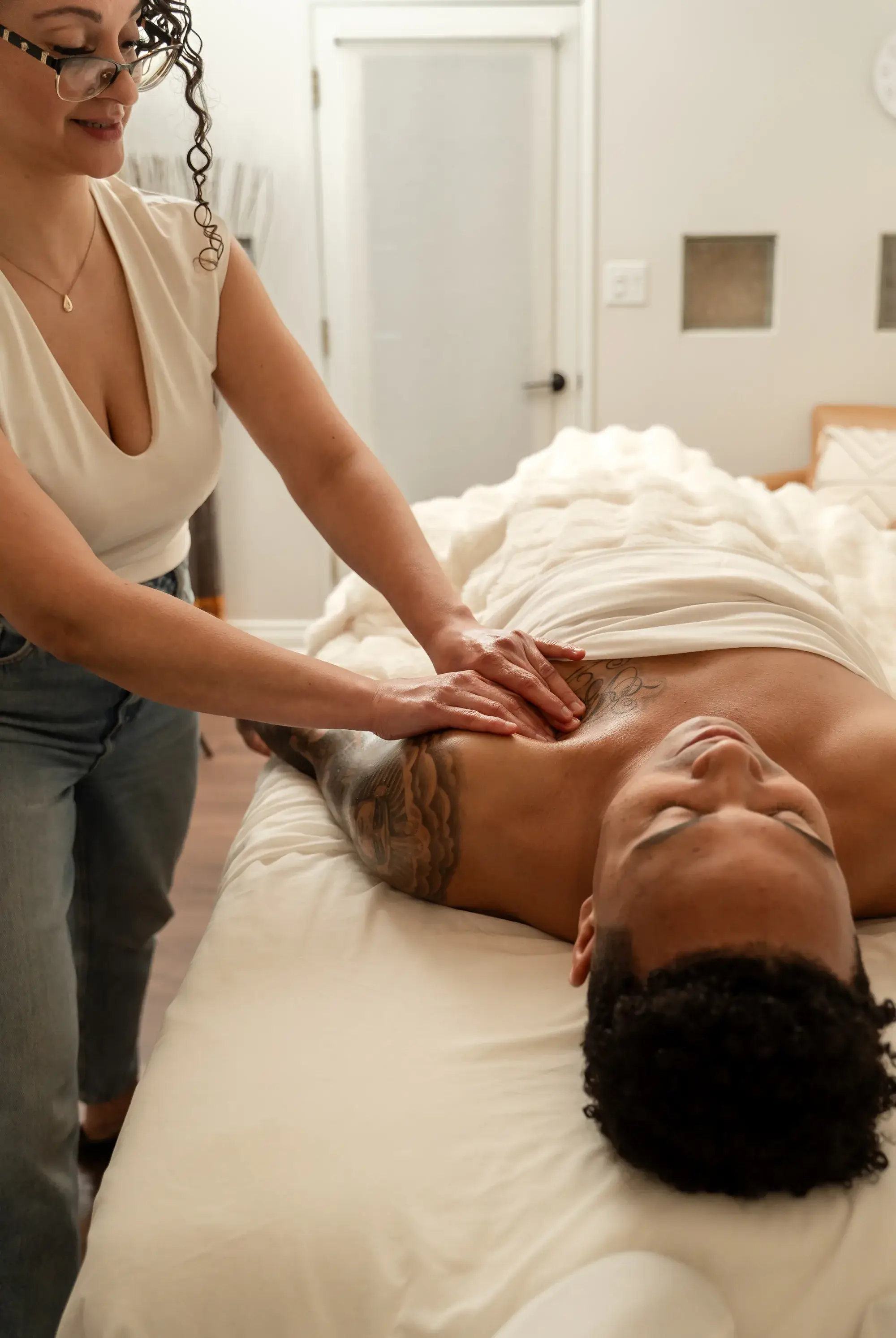
Massage supports comfort here; it does not reposition bone. What it can do is ease the tissues that feel tight and tired after long stretches of sitting or standing, so moving and training feel better.
A session for this complaint usually spends time on:
- the front of the hip and upper thigh, including the hip flexors and quadriceps
- the low back muscles that tend to feel compressed after a long day
- the glutes and outer hip
- the hamstrings, since tight hamstrings appear in the back pain research above
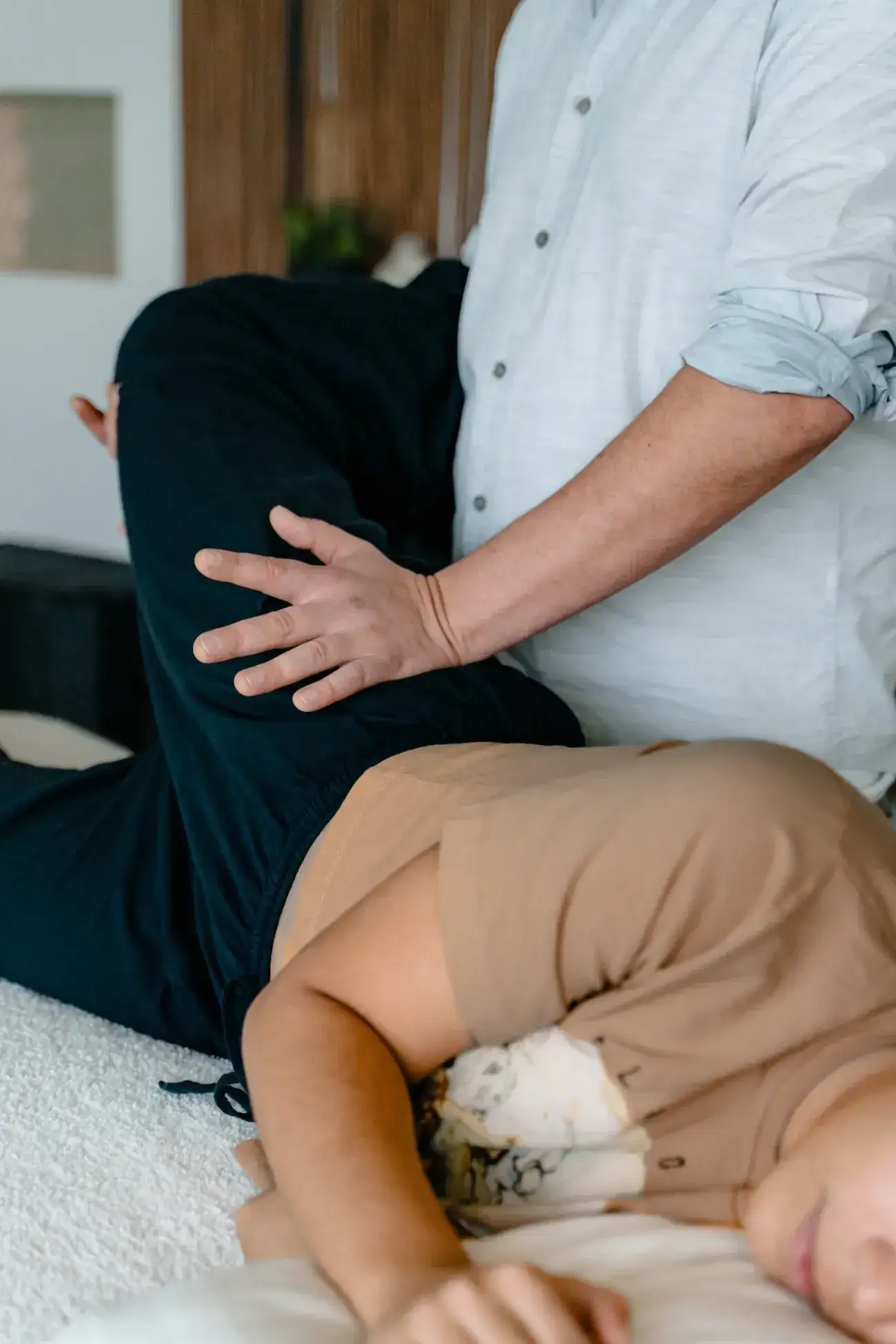
Side-lying positions let your therapist reach the front of the hip and take the leg through a comfortable stretch, as in the photo on this page. Expect to be asked how sitting, standing and training feel, because those answers guide pressure and position more than the tilt angle does. If you are working with a coach or physiotherapist on glute and core strength, massage fits well beside that work.
Booking a massage at Renu
Any of our Registered Massage Therapists can treat tight hips and a tired low back, whether the cause is driving, desk work or long days on your feet. A 45-minute massage ($100) covers hips, thighs and low back; a 60-minute massage ($120) leaves room for the upper back and neck too. Myofascial cupping (60 minutes, $120) is another option if you like gliding work through the thighs and back.
Book online through Jane, choosing the therapist and time that suit you. We are open seven days a week in West Hillhurst, with free street parking. If you sit for work, our page on massage for desk workers and the lower back stretches after a day of sitting pair well with this one.
When to see your doctor first
Most tight-hip, sore-back days are not dangerous, but some back pain needs medical care before massage. The NHS advises seeing a GP if back pain:
- does not improve after a few weeks of looking after it at home
- is worse at night or does not ease with rest
- comes with weight loss you cannot explain, or a lump or change in the shape of your back
- is worse when you cough, sneeze or have a bowel movement
Call 911 or go to an emergency department if back pain comes with numbness, tingling or weakness in both legs, loss of feeling around the genitals or anus, new trouble controlling your bladder or bowels, chest pain, or follows a serious accident.
Pain that sits deep in the groin and catches when you bend the hip up, rather than a general tightness, can come from the hip joint itself. Our page on massage for hip impingement explains that picture, and a sudden pull at the front of the hip during sport is covered under hip flexor strain.
Questions people ask
Can I see anterior pelvic tilt in a mirror or phone photo?
Not reliably. The usual measure compares two bony points at the front and back of the pelvis, and in a cadaver study those points alone sat anywhere from 0 to 23 degrees apart in people's bones. A photo cannot separate bone shape from posture.
Is anterior pelvic tilt the same as swayback?
People use the words loosely, so it is worth asking whoever told you what they measured. The research on this page looks at two separate things: the angle of the pelvis and the curve of the lower spine (lumbar lordosis). They are related, but neither one on its own explains back pain.
Will stretching my hip flexors every day fix my posture?
Stretching can make tight hips feel easier, but the one trial of a home program aimed at reducing tilt, which combined stretching with core and strength work, found the average angle barely moved. Treat it as a comfort habit, not a posture correction.
Should I get a deep tissue massage for tight hip flexors?
Firm pressure is fine for many people, but deeper is not more corrective here because the goal is comfort, not moving bone. Tell your therapist how sitting and standing feel and let them adjust pressure to what your tissues tolerate.
Sources
- Herrington (2011), Manual Therapy: Assessment of the degree of pelvic tilt within a normal asymptomatic population
- Preece et al. (2008), Journal of Manual & Manipulative Therapy: Variation in pelvic morphology may prevent the identification of anterior pelvic tilt
- Chun et al. (2017), The Spine Journal: The relationships between low back pain and lumbar lordosis, a systematic review and meta-analysis
- Sadler et al. (2017), BMC Musculoskeletal Disorders: Restriction in lateral bending, lumbar lordosis and hamstring flexibility predicts low back pain
- Choi et al. (2015), Journal of Electromyography and Kinesiology: Isometric hip abduction with a Thera-Band during bridging
- Falk Brekke et al. (2022), Musculoskeletal Science and Practice: Exercise in acetabular retroversion and excessive anterior pelvic tilt
- NHS: Back pain
Page reviewed October 5, 2026. This page is education, not a diagnosis. For your own situation, talk to your doctor, surgeon or care team, or ask us.
Keep reading
Related pages