

How long does complete decongestive therapy take?
How long does complete decongestive therapy take? The intensive phase is about 3 to 8 weeks, ideally 5 days a week; maintenance follows and can be lifelong.
By The Renu lymphatic and massage team · 6 min read
The intensive phase of complete decongestive therapy usually runs about three to eight weeks, ideally with treatment five days a week, and continues until the swelling stops going down. The National Cancer Institute gives an average of about 15 daily treatment days. Maintenance starts immediately afterwards, with compression garments, self-drainage, exercise and skin care, and for moderate to advanced lymphedema it can last for life, with garments refitted every four to six months.
The short version for your calendar
Complete decongestive therapy (CDT) comes in two parts, and they take very different amounts of time. The intensive phase is a block of frequent appointments lasting a few weeks. The maintenance phase is what you do at home afterwards, and it does not have a fixed end date.
| Phase | How often | How long | Where |
|---|---|---|---|
| Intensive (Phase I) | Ideally five days a week | Until the swelling stops going down, typically 3 to 8 weeks | In the clinic, with bandages worn between visits |
| Maintenance (Phase II) | Daily self-care, periodic check-ins | Months to life, depending on stage | Mostly at home |
| Garment refits | Every 4 to 6 months | Ongoing | Clinic or fitter |
The rest of this page explains where those numbers come from, and what changes them, so you can plan work, childcare and travel with realistic expectations.
The intensive phase: three to eight weeks, most weekdays
The intensive phase usually takes three to eight weeks of near-daily sessions. The National Lymphedema Network’s 2025 position paper says CDT is ideally performed five days a week until a volume reduction plateau is reached, typically over three to eight weeks. The National Cancer Institute’s summary for health professionals describes the reduction phase as skin care, exercise, manual lymphatic drainage and compression bandages, performed daily for an average of 15 days.
A plateau is the point where your measurements stop dropping from one session to the next. It is not a set date, which is why no therapist can promise you an exact number of weeks at the first visit. The NLN lists what stretches or shortens it: how severe the lymphedema is, the condition of your skin, your risk of infection, how much your function is limited, and practical constraints. It notes that more sessions are needed for advanced stages. For comparison, a 194-person Belgian trial of breast cancer-related lymphedema used a fixed three-week intensive phase followed by six months of maintenance.
What a typical intensive day involves:
- Taking off the previous day’s bandages and checking the skin
- Cleansing and moisturizing
- Manual lymphatic drainage
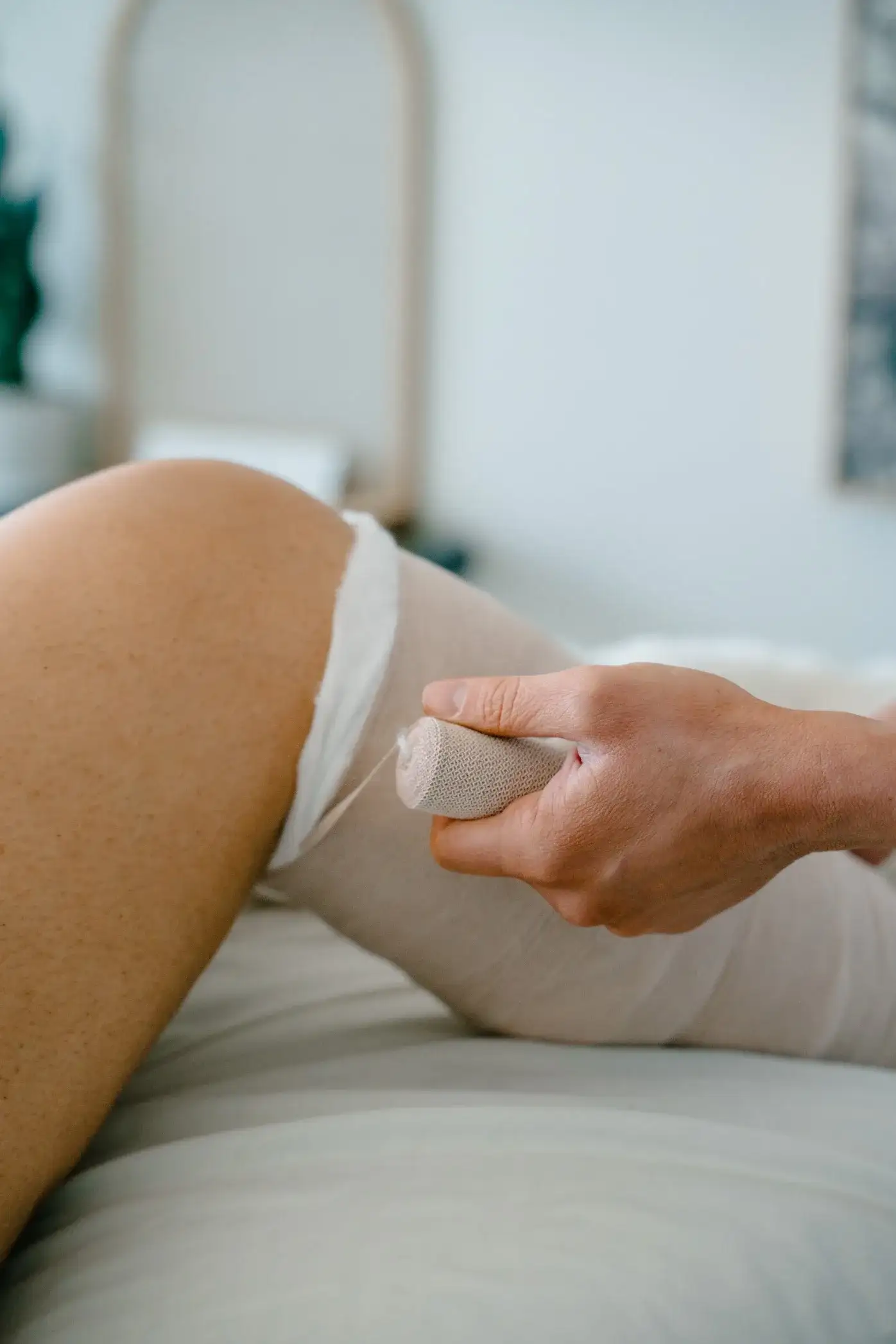
- Reapplying multilayer short-stretch bandaging, which stays on until the next session
Bandages around the clock
The time commitment is not only the appointments. The NLN says there should be no gap in compression bandaging during Phase I: bandages are kept on 24 hours a day unless they need to come off for discomfort, changes in skin or sensation, skin checks or daily hygiene. Bandages lose pressure as the limb shrinks, which is one reason sessions are so frequent; the NLN cites a loss of about a quarter of the pressure within 30 to 60 minutes and only about 56% remaining after three hours.
For planning, that means:
- Clothing and shoes that fit over a bandaged arm or leg for the whole intensive phase
- Work that allows a bulky limb and time away for appointments most weekdays
- Travel: a trip in the middle of the intensive phase interrupts it, so schedule CDT around a time you can stay in Calgary
If five days a week is not realistic, say so early. The NLN says daily sessions are optimal but modified schedules may also give positive outcomes for some patients.
Maintenance: straight on, and possibly for life
When the swelling plateaus, you move directly into maintenance. The NLN is specific that people transition immediately to Phase II without a gap in compression. The hand-over itself is covered in from bandaging to a compression garment.
How long maintenance lasts depends on your stage. The NLN says Phase II may last a lifetime, particularly for stage 2 and 3 lymphedema, while early stage 0 to 1 lymphedema may need only minimal management focused on preventing flare-ups. Its goals are sustained limb size and shape, healthy skin, and confidence managing on your own: day and night garments, self-administered lymphatic drainage, activity, weight management and specific exercises. The NCI describes maintenance as skin care, exercise, lymphatic drainage as needed and compression garments.
Ongoing support has its own rhythm. The NLN recommends regular garment fittings and replacements every four to six months, because garments lose pressure with wear and your measurements change; our page on when to replace compression garments lists the signs. It also notes that multiple intensive phases may be needed to achieve further improvement, so a second block of CDT later is not a sign that the first one failed.
Before you start: questions to ask
Starting CDT is easier with a plan. Questions worth asking your therapist at the first appointment:
- How many sessions a week do you recommend for me, and roughly for how many weeks?
- How will we decide that I have reached a plateau?
- Which days are the bandages reapplied, and what do I do if they slip or hurt?
- When will I be measured for a garment, and will I need a day and a night garment?
- What will my maintenance routine look like each day?
If your garments may be funded, our page on AADL compression garment funding explains the Alberta program.
When to call your doctor during CDT
Stop and contact your doctor promptly if, during treatment, the limb becomes red, hot and more painful, you develop a fever, or one limb suddenly swells, aches or changes colour. Acute infection, decompensated congestive heart failure and acute deep vein thrombosis are on the NLN’s list of reasons not to have manual lymphatic drainage, so these need a medical check before therapy carries on. If bandages cause discomfort or changes in skin or sensation, the NLN says they may need to come off, so call your therapist rather than putting up with it.
CDT at Renu
At Renu, complete decongestive therapy is provided by Meeghan Mackenzie, our founder, who is a Registered Massage Therapist, Certified Lymphedema Therapist and Certified Compression Fitter. We do not publish a fixed CDT schedule, because the number of weeks depends on the factors above, so ask Meeghan the questions on this page when you book through Jane. Published rows on our complete decongestive therapy page include lipedema management (30 minutes, $105; full body 60 minutes, $140) and compression fitting (30 minutes, $25). How often bandaging sessions can be scheduled is something to ask Meeghan when you book. We are in West Hillhurst and open seven days, with weekday hours until 8:30 pm.
Questions people ask
Can I do CDT if I cannot come in five days a week?
Often, yes. The National Lymphedema Network says daily sessions are optimal but that modified schedules may also give good results for some people. Expect the reduction to take longer, and ask your therapist how to protect the progress between visits.
Can I go back to work during the intensive phase?
Many people do, but plan for it. You will spend time at appointments most weekdays, and bandages are bulky under clothes and in shoes. Talk with your therapist about what your job involves so the bandaging and timing fit around it.
Will I need a second round of intensive therapy?
Some people do. The NLN notes that more than one intensive phase may be needed to achieve further improvement, for example after an infection, a flare or a change in your health. Your maintenance routine is what keeps the gap between rounds as long as possible.
Do I have to wear bandages at night during CDT?
During the intensive phase, yes: the NLN says bandages are kept on 24 hours a day unless they need to come off for discomfort, skin or sensation changes, inspection or hygiene. In maintenance, some people use a separate night-time garment instead.
Sources
- National Lymphedema Network: Lymphedema diagnosis and treatment, position paper (2025)
- National Cancer Institute: Lymphedema (PDQ), health professional version
- Devoogdt et al., Cancers 2023: Fluoroscopy-guided manual lymph drainage as part of decongestive lymphatic therapy, randomised controlled trial
Page reviewed October 5, 2026. This page is education, not a diagnosis. For your own situation, talk to your doctor, surgeon or care team, or ask us.

