
Can you have TMJ massage with braces or Invisalign?
Can you have TMJ massage with braces or Invisalign? Usually yes: aligners come out for the session, and gloved work can stay clear of brackets and wires.
By The Renu lymphatic and massage team · 6 min read
Usually, yes. Clear aligners such as Invisalign are designed to come out, so you simply remove them for the intra-oral part of the session. With fixed braces, the jaw muscles can be worked from outside the face and, where it is comfortable, inside the cheek clear of brackets and wires. Tell us about your hardware when you book and ask how your session will be planned around it. If your pain started right after braces were fitted or tightened, check with your orthodontist first, because tooth soreness from an adjustment is a different problem from sore jaw muscles.
Yes, in most cases you can. Orthodontic hardware changes the practical details of a TMJ massage, not whether it can happen. The more useful question is what is actually hurting: the teeth, which are often sore after braces go on or get tightened, or the chewing muscles and jaw joint, which is what TMJ massage is for.
Braces and aligners change the logistics, not the answer
The two kinds of appliance need slightly different handling, and neither rules out treatment.
| Fixed braces | Clear aligners (Invisalign and similar) | |
|---|---|---|
| What is in your mouth | Brackets glued to each tooth, joined by a wire | Removable plastic trays, sometimes with small tooth-coloured attachments bonded to teeth |
| During the session | Hardware stays in; the gloved finger stays on the cheek muscle, not on brackets or wire | Trays come out for the intra-oral part and go back in afterwards |
| Usual tenderness | Teeth sore for a few days after fitting or an adjustment | Pressure or soreness when a new tray starts, easing within a few days |
The NHS describes fixed braces as small metal squares glued to each tooth, with a wire tying them together, adjusted every 6 to 8 weeks. Cleveland Clinic explains that clear aligners are meant to come out for eating, drinking and brushing, that they are worn for 22 to 23 hours a day, and that a new tray usually arrives about every two weeks. A TMJ session is simply one more short break.
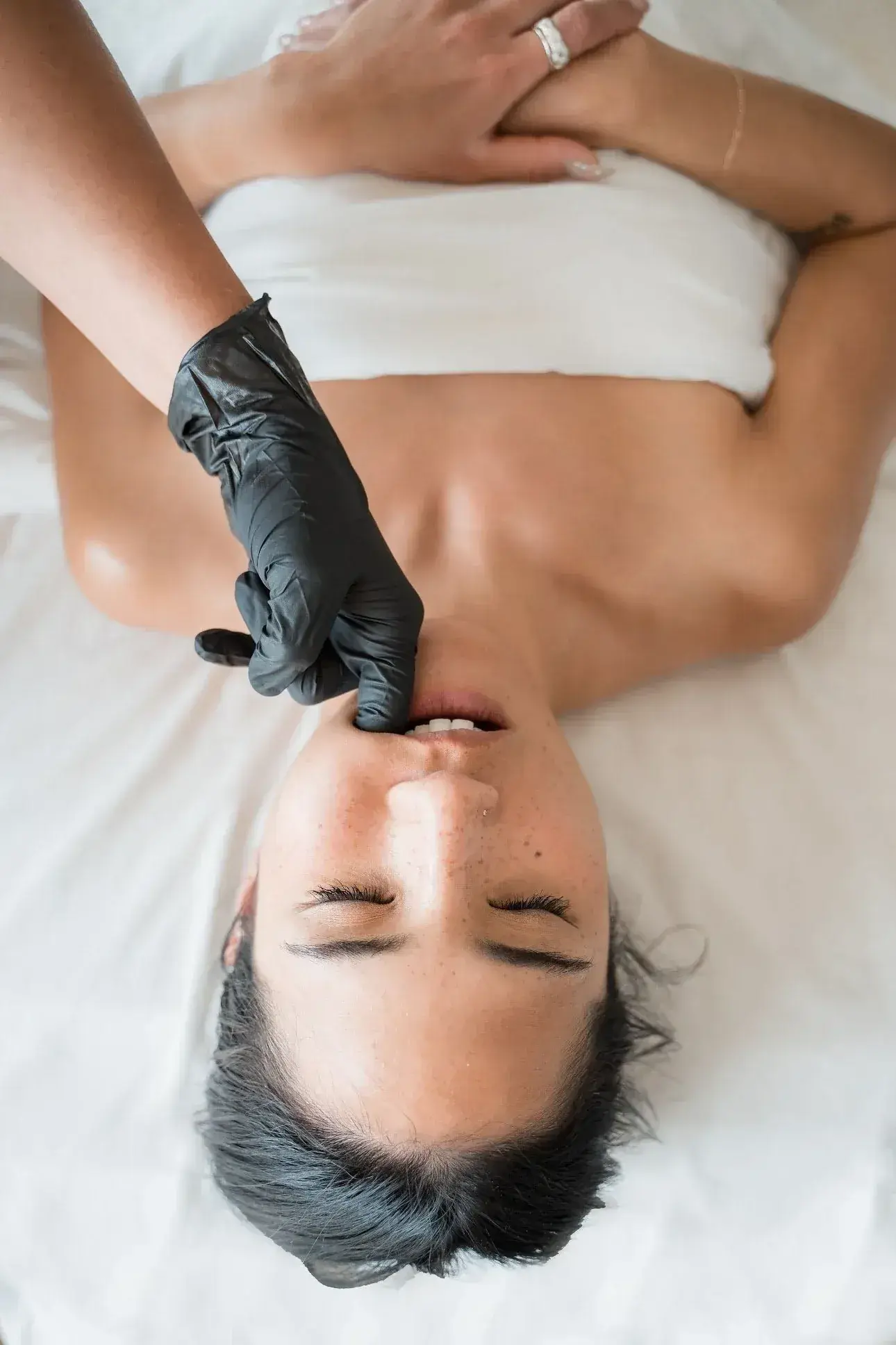
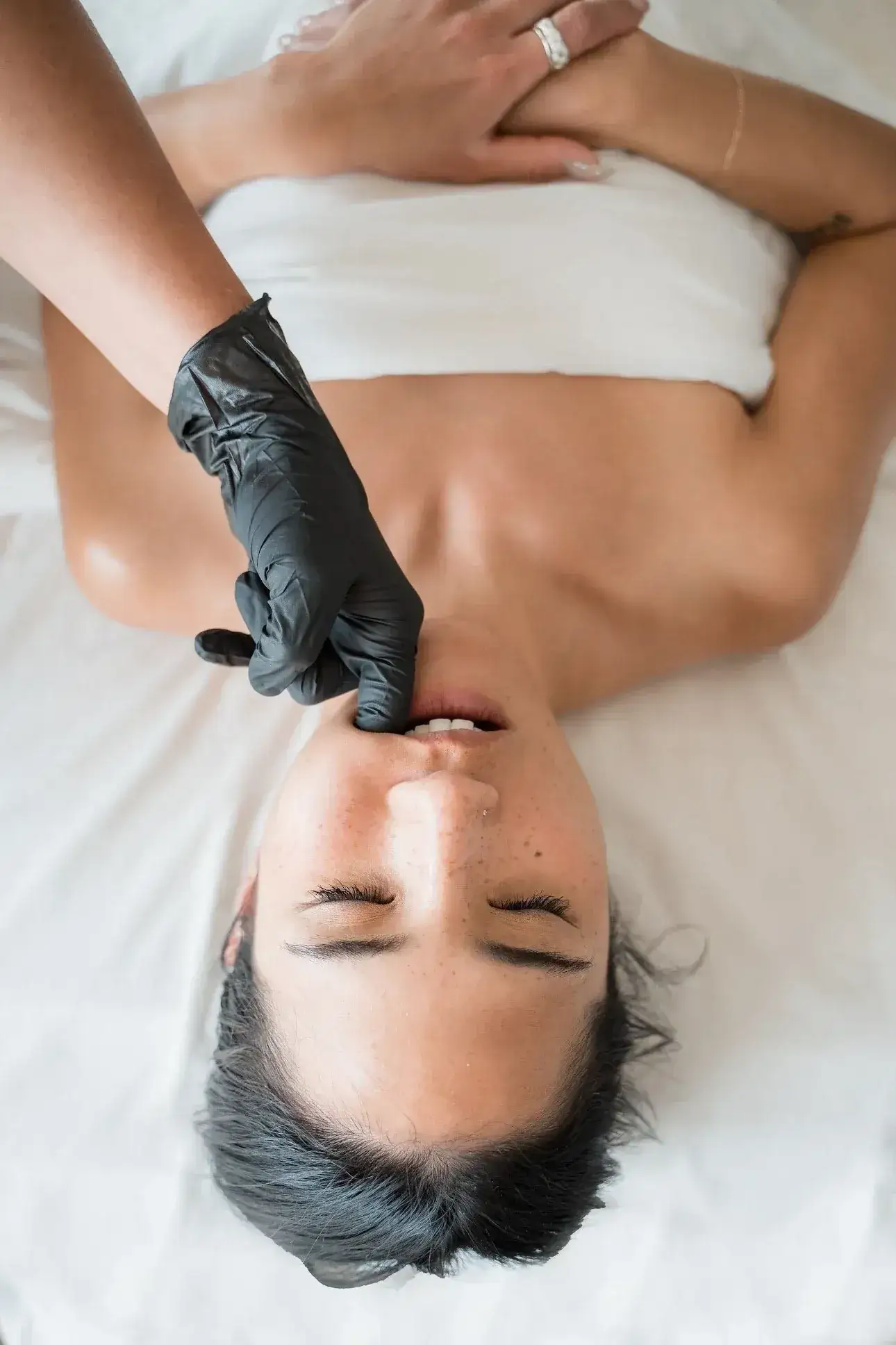
Intra-oral TMJ massage reaches muscle on the inside of the cheek, so the work is on soft tissue rather than teeth. With fixed braces, the brackets sit on the outer surface of the teeth, close to the inside of the cheek. That is why it is worth talking through before starting: the cheek can be tender where it rubs on the hardware, so how much inside work suits you that day is a conversation with your therapist. Ask about this when you book.
Is it your teeth or your jaw muscles?
The answer shapes what you book. Orthodontic soreness and muscular jaw pain feel different and have different causes.
Signs it is more likely the teeth:
- the ache started within a day or two of braces going on, a wire change or a new aligner tray
- the teeth feel tender to bite on, especially when chewing
- it settles over a few days, then returns with the next adjustment
Signs it is more likely the chewing muscles or the joint:
- aching in the cheeks or temples, often worse in the morning or after a long day of clenching
- pain that spreads to the face or neck, jaw stiffness, or difficulty opening fully
- painful clicking or a jaw that catches
The NIDCR lists pain in the chewing muscles or jaw joint as the most common sign of a temporomandibular disorder (TMD), along with pain spreading to the face or neck, stiffness and limited movement. It also notes that clicking without pain is common and does not need treatment.
Both can happen at the same time, so it is worth noticing which pattern fits you before you book.
Did the braces cause the jaw pain?
Probably not, though the question is reasonable. The NIDCR states that research does not support the belief that a bad bite or orthodontic treatment such as braces causes TMD. For most people, the exact cause of TMD is not clear, and a mix of genes, stress and how someone processes pain seems to play a part.
There is a dissenting signal. A 2022 meta-analysis that pooled six case-control and cohort studies reported that people who had orthodontic treatment had higher odds of TMD (odds ratio 1.84). Those studies are observational: they show the two turn up together, not that braces caused the pain. People who seek orthodontic care may also differ in ways that matter. We read it as a reason to take new jaw pain during treatment seriously, not as proof that braces damage the jaw.
The reverse belief is also common: that braces will fix jaw pain by correcting the bite. The NIDCR puts orthodontic treatment among the occlusal treatments that change the teeth and bite, and says there is insufficient evidence that these work for TMD and that in some cases they make it worse. If anyone suggests orthodontics specifically to treat your jaw pain, ask for a second opinion.
What TMJ massage can and cannot do here
TMJ massage aims at the muscles. It can ease tight, tender chewing muscles and help a stiff jaw move more comfortably. It leaves the brackets, wire and tooth movement alone, and it will not undo or speed up your orthodontic work.
The NIDCR lists manual therapy, a therapist using their hands to stretch the soft tissues and muscles around the joint, among the treatments that can help improve function and relieve pain. In a randomised trial of 46 people with chronic muscular TMD, those who received intra-oral myofascial therapy twice a week for five weeks had lower average pain at six weeks than a group given education and self-care exercises. Only the massage group reached a change of two points or more on the pain scale. Results vary, so treat it as a reason to try rather than a promised result.
When to call your orthodontist or dentist first
Book with your orthodontist or dentist before, or instead of, a massage if:
- your teeth stay painful for more than a few days after braces are fitted or adjusted (the NHS threshold for contacting the orthodontist)
- your gums are very red, swollen or painful
- a bracket, wire or attachment is broken or poking
- your bite suddenly feels different, which the NIDCR lists among possible TMD signs and which an orthodontist should look at mid-treatment
The NIDCR advises starting with simple, reversible care and being wary of anything that permanently changes the teeth, bite or joints. Massage fits the simple, reversible category, but it is not a substitute for your orthodontist’s check when the hardware itself is the issue. Our page on whether to see a dentist before booking TMJ massage covers the general version of this decision.
Booking TMJ massage at Renu with braces or aligners
At Renu, TMJ massage is a 60-minute session ($120) with Sasha Bernard, a Registered Massage Therapist whose credentials include TMJ intra-oral work. You book online through Jane, and the clinic is open seven days a week.
A few things make the visit easier when you are mid-treatment:
- Bring your aligner case. You will take the trays out for the inside work, and a case keeps them clean.
- Tell us when your last adjustment was. If it was yesterday and your teeth are tender, your therapist needs to know before any inside work.
- Mention any loose hardware. Your orthodontist should also hear about it, since a loose bracket is theirs to repair.
- Say how wide you can comfortably open. Comfort guides the session, and you can ask to stop at any point.
If you want to know how intra-oral work feels before you come, read why TMJ massage goes inside the mouth. For a sense of how many visits to plan, see how many TMJ massage sessions you might need. And if a night guard has also come up, our TMJ massage vs night guard comparison explains what each one is for.
Questions people ask
Should I put my aligners back in straight after TMJ massage?
Yes, unless your orthodontist has told you otherwise. Clear aligner treatment depends on wearing the trays for most of the day, so the session is just one more short break, like a meal. Rinse your mouth and the trays first.
Can intra-oral work loosen my brackets?
Intra-oral TMJ massage is aimed at muscle inside the cheek, not at the teeth, so the therapist keeps a gloved finger on soft tissue and away from the hardware. If a bracket is already loose or a wire is poking, tell your therapist before you start and call your orthodontist about the repair.
Will TMJ massage move my teeth or undo my orthodontic work?
No. Massage works on muscle and does not apply the steady, directed force that moves teeth. Your orthodontist's appliance is what changes tooth position.
Are braces or aligners a treatment for TMJ pain?
The US National Institute of Dental and Craniofacial Research lists orthodontic treatment among the bite-changing treatments that lack good evidence for TMD and can sometimes make it worse. Braces are for straightening teeth, not for treating jaw pain.
Sources
- NIDCR: TMD (temporomandibular disorders)
- NHS: Braces
- Cleveland Clinic: Clear aligners
- Coronel-Zubiate et al., J Clin Exp Dent 2022: Orthodontic treatment and TMD, systematic review and meta-analysis
- Kalamir et al., Chiropr Man Therap 2013: Intra-oral myofascial therapy for chronic myogenous TMD, randomised trial
Page reviewed October 5, 2026. This page is education, not a diagnosis. For your own situation, talk to your doctor, surgeon or care team, or ask us.
Keep reading
Related pages